
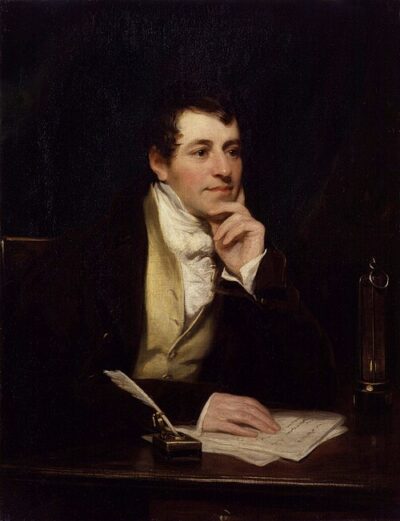
Humphry Davy
Humphry Davy was a British chemist. Born December 17, 1778, in Penzance. Died May 29, 1829, in Geneva. Positions held include President of the Royal Society (1820–1827). Educated at Truro Cathedral School. Awards include Fellow of the Royal Society, Copley Medal and Royal Medal.
Facts
44 facts · 2 confirmed by two sources · 13 cited · 29 from one source
Where this comes from
Papalocal keeps its own record. It started from these sources; what each one said is kept here as it was copied, so a change on their side never changes this page by itself. Tap one to read its version.
What Wikidata says · copied November 16, 2026 · revision 2565529507
- Described as
- British chemist
- Other names
- Sir Humphry Davy, Sir Humphy Davy
- Born
- December 17, 1778 · 12 references
- Died
- May 29, 1829 · 10 references
- Born in
- Penzance · 5 references
- Died in
- Geneva · 4 references
- Buried in
- Cemetery of Kings · 1 reference
- Citizen of
- United Kingdom of Great Britain and Ireland; Kingdom of Great Britain (–1801)
- Occupation
- chemist · 3 references; inventor; physicist · 2 references; geologist; photographer; poet; writer · 1 reference; naturalist · 1 reference
- Positions held
- President of the Royal Society (1820–1827)
- Worked for
- Royal Society of London
- Education
- Truro Cathedral School
- Member of
- Royal Swedish Academy of Sciences; Saint Petersburg Academy of Sciences (1826–); American Academy of Arts and Sciences; Zoological Society of London; Warsaw Society of Friends of Learning; Royal Society of London (1803–); Royal Prussian Academy of Sciences; Institut de France (1817–); Accademia Nazionale delle Scienze detta dei XL; Bavarian Academy of Sciences and Humanities
- Awards
- Fellow of the Royal Society; Copley Medal (1805) · 1 reference; Royal Medal (1827); Rumford Medal (1816) · 1 reference; Galvanism Prize (1807); Royal Society Bakerian Medal (1826) · 7 references; Fellow of the Zoological Society of London; Fellow of the American Academy of Arts and Sciences; Royal Society Bakerian Medal
- Field
- chemistry; physics; geology
- Spouse
- Jane Davy (1812–) · 3 references
- Father
- Robert Davy · 1 reference
- Mother
- Grace Millett · 1 reference
- Siblings
- John Davy · 1 reference
- Wikipedias with a page
- 102
Wikidata item Q131761 (wikidata.org/wiki/Q131761), public domain (CC0). Copied November 16, 2026.
What Wikipedia says · copied November 16, 2026 · revision 1383111623
Sir Humphry Davy, 1st Baronet (17 December 1778 – 29 May 1829) was a British chemist and inventor who invented the Davy lamp and an early form of arc lamp. He is also remembered for isolating, by using electricity, several elements for the first time: potassium and sodium in 1807 and calcium, strontium, barium, magnesium, and boron the following year, and for discovering the elemental nature of chlorine and iodine. Davy also studied the forces involved in these separations, inventing the new field of electrochemistry. He is credited with discovering clathrate hydrates.
In 1799, Davy experimented with nitrous oxide and was astonished when inhaling it made him laugh. He nicknamed it "laughing gas" and wrote about its potential as an anaesthetic to relieve pain during surgery.
Davy was a baronet, President of the Royal Society (PRS), Member of the Royal Irish Academy (MRIA), a founder member and Fellow of the Geological Society of London, a member of the Royal Geological Society of Cornwall, and a member of the American Philosophical Society. Berzelius called Davy's 1806 Bakerian Lecture "On Some Chemical Agencies of Electricity" "one of the best memoirs which has ever enriched the theory of chemistry."
- Born, in its opening lines
- December 17, 1778
- Died, in its opening lines
- May 29, 1829
From the Wikipedia article “Humphry Davy” (en.wikipedia.org/wiki/Humphry_Davy), by its contributors, under CC BY-SA 4.0 (creativecommons.org/licenses/by-sa/4.0/). Copied November 16, 2026; not changed.
Confirmed Two sources agree. Cited One source, and it names where it got it. One source One source, without a reference of its own. Sources disagree The sources disagree. We show the best-supported value and keep theirs below.
