
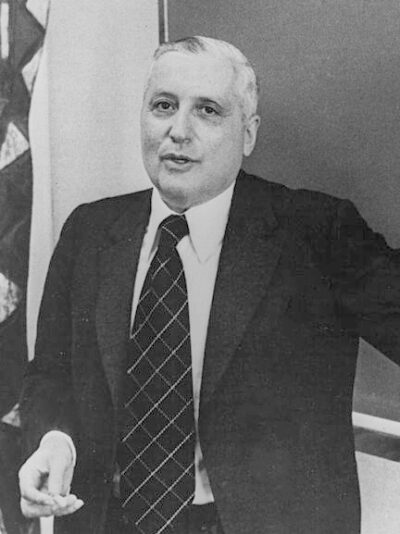
Ilya Prigogine
Ilya Prigogine was a Russian-Belgian physical chemist. Born January 25, 1917, in Moscow. Died May 28, 2003, in Brussels metropolitan area. Educated at Université libre de Bruxelles. Awards include Francqui Prize, honorary doctor of the University of Poitiers and Bourke Award.
Facts
42 facts · 2 confirmed by two sources · 25 cited · 15 from one source
What’s different
- Born: we show January 25, 1917 (Confirmed). Wikidata also lists January 12, 1917
Where this comes from
Papalocal keeps its own record. It started from these sources; what each one said is kept here as it was copied, so a change on their side never changes this page by itself. Tap one to read its version.
What Wikidata says · copied November 16, 2026 · revision 2566090515
- Described as
- Russian-Belgian physical chemist (1917–2003)
- Other names
- Ilya Romanovich Prigozhin, Ilya R. Prigozhin, Ilya R Prigozhin, I. R. Prigozhin, I R Prigozhin, IR Prigozhin, I. Prigozhin, I Prigozhin, Prigozhin, Prigozhin I, Prigozhin I., Prigozhin I. R.
- Born
- January 12, 1917 · 1 reference; January 25, 1917 · 1 reference
- Died
- May 28, 2003 · 10 references
- Born in
- Moscow · 1 reference
- Died in
- Brussels metropolitan area
- Citizen of
- Belgium (1949–) · 1 reference; Russian Empire
- Occupation
- philosopher · 1 reference; physicist · 1 reference; university teacher; chemist · 1 reference; non-fiction writer
- Worked for
- University of Texas at Austin; Université libre de Bruxelles; University of Chicago · 1 reference
- Education
- Université libre de Bruxelles
- Member of
- German Academy of Sciences Leopoldina (1970–) · 1 reference; North Rhine-Westphalia Academy for Sciences and Arts; Academy of Sciences of the USSR; National Academy of Sciences of Ukraine; Romanian Academy (1965–) · 2 references; German Academy of Sciences at Berlin; American Academy of Arts and Sciences (1960–) · 1 reference; Russian Academy of Sciences (1982–) · 1 reference; International Academy of the History of Science · 1 reference; National Academy of Sciences (1967–) · 1 reference
- Awards
- Francqui Prize (1955) · 1 reference; honorary doctor of the University of Poitiers (1966) · 1 reference; Bourke Award (1972) · 2 references; honorary doctorate from University of Bordeaux-I (1972) · 1 reference; Cothenius Medal (1975) · 1 reference; Rumford Medal (1976) · 1 reference; Nobel Prize in Chemistry (1977) · 2 references; honorary doctor of the Paul Cézanne University (1978) · 1 reference; Honda Prize (1983) · 1 reference; honorary doctorate of Tours University (1986) · 1 reference; honorary doctorate from the University of Nice-Sophia Antipolis (1991) · 1 reference; Kampé de Fériet Award (1994); honorary doctor of the National Polytechnic Institute of Lorraine (1994) · 1 reference; honorary doctorate of the University of Valladolid (1995) · 1 reference; honorary doctorate of the Vrije Universiteit Brussel (1995) · 1 reference
- Field
- chemistry; physics
- Wikipedias with a page
- 77
Wikidata item Q183509 (wikidata.org/wiki/Q183509), public domain (CC0). Copied November 16, 2026.
What Wikipedia says · copied November 16, 2026 · revision 1380386688
Viscount Ilya Romanovich Prigogine (; Russian: Илья Романович Пригожин; 25 January [O.S. 12 January] 1917 – 28 May 2003) was a Belgian physical chemist of Russian origin, noted for his work on dissipative structures, complex systems, and irreversibility.
Prigogine's work most notably earned him the 1977 Nobel Prize in Chemistry “for his contributions to non-equilibrium thermodynamics, particularly the theory of dissipative structures”, as well as the Francqui Prize in 1955, and the Rumford Medal in 1976.
- Born, in its opening lines
- January 25, 1917
- Died, in its opening lines
- May 28, 2003
From the Wikipedia article “Ilya Prigogine” (en.wikipedia.org/wiki/Ilya_Prigogine), by its contributors, under CC BY-SA 4.0 (creativecommons.org/licenses/by-sa/4.0/). Copied November 16, 2026; not changed.
Confirmed Two sources agree. Cited One source, and it names where it got it. One source One source, without a reference of its own. Sources disagree The sources disagree. We show the best-supported value and keep theirs below.
