
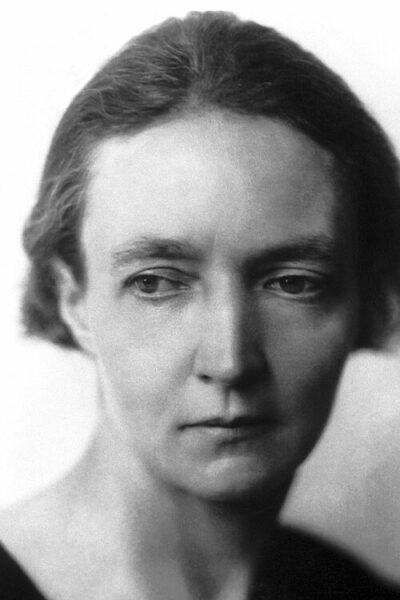
Irène Joliot-Curie
Irène Joliot-Curie was a French chemist and physicist. Born September 12, 1897, in 13th arrondissement of Paris. Died March 17, 1956, in Paris. Positions held include undersecretary (1936). Educated at Science Faculty of Paris and Collège Sévigné. Awards include Officer of the Legion of Honour, Nobel Prize in Chemistry and honorary doctor of the Jagiellonian University of Krakow.
Facts
43 facts · 2 confirmed by two sources · 14 cited · 27 from one source
Where this comes from
Papalocal keeps its own record. It started from these sources; what each one said is kept here as it was copied, so a change on their side never changes this page by itself. Tap one to read its version.
What Wikidata says · copied November 16, 2026 · revision 2565554203
- Described as
- French chemist and physicist (1897–1956)
- Other names
- Irène Curie, Irene Joliot-Curie
- Born
- September 12, 1897 · 16 references
- Died
- March 17, 1956 · 17 references
- Born in
- 13th arrondissement of Paris · 1 reference
- Died in
- Paris · 2 references
- Buried in
- Cemetery Sceaux · 2 references
- Cause of death
- leukemia
- Name at birth
- Irene Curie
- Citizen of
- France
- Occupation
- physicist · 2 references; chemist · 3 references; professor; politician · 1 reference; nuclear physicist; researcher
- Positions held
- undersecretary (1936)
- Worked for
- Science Faculty of Paris
- Education
- Science Faculty of Paris (–1925) · 1 reference; Collège Sévigné; University of Paris · 1 reference
- Member of
- German Academy of Sciences at Berlin; Russian Academy of Sciences (1947–) · 1 reference; Royal Academy of Medicine of Belgium; Royal Netherlands Academy of Arts and Sciences · 1 reference; Polish Academy of Sciences; Romanian Academy
- Awards
- Officer of the Legion of Honour (1939); Nobel Prize in Chemistry (1935) · 2 references; honorary doctor of the Jagiellonian University of Krakow (1951); Matteucci Medal (1932); Order of the Cross of Grunwald, 3rd class (1946); Barnard Medal for Meritorious Service to Science · 1 reference; honorary doctor of the Maria Curie-Skłodowska University (1950) · 1 reference; Commander with Star of the Order of Polonia Restituta (1947); 72 scientist women names on the Eiffel tower
- Field
- chemistry; radiobiology
- Spouse
- Frédéric Joliot-Curie (1926–) · 2 references
- Children
- Pierre Joliot; Hélène Langevin-Joliot · 1 reference
- Father
- Pierre Curie · 1 reference
- Mother
- Marie Curie · 1 reference
- Siblings
- Ève Curie · 1 reference
- Lived in
- Paris
- Wikipedias with a page
- 113
Wikidata item Q7504 (wikidata.org/wiki/Q7504), public domain (CC0). Copied November 16, 2026.
What Wikipedia says · copied November 16, 2026 · revision 1383409873
Irène Joliot-Curie (French: [iʁɛn ʒɔljo kyʁi] ; née Curie; 12 September 1897 – 17 March 1956) was a French chemist and physicist who received the 1935 Nobel Prize in Chemistry with her husband, Frédéric Joliot-Curie, for their discovery of induced radioactivity, also known as artificial radioactivity. The couple also discovered positron emission during their research. They were the second married couple, after her parents, to win the prize, adding to the Curie family's unbeaten legacy of four Nobel Prizes.
The eldest child of scientists Marie and Pierre Curie, Irène grew up showing talent in mathematics and received a rigorous education from her mother and other prominent French scholars as part of a private cooperative of students. She served as a nurse radiographer at battlefield hospitals during World War I, supervising mobile X-ray units and teaching doctors how to locate shrapnel in wounds using radiology. In 1918, she joined her mother at the Radium Institute in Paris, conducting research on the alpha decay of polonium for her doctorate in 1925.
Irène and her husband jointly studied atomic nuclei during the 1930s, and they contributed directly to the creation of the first French nuclear reactor in 1948. She was one of the first three women to be appointed a member of a French government, becoming undersecretary for scientific research under the Popular Front in 1936. In 1945, she was one of six commissioners of the newly established French Alternative Energies and Atomic Energy Commission (CEA) created by de Gaulle and the Provisional Government of the French Republic. Both children of the Joliot-Curies, Hélène and Pierre, also became scientists.
Irène Joliot-Curie died in Paris on 17 March 1956 from acute leukemia linked to her long-term exposure to polonium and X-rays. The annual Prix Joliot-Curie and Irène Joliot-Curie Prize are named in her honour. In 2026, Irène Joliot-Curie was announced as one of 72 historical women in STEM whose names were proposed to be added to the 72 men already celebrated on the Eiffel Tower.
- Born, in its opening lines
- September 12, 1897
- Died, in its opening lines
- March 17, 1956
From the Wikipedia article “Irène Joliot-Curie” (en.wikipedia.org/wiki/Irène_Joliot-Curie), by its contributors, under CC BY-SA 4.0 (creativecommons.org/licenses/by-sa/4.0/). Copied November 16, 2026; not changed.
Confirmed Two sources agree. Cited One source, and it names where it got it. One source One source, without a reference of its own. Sources disagree The sources disagree. We show the best-supported value and keep theirs below.
