
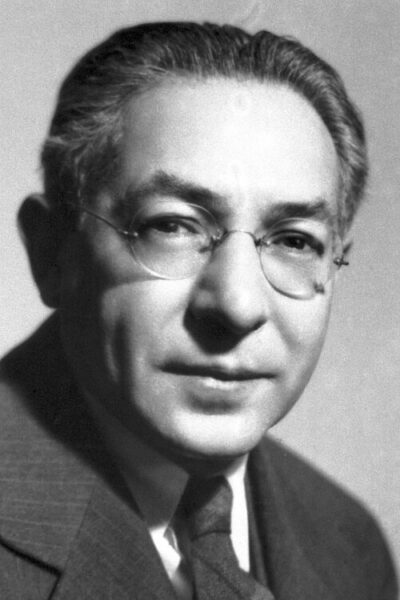
Isidor Isaac Rabi
Isidor Isaac Rabi was an American physicist. Born July 29, 1898, in Rymanów. Died January 11, 1988, in Manhattan. Educated at Columbia University and Cornell University. Awards include Atoms for Peace Award, Niels Bohr International Gold Medal and Nobel Prize in Physics.
Facts
36 facts · 2 confirmed by two sources · 13 cited · 21 from one source
Where this comes from
Papalocal keeps its own record. It started from these sources; what each one said is kept here as it was copied, so a change on their side never changes this page by itself. Tap one to read its version.
What Wikidata says · copied November 13, 2026 · revision 2563200033
- Described as
- American physicist (1898–1988)
- Other names
- Israel Isaac Rabi, I. I. Rabi
- Born
- July 29, 1898 · 8 references
- Died
- January 11, 1988 · 9 references
- Born in
- Rymanów · 1 reference
- Died in
- Manhattan · 2 references
- Buried in
- Riverside Cemetery · 1 reference
- Citizen of
- United States · 1 reference; Cisleithania · 1 reference
- Occupation
- physicist · 1 reference; nuclear physicist; university teacher; theoretical physicist
- Worked for
- Columbia University; Massachusetts Institute of Technology · 1 reference
- Education
- Columbia University; Cornell University; John Jay Educational Campus · 1 reference
- Member of
- National Academy of Sciences (1940–); American Physical Society; American Academy of Arts and Sciences; American Association for the Advancement of Science; American Philosophical Society (1941–); Japan Academy (1950–) · 1 reference
- Awards
- Atoms for Peace Award; Niels Bohr International Gold Medal (1967); Nobel Prize in Physics (1944) · 2 references; Elliott Cresson Medal (1942) · 1 reference; Four Freedoms Award – Freedom from Fear (1985) · 1 reference; Oersted Medal (1982) · 1 reference; NAS Public Welfare Medal (1985) · 1 reference; Officer of the Legion of Honour; Richtmyer Memorial Lecture Award (1945) · 1 reference; Fellow of the American Physical Society; I. I. Rabi Award (1983) · 1 reference
- Field
- atomic physics
- Spouse
- Helen Newmark
- Religion
- Judaism
- Wikipedias with a page
- 86
Wikidata item Q165969 (wikidata.org/wiki/Q165969), public domain (CC0). Copied November 13, 2026.
What Wikipedia says · copied November 13, 2026 · revision 1384478893
Israel Isaac "Isidor" Rabi (; Yiddish: איזידאָר יצחק ראַבי, romanized: Izidor Yitzkhok Rabi; July 29, 1898 – January 11, 1988) was an American physicist who received the Nobel Prize in Physics in 1944 "for his resonance method for recording the magnetic properties of atomic nuclei." He was also one of the first scientists in the United States to work on the cavity magnetron, which is used in microwave radar and microwave ovens.
Born into a traditional Polish-Jewish family in Rymanów, Austria-Hungary, Rabi came to the United States as an infant and was raised in New York's Lower East Side. He entered Cornell University as an electrical engineering student in 1916, but soon switched to chemistry. Later, he became interested in physics. He continued his studies at Columbia University, where he was awarded his doctorate for a thesis on the magnetic susceptibility of certain crystals. In 1927, he headed for Europe, where he met and worked with many of the finest physicists of the time.
In 1929, Rabi returned to the United States, where Columbia offered him a faculty position. In collaboration with Gregory Breit, he developed the Breit–Rabi equation and predicted that the Stern–Gerlach experiment could be modified to confirm the properties of the atomic nucleus. His techniques for using nuclear magnetic resonance to discern the magnetic moment and nuclear spin of atoms earned him the Nobel Prize in Physics in 1944. Nuclear magnetic resonance became an important tool for nuclear physics and chemistry, and the subsequent development of magnetic resonance imaging (MRI) from it has also made it important to the field of medicine.
During World War II he worked on radar at the Massachusetts Institute of Technology (MIT) Radiation Laboratory and on the Manhattan Project. After the war, he served on the General Advisory Committee (GAC) of the Atomic Energy Commission, and was chairman from 1952 to 1956. He also served on the Science Advisory Committees (SACs) of the Office of Defense Mobilization and the Army's Ballistic Research Laboratory, and was Science Advisor to President Dwight D. Eisenhower. He was involved with the establishment of the Brookhaven National Laboratory in 1946, and later, as United States delegate to UNESCO, with the creation of CERN in 1952. When Columbia created the rank of university professor in 1964, Rabi was the first to receive that position. A special chair was named after him in 1985. He retired from teaching in 1967, but remained active in the department and held the title of University Professor Emeritus and Special Lecturer until his death.
- Born, in its opening lines
- July 29, 1898
- Died, in its opening lines
- January 11, 1988
From the Wikipedia article “Isidor Rabi” (en.wikipedia.org/wiki/Isidor_Rabi), by its contributors, under CC BY-SA 4.0 (creativecommons.org/licenses/by-sa/4.0/). Copied November 13, 2026; not changed.
Confirmed Two sources agree. Cited One source, and it names where it got it. One source One source, without a reference of its own. Sources disagree The sources disagree. We show the best-supported value and keep theirs below.
