
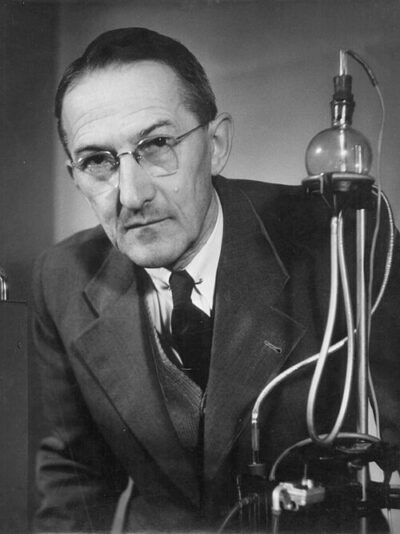
Jaroslav Heyrovský
Jaroslav Heyrovský was a Czech chemist. Born December 20, 1890, in Prague. Died March 27, 1967, in Prague. Educated at University College London and Akademické gymnázium Štěpánská. Awards include Klement Gottwald State Prize, Nobel Prize in Chemistry and doctor honoris causa from the University of Aix-Marseille.
Facts
45 facts · 2 confirmed by two sources · 17 cited · 26 from one source
Where this comes from
Papalocal keeps its own record. It started from these sources; what each one said is kept here as it was copied, so a change on their side never changes this page by itself. Tap one to read its version.
What Wikidata says · copied November 16, 2026 · revision 2567379714
- Described as
- Czech chemist (1890-1967)
- Other names
- Jaroslav Heyrovsky, Jaroslav Viktor Leopold Heyrovský
- Born
- December 20, 1890 · 14 references
- Died
- March 27, 1967 · 13 references
- Born in
- Prague · 6 references
- Died in
- Prague · 4 references
- Buried in
- Vyšehrad cemetery · 2 references
- Name at birth
- Jaroslav Viktor Leopold Heyrovský
- Citizen of
- Czechoslovakia
- Occupation
- chemist · 1 reference; physicist · 1 reference; inventor; teacher · 1 reference; scientist · 1 reference
- Worked for
- Charles University
- Education
- University College London; Akademické gymnázium Štěpánská; Charles University; Sorbonne; Faculty of Arts, Charles University in Prague · 1 reference
- Member of
- Royal Society of London (1965–); German Academy of Sciences at Berlin; German Academy of Sciences Leopoldina · 1 reference; Czech Academy of Science and Art; Royal Czech Society of Sciences; Academy of Sciences of the USSR; Hungarian Academy of Sciences; American Academy of Arts and Sciences; Russian Academy of Sciences; Polish Academy of Sciences
- Awards
- Klement Gottwald State Prize (1951); Nobel Prize in Chemistry (1959) · 2 references; doctor honoris causa from the University of Aix-Marseille (1959) · 1 reference; doctor honoris causa from the University of Paris (1960) · 1 reference; Foreign Member of the Royal Society (1965) · 1 reference; honorary doctor of the University of Vienna · 1 reference; Order of the Republic
- Field
- chemistry; polarography · 1 reference; physical chemistry · 1 reference; discoveries and inventions · 1 reference
- Spouse
- Marie Kořánová
- Children
- Michael Heyrovský; Jitka Černá-Heyrovská
- Father
- Leopold Heyrovský
- Siblings
- Leopold Heyrovský
- Military branch
- 28th Czech Infantry Regiment
- Wikipedias with a page
- 64
Wikidata item Q157701 (wikidata.org/wiki/Q157701), public domain (CC0). Copied November 16, 2026.
What Wikipedia says · copied November 16, 2026 · revision 1374437031
Jaroslav Heyrovský (Czech: [ˈjaroslav ˈɦɛjrofskiː] ; 20 December 1890 – 27 March 1967) was a Czech chemist and inventor who received the Nobel Prize in Chemistry in 1959 for his invention of polarography.
- Born, in its opening lines
- December 20, 1890
- Died, in its opening lines
- March 27, 1967
From the Wikipedia article “Jaroslav Heyrovský” (en.wikipedia.org/wiki/Jaroslav_Heyrovský), by its contributors, under CC BY-SA 4.0 (creativecommons.org/licenses/by-sa/4.0/). Copied November 16, 2026; not changed.
Confirmed Two sources agree. Cited One source, and it names where it got it. One source One source, without a reference of its own. Sources disagree The sources disagree. We show the best-supported value and keep theirs below.
