
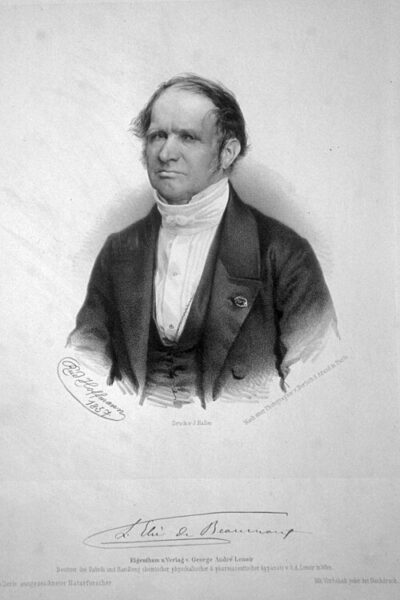
Jean Baptiste Armand Louis Léonée Elie de Beaumont
Jean Baptiste Armand Louis Léonée Elie de Beaumont was a French geologist. Born September 25, 1798, in Château de Canon. Died September 21, 1874, in Château de Canon. Positions held include Second Empire senator (1852–1870), Vice-président du Conseil général des mines (1861–1868) and professor (1832–1874). Educated at École polytechnique and Mines ParisTech. Awards include Grand Officer of the Legion of Honour, Fellow of the Royal Society of Edinburgh and Foreign Member of the Royal Society.
Facts
47 facts · 2 confirmed by two sources · 15 cited · 30 from one source
Where this comes from
Papalocal keeps its own record. It started from these sources; what each one said is kept here as it was copied, so a change on their side never changes this page by itself. Tap one to read its version.
What Wikidata says · copied November 18, 2026 · revision 2564840873
- Described as
- French geologist
- Other names
- Jean-Baptiste Élie de Beaumont, Jean-Baptiste Elie de Beaumont, Léonce Élie de Beaumont, Jean-Baptiste Armand Louis Léonce Élie de Beaumont
- Born
- September 25, 1798 · 9 references
- Died
- September 21, 1874 · 8 references
- Born in
- Château de Canon · 1 reference
- Died in
- Château de Canon
- Buried in
- Montparnasse Cemetery
- Name at birth
- Jean Baptiste Armand Louis Léonce Élie de Beaumont
- Citizen of
- France
- Occupation
- entomologist; geologist · 1 reference; politician · 1 reference; mining engineer; professor · 1 reference
- Positions held
- Second Empire senator (1852–1870) · 1 reference; Vice-président du Conseil général des mines (1861–1868); professor (1832–1874); Perpetual Secretary (1853–1874) · 1 reference; President of the Geological Society of France (4 times) (1836–1855); president of the French Academy of Sciences (1845); president (1868–); President of the Société nationale d'encouragement au bien (1869–1874); Inspector general of Mines
- Worked for
- Collège de France (1832–1874) · 1 reference
- Education
- École polytechnique (1817–1819); Mines ParisTech (1819–1820); Lycée Henri-IV · 1 reference
- Member of
- Royal Society of London (1835–) · 1 reference; Société Philomathique de Paris; Royal Prussian Academy of Sciences; German Academy of Sciences Leopoldina; Royal Swedish Academy of Sciences; French Academy of Sciences (1835–) · 1 reference; Saint Petersburg Academy of Sciences; American Academy of Arts and Sciences; Société linnéenne de Normandie; Russian Academy of Sciences
- Awards
- Grand Officer of the Legion of Honour (1860) · 1 reference; Fellow of the Royal Society of Edinburgh; Foreign Member of the Royal Society (1835) · 1 reference; Fellow of the American Academy of Arts and Sciences; Wollaston Medal (1843) · 1 reference; Knight of the Legion of Honour (1831) · 1 reference; Officer of the Legion of Honour (1840) · 1 reference; Commander of the Legion of Honour (1850) · 1 reference; honorary member of the Physics Association (Frankfurt am Main, Germany) (1839) · 1 reference
- Field
- geology
- Spouse
- Thérèse Marie Augusta Élie de Beaumont (1859–) · 1 reference
- Father
- Armand Elie de Beaumont
- Wikipedias with a page
- 22
Wikidata item Q55030753 (wikidata.org/wiki/Q55030753), public domain (CC0). Copied November 18, 2026.
What Wikipedia says · copied November 18, 2026 · revision 1373602262
Jean-Baptiste Armand Louis Léonce Élie de Beaumont (25 September 1798 – 21 September 1874) was a French geologist. Among his ideas was that mountains were created in a series of episodes over geological time due to the cooling and shrinking of the earth. He also suggested that there was a pattern in the orientation of the mountain systems of the world which followed a system of five circles meeting at points on the earth that marked the points of a polyhedron.
- Born, in its opening lines
- September 25, 1798
- Died, in its opening lines
- September 21, 1874
From the Wikipedia article “Jean-Baptiste Élie de Beaumont” (en.wikipedia.org/wiki/Jean-Baptiste_Élie_de_Beaumont), by its contributors, under CC BY-SA 4.0 (creativecommons.org/licenses/by-sa/4.0/). Copied November 18, 2026; not changed.
Confirmed Two sources agree. Cited One source, and it names where it got it. One source One source, without a reference of its own. Sources disagree The sources disagree. We show the best-supported value and keep theirs below.
