
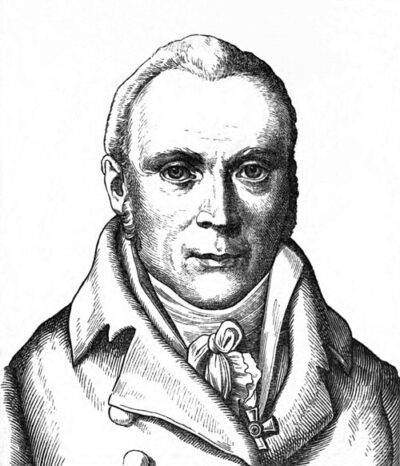
Johann Friedrich Blumenbach
Johann Friedrich Blumenbach was a German physician, naturalist, physiologist, and anthropologist. Born May 11, 1752, in Gotha. Died January 22, 1840, in Göttingen. Positions held include professor. Educated at University of Göttingen and University of Jena. Awards include Fellow of the American Academy of Arts and Sciences and Foreign Member of the Royal Society.
Facts
43 facts · 2 confirmed by two sources · 19 cited · 22 from one source
Where this comes from
Papalocal keeps its own record. It started from these sources; what each one said is kept here as it was copied, so a change on their side never changes this page by itself. Tap one to read its version.
What Wikidata says · copied November 16, 2026 · revision 2568910694
- Described as
- German physician, naturalist, physiologist, and anthropologist (1752 – 1840)
- Other names
- Blumenbach, J. F. Blumenbach, J.F. Blumenbach, Blumenbach, Johann Friedrich, Blumenbach, J. F., Blumenbach, J.F., Blumenbach JF
- Born
- May 11, 1752 · 10 references
- Died
- January 22, 1840 · 9 references
- Born in
- Gotha · 3 references
- Died in
- Göttingen · 3 references
- Buried in
- Albanifriedhof
- Citizen of
- Duchy of Saxe-Gotha-Altenburg; Duchy of Saxe-Coburg and Gotha
- Occupation
- anatomist; anthropologist · 3 references; paleontologist · 1 reference; zoologist · 1 reference; physician · 2 references; university teacher · 1 reference; physiologist · 1 reference; curator · 1 reference
- Positions held
- professor
- Worked for
- University of Göttingen · 1 reference
- Education
- University of Göttingen · 1 reference; University of Jena · 1 reference; Ernestinum Gotha
- Member of
- Royal Society of London (1793–); Academy of Sciences of Turin (1803–) · 1 reference; Russian Academy of Sciences (1826–) · 1 reference; German Academy of Sciences Leopoldina; Royal Swedish Academy of Sciences; American Academy of Arts and Sciences; Bavarian Academy of Sciences and Humanities; Royal Prussian Academy of Sciences; Royal Netherlands Academy of Arts and Sciences; Göttingen Academy of Sciences and Humanities in Lower Saxony
- Awards
- Fellow of the American Academy of Arts and Sciences (1794–); Foreign Member of the Royal Society (1793) · 1 reference
- Field
- anthropology
- Spouse
- Louise Amalie Blumenbach · 1 reference
- Children
- Georg Heinrich Wilhelm Blumenbach · 1 reference; Carl Ludwig Edmund Blumenbach; Adele Blumenbach · 1 reference; Emma Marie Hedwig Jasmund · 1 reference
- Father
- Heinrich Blumenbach · 1 reference
- Mother
- Charlotte Eleonore Hedwig Buddeus
- Siblings
- Charlotte Sophie Henriette Blumenbach; Friedrich Wilhelm Carl Ernst
- Lived in
- Kingdom of Hanover
- Wikipedias with a page
- 52
Wikidata item Q58588 (wikidata.org/wiki/Q58588), public domain (CC0). Copied November 16, 2026.
What Wikipedia says · copied November 16, 2026 · revision 1385493878
Johann Friedrich Blumenbach (German: [ˈbluːmənˌbax]; 11 May 1752 – 22 January 1840) was a German medical doctor, naturalist, physiologist, and anthropologist. He is considered to be a main founder of zoology and anthropology as comparative, scientific disciplines. He has been called the "founder of racial classifications".
He was one of the first to explore the study of the human being as an aspect of natural history. His teachings in comparative anatomy were applied to his classification of human races, of which he claimed there were five: Caucasian, Mongolian, Malayan, Ethiopian, and American. He was a member of what modern historians call the Göttingen school of history.
He is considered a pivotal figure in the development of physical anthropology. Blumenbach's peers considered him one of the great theorists of his day, and he was a mentor or influence on many of the next generation of German biologists, including Alexander von Humboldt.
- Born, in its opening lines
- May 11, 1752
- Died, in its opening lines
- January 22, 1840
From the Wikipedia article “Johann Friedrich Blumenbach” (en.wikipedia.org/wiki/Johann_Friedrich_Blumenbach), by its contributors, under CC BY-SA 4.0 (creativecommons.org/licenses/by-sa/4.0/). Copied November 16, 2026; not changed.
Confirmed Two sources agree. Cited One source, and it names where it got it. One source One source, without a reference of its own. Sources disagree The sources disagree. We show the best-supported value and keep theirs below.
