
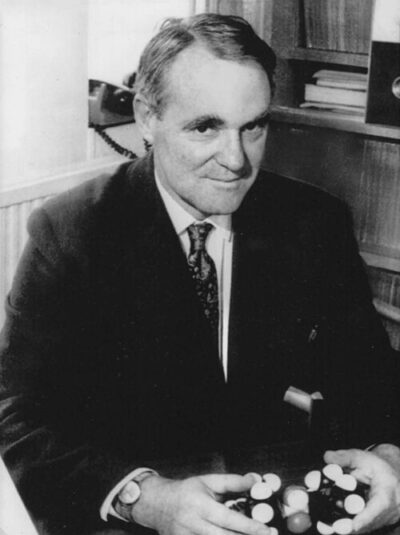
John Cornforth
John Cornforth was an Australian-British chemist. Born September 7, 1917, in Sydney. Died December 8, 2013, in Brighton. Educated at University of Sydney and St Catherine's College. Awards include Fellow of the Royal Society, Commander of the Order of the British Empire and Copley Medal.
Facts
39 facts · 2 confirmed by two sources · 21 cited · 16 from one source
Where this comes from
Papalocal keeps its own record. It started from these sources; what each one said is kept here as it was copied, so a change on their side never changes this page by itself. Tap one to read its version.
What Wikidata says · copied November 16, 2026 · revision 2565526772
- Described as
- Australian-British chemist
- Other names
- John Warcup Cornforth, Kappa Cornfoth, Sir John Cornforth, Sir John Warcup Cornforth, John Conforth
- Born
- September 7, 1917 · 12 references
- Died
- December 8, 2013 · 10 references
- Born in
- Sydney · 2 references
- Died in
- Brighton
- Buried in
- Clayton Wood Natural Burial Ground · 1 reference
- Citizen of
- Australia
- Occupation
- chemist · 1 reference; university teacher
- Worked for
- University of Warwick; University of Sussex (1975–) · 1 reference
- Education
- University of Sydney (1934–1938) · 1 reference; St Catherine's College; Sydney Boys High School (–1933) · 1 reference; University of Oxford · 1 reference
- Member of
- Royal Society of London (1953–); National Academy of Sciences (1978–) · 1 reference; Australian Academy of Science; American Academy of Arts and Sciences (1973–) · 1 reference; Royal Netherlands Academy of Arts and Sciences; Academia Europaea (1994–) · 1 reference
- Awards
- Fellow of the Royal Society (1953) · 1 reference; Commander of the Order of the British Empire; Copley Medal (1982) · 1 reference; Corday-Morgan Prize (1953) · 1 reference; Royal Medal (1976); Nobel Prize in Chemistry (1975) · 2 references; Centenary Medal (2001) · 1 reference; Companion of the Order of Australia (1991) · 1 reference; Australian of the Year (1975); 1851 Research Fellowship · 1 reference; Flintoff medal (1966) · 1 reference; Ernest Guenther Award (1969) · 2 references; Portland Press Excellence in Science Award (1966); Davy Medal (1968) · 1 reference; Corresponding Member of the Australian Academy of Science (1977)
- Field
- organic chemistry
- Spouse
- Rita Harradence (1941–) · 1 reference
- Siblings
- Roger Cornforth · 1 reference
- Lived in
- Brighton · 1 reference
- Wikipedias with a page
- 60
Wikidata item Q135154 (wikidata.org/wiki/Q135154), public domain (CC0). Copied November 16, 2026.
What Wikipedia says · copied November 16, 2026 · revision 1385924055
Sir John Warcup Cornforth Jr., (7 September 1917 – 8 December 2013) was an Australian–British chemist who won the Nobel Prize in Chemistry in 1975 for his work on the stereochemistry of enzyme-catalysed reactions, becoming the only Nobel laureate born in New South Wales.
Cornforth investigated enzymes that catalyse structural changes in organic substrates by replacing specific hydrogen atoms within their chains and rings. In his syntheses and descriptions of the structure of various terpenes, olefins, and steroids, Cornforth determined precisely which hydrogen atoms were displaced by an enzyme to drive a given transformation, allowing him to detail the biosynthesis of cholesterol. For this work, he won the Nobel Prize in Chemistry in 1975 with Vladimir Prelog, and was knighted in 1977.
- Born, in its opening lines
- September 7, 1917
- Died, in its opening lines
- December 8, 2013
From the Wikipedia article “John Cornforth” (en.wikipedia.org/wiki/John_Cornforth), by its contributors, under CC BY-SA 4.0 (creativecommons.org/licenses/by-sa/4.0/). Copied November 16, 2026; not changed.
Confirmed Two sources agree. Cited One source, and it names where it got it. One source One source, without a reference of its own. Sources disagree The sources disagree. We show the best-supported value and keep theirs below.
