
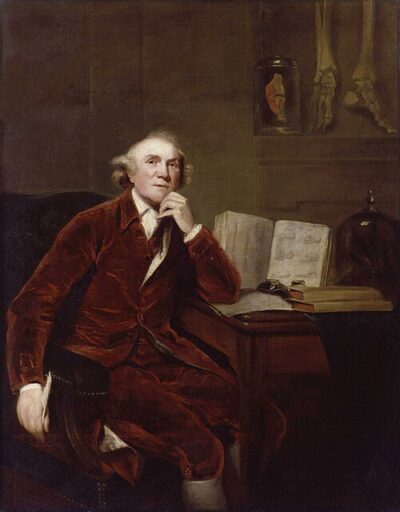
John Hunter
John Hunter was a Scottish surgeon. Born February 13, 1728, in East Kilbride. Died October 16, 1793, in London. Educated at St George's, University of London and Barts and The London School of Medicine and Dentistry. Awards include Fellow of the Royal Society, Copley Medal and Croonian Medal and Lecture.
Facts
24 facts · 2 confirmed by two sources · 5 cited · 17 from one source
Where this comes from
Papalocal keeps its own record. It started from these sources; what each one said is kept here as it was copied, so a change on their side never changes this page by itself. Tap one to read its version.
What Wikidata says · copied November 16, 2026 · revision 2564349333
- Described as
- Scottish surgeon (1728-1793)
- Born
- February 13, 1728 · 8 references
- Died
- October 16, 1793 · 10 references
- Born in
- East Kilbride
- Died in
- London
- Buried in
- Westminster Abbey
- Cause of death
- myocardial infarction
- Citizen of
- Kingdom of Great Britain
- Occupation
- military physician; physician · 1 reference; university teacher; surgeon · 2 references; anatomist · 1 reference
- Worked for
- University of London
- Education
- St George's, University of London; Barts and The London School of Medicine and Dentistry
- Member of
- Royal Society of London; American Philosophical Society · 1 reference
- Awards
- Fellow of the Royal Society; Copley Medal (1787) · 1 reference; Croonian Medal and Lecture (1775)
- Spouse
- Anne Hunter
- Siblings
- William Hunter
- Military branch
- British Army
- Military rank
- general
- Wikipedias with a page
- 33
Wikidata item Q505981 (wikidata.org/wiki/Q505981), public domain (CC0). Copied November 16, 2026.
What Wikipedia says · copied November 16, 2026 · revision 1368206754
John Hunter (13 February 1728 – 16 October 1793) was a Scottish surgeon, one of the most distinguished scientists and surgeons of his day. He was an early advocate of careful observation and scientific methods in medicine. He was a teacher of, and collaborator with, Edward Jenner, pioneer of the smallpox vaccine. His wife, Anne Hunter (née Home), was a poet, some of whose poems were set to music by Joseph Haydn.
He learned anatomy by assisting his elder brother William with dissections in William's anatomy school in Central London, starting in 1748, and quickly became an expert in anatomy. He spent some years as an Army surgeon, worked with the dentist James Spence conducting tooth transplants, and in 1764 set up his own anatomy school in London. He built up a collection of living animals whose skeletons and other organs he prepared as anatomical specimens, eventually amassing nearly 14,000 preparations demonstrating the anatomy of humans and other vertebrates, including 3,000+ animals.
Hunter became a Fellow of the Royal Society in 1767. He was elected to the American Philosophical Society in 1787. The Hunterian Society of London was named in his honour, and the Hunterian Museum in London preserves his name and his collection of anatomical specimens.
- Born, in its opening lines
- February 13, 1728
- Died, in its opening lines
- October 16, 1793
From the Wikipedia article “John Hunter (surgeon)” (en.wikipedia.org/wiki/John_Hunter_(surgeon)), by its contributors, under CC BY-SA 4.0 (creativecommons.org/licenses/by-sa/4.0/). Copied November 16, 2026; not changed.
Confirmed Two sources agree. Cited One source, and it names where it got it. One source One source, without a reference of its own. Sources disagree The sources disagree. We show the best-supported value and keep theirs below.
