
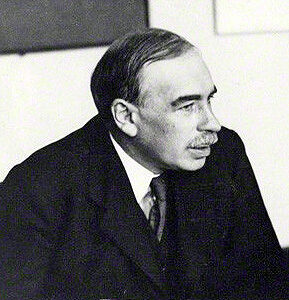
John Maynard Keynes
John Maynard Keynes was a British economist. Born June 5, 1883, in Cambridge. Died April 21, 1946, in Firle. Positions held include member of the House of Lords (1942–1946). Known for The General Theory of Employment, Interest and Money, Indian Currency and Finance and The Economic Consequences of the Peace. Educated at Eton College and King's College. Awards include Companion of the Order of the Bath, Adam Smith Prize and Fellow of the Econometric Society.
Facts
44 facts · 2 confirmed by two sources · 17 cited · 25 from one source
Where this comes from
Papalocal keeps its own record. It started from these sources; what each one said is kept here as it was copied, so a change on their side never changes this page by itself. Tap one to read its version.
What Wikidata says · copied November 16, 2026 · revision 2570046241
- Described as
- British economist (1883–1946)
- Other names
- Lord Keynes, Baron Keynes of Tilton, John Maynard Keynes, 1st Baron Keynes, Keynes
- Born
- June 5, 1883 · 17 references
- Died
- April 21, 1946 · 17 references
- Born in
- Cambridge · 3 references
- Died in
- Firle · 1 reference
- Cause of death
- myocardial infarction
- Citizen of
- United Kingdom; United Kingdom of Great Britain and Ireland (–1927)
- Occupation
- economist · 1 reference; mathematician · 1 reference; politician · 2 references; philosopher; professor; diplomat · 1 reference; non-fiction writer; businessperson · 1 reference
- Positions held
- member of the House of Lords (1942–1946)
- Political party
- Liberal Party
- Worked for
- University of Cambridge; King's College
- Education
- Eton College · 1 reference; King's College (1902–1905) · 1 reference; University of Cambridge; St Faith's School
- Member of
- Royal Swedish Academy of Sciences; British Academy; American Academy of Arts and Sciences; Econometric Society (1933–) · 1 reference
- Known for
- The General Theory of Employment, Interest and Money (1936); Indian Currency and Finance (1913); The Economic Consequences of the Peace (1919); A Treatise on Probability (1921); A Treatise on Money (1930); Economic Possibilities for our Grandchildren (1930)
- Awards
- Companion of the Order of the Bath; Adam Smith Prize (1909) · 1 reference; Fellow of the Econometric Society (1933) · 1 reference; Fellow of the British Academy; doctor honoris causa from the University of Paris (1945) · 1 reference
- Field
- macroeconomics · 1 reference
- Spouse
- Lydia Lopokova (1921–1946) · 3 references
- Father
- John Neville Keynes · 2 references
- Mother
- Florence Ada Keynes · 2 references
- Siblings
- Margaret Neville Keynes · 1 reference; Geoffrey Keynes · 1 reference
- Wikipedias with a page
- 188
Wikidata item Q9317 (wikidata.org/wiki/Q9317), public domain (CC0). Copied November 16, 2026.
What Wikipedia says · copied November 16, 2026 · revision 1385931061
John Maynard Keynes, 1st Baron Keynes ( KAYNZ; 5 June 1883 – 21 April 1946), was an English economist. His writings formed the basis for the school of thought known as Keynesian economics, as well as its various offshoots. Originally trained in mathematics, he built on and refined earlier work on the causes of business cycles. His ideas, further developed after his death as New Keynesianism, are seen as foundational to mainstream macroeconomics. He has been referred to as the "father of macroeconomics" and is considered one of the most influential economists of the 20th century.
Keynes was educated at King's College at the University of Cambridge, where he graduated in 1904 with a B.A. in mathematics. During the Great Depression of the 1930s, Keynes spearheaded the Keynesian Revolution, challenging the ideas of neoclassical economics that held that free markets would, in the short to medium term, automatically provide full employment, as long as workers were flexible in their wage demands. He argued that aggregate demand (total spending in the economy) determined the overall level of economic activity, and that inadequate aggregate demand could lead to prolonged periods of high unemployment, and since wages and labour costs are rigid downwards, the economy will not automatically rebound to full employment. Keynes advocated the use of fiscal and monetary policies to mitigate the adverse effects of economic recessions and depressions. After the 1929 crisis, Keynes also turned away from free trade, a fundamental pillar of neoclassical economics. He criticised Ricardian comparative advantage theory (the foundation of free trade), considering the theory's initial assumptions unrealistic, and became definitively protectionist. He detailed these ideas in his major work, The General Theory of Employment, Interest and Money, published in early 1936. By the late 1930s, leading Western economies had begun adopting Keynes's policy recommendations. Almost all capitalist governments had done so by the end of the two decades following Keynes's death in 1946. As a leader of the British delegation, Keynes participated in the design of the international economic institutions established after the end of World War II but was overruled by the American delegation on several aspects.
His influence began to wane in the 1970s, partly as a result of the stagflation that plagued the British and American economies during that decade, and partly because of criticism of Keynesian policies by Milton Friedman and other monetarists, who disputed the ability of government to favourably regulate the business cycle with fiscal policy. The 2008 financial crisis sparked the 2008–2009 Keynesian resurgence; Keynesian economics provided the theoretical underpinning for economic policies undertaken in response to the 2008 financial crisis by President Barack Obama of the United States, Prime Minister Gordon Brown of the United Kingdom, and other heads of governments.
When Time magazine included Keynes among its Most Important People of the Century in 1999, it reported that "his radical idea that governments should spend money they don't have may have saved capitalism". The Economist has described Keynes as "Britain's most famous 20th-century economist". In addition to being an economist, Keynes was also a civil servant, a director of the Bank of England, and a part of the Bloomsbury Group of intellectuals.
- Born, in its opening lines
- June 5, 1883
- Died, in its opening lines
- April 21, 1946
From the Wikipedia article “John Maynard Keynes” (en.wikipedia.org/wiki/John_Maynard_Keynes), by its contributors, under CC BY-SA 4.0 (creativecommons.org/licenses/by-sa/4.0/). Copied November 16, 2026; not changed.
Confirmed Two sources agree. Cited One source, and it names where it got it. One source One source, without a reference of its own. Sources disagree The sources disagree. We show the best-supported value and keep theirs below.
