
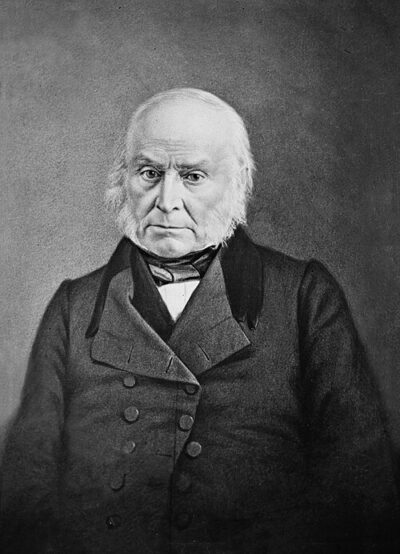
John Quincy Adams
John Quincy Adams was a President of the United States from 1825 to 1829. Born July 11, 1767, in Braintree. Died February 23, 1848, in United States Capitol. Positions held include President of the United States (1825–1829), United States Secretary of State (1817–1825) and United States Ambassador to the United Kingdom (1814–1817). Educated at Harvard University and Leiden University. Awards include Fellow of the American Academy of Arts and Sciences.
Facts
52 facts · 2 confirmed by two sources · 13 cited · 37 from one source
Where this comes from
Papalocal keeps its own record. It started from these sources; what each one said is kept here as it was copied, so a change on their side never changes this page by itself. Tap one to read its version.
What Wikidata says · copied November 13, 2026 · revision 2567583436
- Described as
- President of the United States from 1825 to 1829
- Other names
- J. Adams, John Adams, J. Q. Adams, John Q. Adams
- Born
- July 11, 1767 · 10 references
- Died
- February 23, 1848 · 10 references
- Born in
- Braintree
- Died in
- United States Capitol · 1 reference
- Buried in
- United First Parish Church
- Cause of death
- cerebral hemorrhage
- Name at birth
- John Quincy Adams
- Citizen of
- United States; British America
- Occupation
- politician · 1 reference; lawyer; diplomat; statesperson; diarist · 1 reference; writer · 1 reference; ambassador · 1 reference; jurist · 1 reference
- Positions held
- President of the United States (1825–1829); United States Secretary of State (1817–1825); United States Ambassador to the United Kingdom (1814–1817); United States ambassador to the Russian Empire; United States Ambassador to Germany; United States Ambassador to the Netherlands; United States senator (1803–1808) · 1 reference; President-elect of the United States (1825); member of the State Senate of Massachusetts; United States representative (1831–1848)
- Political party
- Whig Party
- Worked for
- Harvard University
- Education
- Harvard University; Leiden University; Harvard College
- Member of
- American Philosophical Society (1818–); American Academy of Arts and Sciences; Phi Beta Kappa Society; American Antiquarian Society
- Awards
- Fellow of the American Academy of Arts and Sciences (1797–)
- Spouse
- Louisa Adams (1797–1848) · 2 references
- Children
- George Washington Adams; John Adams II; Charles Francis Adams Sr. · 1 reference; Louisa Catherine Adams · 1 reference
- Father
- John Adams · 2 references
- Mother
- Abigail Adams · 1 reference
- Siblings
- Abigail Adams Smith; Susanna Adams; Charles Adams; Thomas Boylston Adams
- Religion
- Unitarianism
- Lived in
- Massachusetts; John Quincy Adams Birthplace · 1 reference
- Height
- 1.71 m (5 ft 7 in)
- Wikipedias with a page
- 166
Wikidata item Q11816 (wikidata.org/wiki/Q11816), public domain (CC0). Copied November 13, 2026.
What Wikipedia says · copied November 13, 2026 · revision 1384610082
John Quincy Adams ( ; July 11, 1767 – February 23, 1848) was the sixth president of the United States, serving from 1825 to 1829. He previously served as the eighth United States secretary of state from 1817 to 1825; minister to Great Britain, Prussia, and Russia; and senator for Massachusetts. After his presidency, Adams uniquely returned to Congress as a member of the lower house until his death in 1848. He was the eldest son of John Adams, the second president, and First Lady Abigail Adams. Among his children were Charles Francis Adams Sr. Initially a Federalist like his father, Adams spent his presidency as a member of the Democratic-Republican Party, and later, in the mid-1830s, became affiliated with the Whig Party.
Born in Braintree, Massachusetts, Adams spent much of his youth in Europe, where his father served as a diplomat during the American Revolutionary War. After returning to the United States, Adams established a successful legal practice in Boston. In 1794, President George Washington appointed Adams as the U.S. minister to the Netherlands, while President Adams named him minister to Prussia. After he was recalled in 1801 by the new president Thomas Jefferson, Federalist leaders in Massachusetts arranged for Adams's election to the United States Senate in 1802. However, Adams broke with the Party over foreign policy and was denied re-election. In 1809, President James Madison, a member of Jefferson's Democratic-Republican Party, appointed Adams as the U.S. minister to Russia, and then to Great Britain, where he led negotiations for the Treaty of Ghent, that ended the War of 1812, and began talks for the Rush–Bagot Treaty that settled lingering claims. In 1817, President James Monroe selected Adams as his secretary of state. In that role, Adams negotiated the Adams–Onís Treaty in 1819, which transferred Spanish Florida to the United States. He also helped formulate the Monroe Doctrine, which became a key tenet of U.S. foreign policy.
Adams stood for the 1824 presidential election as a Democratic-Republican against William H. Crawford, Henry Clay, and Andrew Jackson. Because no candidate won a majority of electoral votes, the House of Representatives held a contingent election, which Adams won with the support of Speaker of the House Clay, whom Adams would controversially appoint as his secretary of state. Adams championed an ambitious agenda that included federally funded infrastructure projects, the establishment of a national university, and engagement with the countries of Latin America, but the conservative Congress refused to pass many of his initiatives. During Adams's presidency, the Democratic-Republican Party splintered into two major camps: the National Republican Party, which supported Adams, and Andrew Jackson's Democratic Party, who attacked Adams and Clay's "corrupt bargain". The Democrats proved to be more effective political organizers, and Jackson soundly defeated Adams in the 1828 presidential election.
After a brief retirement from public service, Adams won election to the U.S. House of Representatives in 1830 as a member of the Anti-Masonic Party. He remains the only former president to be elected to the chamber. After losing his bids for Governor of Massachusetts and Senate, Adams joined the Whig Party, which united those opposed to Jacksonian democracy. During his time in Congress, Adams became increasingly critical of slavery and of the Southern leaders whom he believed controlled the Democratic Party. He was particularly opposed to the annexation of Texas and the Mexican–American War, which he saw as provocations to extend slavery and its political grip on Congress. He also led the fight to repeal the gag rule, which prevented the House of Representatives from debating petitions to abolish slavery. In 1841, the 73-year-old Adams successfully defended enslaved mutineers in the Amistad case before the Supreme Court. He died in the House chamber seven years later. While historians typically rank Adams as an average to above-average president, they generally consider him one of the greatest diplomats and secretaries of state in American history, whose powerlessness as chief executive was followed by vehement speeches against slavery and for the rights of women and Native Americans during his post-presidential congressional career.
- Born, in its opening lines
- July 11, 1767
- Died, in its opening lines
- February 23, 1848
From the Wikipedia article “John Quincy Adams” (en.wikipedia.org/wiki/John_Quincy_Adams), by its contributors, under CC BY-SA 4.0 (creativecommons.org/licenses/by-sa/4.0/). Copied November 13, 2026; not changed.
Confirmed Two sources agree. Cited One source, and it names where it got it. One source One source, without a reference of its own. Sources disagree The sources disagree. We show the best-supported value and keep theirs below.
