
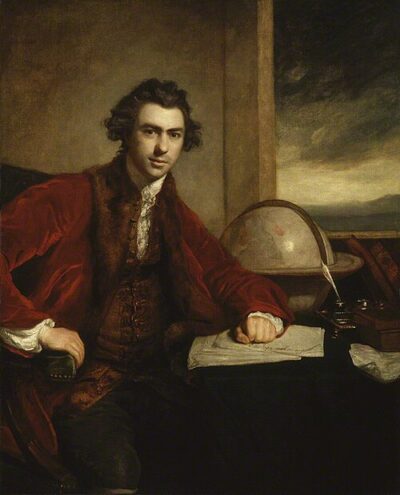
Joseph Banks
Joseph Banks was an English naturalist, botanist and patron of the natural sciences. Born February 13, 1743, in Soho. Died June 19, 1820, in Isleworth. Positions held include President of the Royal Society (1778–1820) and High Sheriff of Lincolnshire (1794–1795). Educated at Christ Church and Harrow School. Awards include Fellow of the Royal Society, Knight Grand Cross of the Order of the Bath and Fellow of the Society of Antiquaries.
Facts
40 facts · 1 confirmed by two sources · 12 cited · 26 from one source · 1 where the sources disagree
What’s different
- Born: we show February 13, 1743 (Sources disagree). Wikipedia says February 24, 1743
Where this comes from
Papalocal keeps its own record. It started from these sources; what each one said is kept here as it was copied, so a change on their side never changes this page by itself. Tap one to read its version.
What Wikidata says · copied November 16, 2026 · revision 2564296780
- Described as
- English naturalist, botanist and patron of the natural sciences (1743-1820)
- Other names
- J. Banks, Sir Joseph Banks, 1st and last Bt., Rt. Hon. Sir Joseph Banks, 1st and last Bt., Sir Joseph Banks, 1st Baronet, Sir Joseph Banks, Joseph, Sir Banks, Banks
- Born
- February 13, 1743 · 2 references
- Died
- June 19, 1820 · 13 references
- Born in
- Soho
- Died in
- Isleworth · 1 reference
- Buried in
- St Leonard's Church, Heston
- Citizen of
- United Kingdom of Great Britain and Ireland
- Occupation
- botanist · 1 reference; archaeologist; scientific explorer · 1 reference; naturalist · 1 reference; botanical collector · 8 references; scientific collector · 1 reference
- Positions held
- President of the Royal Society (1778–1820) · 1 reference; High Sheriff of Lincolnshire (1794–1795) · 1 reference
- Worked for
- British Museum
- Education
- Christ Church; Harrow School · 1 reference; Eton College
- Member of
- Royal Society of London (1766–); Academy of Science for Public Utility; German Academy of Sciences Leopoldina; Royal Swedish Academy of Sciences; Bavarian Academy of Sciences and Humanities; American Academy of Arts and Sciences; Society of Antiquaries of London; Russian Academy of Sciences; Royal Prussian Academy of Sciences; French Academy of Sciences
- Awards
- Fellow of the Royal Society (1766) · 1 reference; Knight Grand Cross of the Order of the Bath (1781); Fellow of the Society of Antiquaries; Fellow of the American Academy of Arts and Sciences (1788–) · 1 reference; baronet
- Field
- botany · 1 reference; geography · 1 reference
- Spouse
- Dorothea Hugessen (1779–) · 1 reference
- Father
- William Banks · 2 references
- Mother
- Sarah Bate · 2 references
- Siblings
- Sarah Sophia Banks · 1 reference
- Lived in
- Soho Square
- Wikipedias with a page
- 54
Wikidata item Q153408 (wikidata.org/wiki/Q153408), public domain (CC0). Copied November 16, 2026.
What Wikipedia says · copied November 16, 2026 · revision 1384593988
Sir Joseph Banks, 1st Baronet (24 February 1743 [O.S. 13 February 1742] – 19 June 1820) was an English naturalist, botanist, and patron of the natural sciences.
Banks made his name on the 1766 natural-history expedition to Newfoundland and Labrador. He took part in Captain James Cook's first great voyage (1768–1771), visiting Brazil, Tahiti, and after 6 months in New Zealand, Australia, returning to immediate fame. He held the position of president of the Royal Society for over 41 years. He advised King George III on the Royal Botanic Gardens, Kew, sending botanists around the world to collect plants, he made Kew the world's leading botanical garden. He is credited for bringing 30,000 plant specimens home with him; amongst them, he was the first European to document 1,400.
Banks advocated British settlement in New South Wales and the colonisation of Australia, as well as the establishment of Botany Bay as a place for the reception of convicts, and advised the British government on all Australian matters. He is credited with introducing the eucalyptus, acacia, and the genus named after him, Banksia, to the Western world. Around 80 species of plants bear his name. He was the leading founder of the African Association and a member of the Society of Dilettanti, which helped to establish the Royal Academy.
- Born, in its opening lines
- February 24, 1743
- Died, in its opening lines
- June 19, 1820
From the Wikipedia article “Joseph Banks” (en.wikipedia.org/wiki/Joseph_Banks), by its contributors, under CC BY-SA 4.0 (creativecommons.org/licenses/by-sa/4.0/). Copied November 16, 2026; not changed.
Confirmed Two sources agree. Cited One source, and it names where it got it. One source One source, without a reference of its own. Sources disagree The sources disagree. We show the best-supported value and keep theirs below.
