
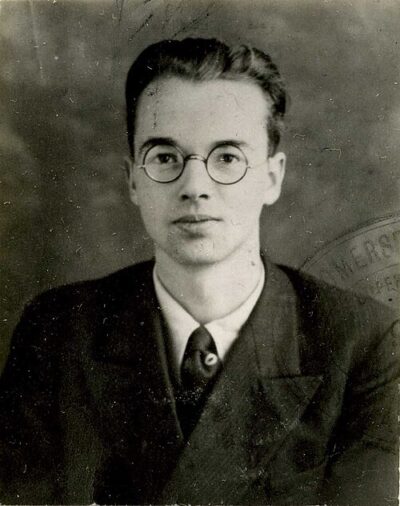
Klaus Fuchs
Klaus Fuchs was a German-born British theoretical physicist and atomic spy. Born December 29, 1911, in Rüsselsheim am Main. Died January 28, 1988, in East Berlin. Educated at Leipzig University and Kiel University. Awards include Order of Karl Marx, National Prize of East Germany and Hervorragender Wissenschaftler des Volkes.
Facts
39 facts · 2 confirmed by two sources · 22 cited · 15 from one source
Where this comes from
Papalocal keeps its own record. It started from these sources; what each one said is kept here as it was copied, so a change on their side never changes this page by itself. Tap one to read its version.
What Wikidata says · copied November 16, 2026 · revision 2568994337
- Described as
- German-born British theoretical physicist and atomic spy (1911-1988)
- Other names
- Emil Julius Klaus Fuchs, Klaus Emil Julius Fuchs
- Born
- December 29, 1911 · 7 references
- Died
- January 28, 1988 · 7 references
- Born in
- Rüsselsheim am Main · 1 reference
- Died in
- East Berlin · 1 reference
- Buried in
- The Socialists' Memorial · 2 references
- Name at birth
- Emil Julius Klaus Fuchs
- Citizen of
- United Kingdom (1942–) · 1 reference; East Germany; United Kingdom of Great Britain and Ireland (–1928)
- Occupation
- nuclear physicist; atomic spies; politician; theoretical physicist; university teacher; physicist · 1 reference
- Political party
- Social Democratic Party of Germany (1930–1932) · 1 reference; Communist Party of Germany (1932–1933) · 1 reference; Socialist Unity Party of Germany (1959–) · 1 reference
- Worked for
- Los Alamos National Laboratory (1944–1946) · 1 reference; Atomic Energy Research Establishment (1946–1950) · 1 reference; Helmholtz-Zentrum Dresden-Rossendorf (1959–1979) · 1 reference; University of Birmingham (1941–1944) · 1 reference; University of Edinburgh (1937–1941) · 1 reference
- Education
- Leipzig University (1930–1931) · 1 reference; Kiel University (1931–1933) · 1 reference; Frederick William University Berlin (1933) · 1 reference; University of Bristol (1933–1937) · 1 reference
- Member of
- German Academy of Sciences at Berlin; Reichsbanner Schwarz-Rot-Gold; Central Committee of the Socialist Unity Party of Germany (1967–); Research Council of the GDR (1983–)
- Awards
- Order of Karl Marx (1979); National Prize of East Germany (1975); Hervorragender Wissenschaftler des Volkes (1986) · 1 reference
- Spouse
- Grete Keilson (1959–) · 1 reference
- Father
- Emil Fuchs · 1 reference
- Lived in
- Paris (1933–) · 1 reference; Great Britain · 1 reference; East Germany (1959–) · 1 reference
- Wikipedias with a page
- 43
Wikidata item Q57475 (wikidata.org/wiki/Q57475), public domain (CC0). Copied November 16, 2026.
What Wikipedia says · copied November 16, 2026 · revision 1384370828
Klaus Emil Julius Fuchs (29 December 1911 – 28 January 1988) was a German theoretical physicist, atomic spy, and communist who supplied information from the American, British, and Canadian Manhattan Project to the Soviet Union during and shortly after World War II. While at the Los Alamos Laboratory, Fuchs was responsible for many significant theoretical calculations relating to the first nuclear weapons and, later, early models of the hydrogen bomb. After his conviction in 1950, he served nine years in prison in the United Kingdom, then migrated to East Germany where he resumed his career as a physicist and scientific leader.
The son of a Lutheran pastor, Fuchs attended the University of Leipzig, where his father was a professor of theology, and became involved in student politics, joining the student branch of the Social Democratic Party of Germany (SPD), and the Reichsbanner Schwarz-Rot-Gold, an SPD-allied paramilitary organisation. He was expelled from the SPD in 1932, and joined the Communist Party of Germany (KPD). He went into hiding after the 1933 Reichstag fire and the subsequent persecution of communists in Nazi Germany, and fled to the United Kingdom, where he received his PhD from the University of Bristol under the supervision of Nevill Francis Mott, and his DSc from the University of Edinburgh, where he worked as an assistant to Max Born.
After the Second World War broke out in Europe, he was interned in the Isle of Man, and later in Canada. After he returned to Britain in 1941, he became an assistant to Rudolf Peierls, working on "Tube Alloys"—the British atomic bomb project. He began passing information on the project to the Soviet Union through Ursula Kuczynski, codenamed "Sonya", a German communist and a major in Soviet military intelligence who had worked with Richard Sorge's spy ring in the Far East. In 1943, Fuchs and Peierls went to Columbia University, in New York City, to work on the Manhattan Project. In August 1944, Fuchs joined the Theoretical Physics Division at the Los Alamos Laboratory, working under Hans Bethe. His chief area of expertise was the problem of implosion, necessary for the development of the plutonium bomb. After the war, he returned to the UK and worked at the Atomic Energy Research Establishment at Harwell as head of the Theoretical Physics Division.
In January 1950, Fuchs confessed that he had passed information to the Soviets over a seven-year period beginning in 1942. A British court sentenced him to fourteen years' imprisonment and he was subsequently stripped of his British citizenship. He was released in 1959, after serving nine years, and migrated to the German Democratic Republic (East Germany), where he was elected to the Academy of Sciences and became a member of the Socialist Unity Party of Germany (SED) central committee. He was later appointed deputy director of the Central Institute for Nuclear Physics in Dresden, where he served until his retirement in 1979.
Post Cold War declassified information states that the Russians freely acknowledged that Fuchs gave them the fission bomb.
- Born, in its opening lines
- December 29, 1911
- Died, in its opening lines
- January 28, 1988
From the Wikipedia article “Klaus Fuchs” (en.wikipedia.org/wiki/Klaus_Fuchs), by its contributors, under CC BY-SA 4.0 (creativecommons.org/licenses/by-sa/4.0/). Copied November 16, 2026; not changed.
Confirmed Two sources agree. Cited One source, and it names where it got it. One source One source, without a reference of its own. Sources disagree The sources disagree. We show the best-supported value and keep theirs below.
