
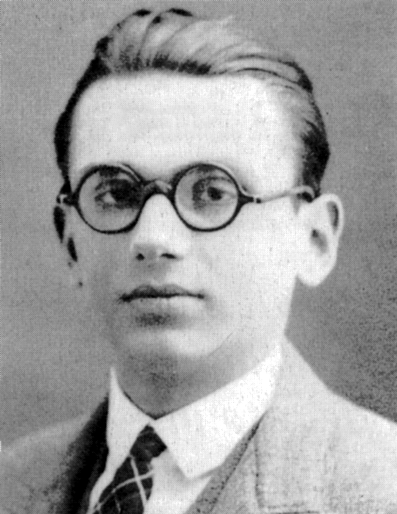
Kurt Gödel
Kurt Gödel was an Austrian-American logician, mathematician, and philosopher of mathematics. Born April 28, 1906, in Brno. Died January 14, 1978, in Princeton. Known for Gödel's incompleteness theorems, Gödel's completeness theorem and Gödel numbering. Educated at University of Vienna. Awards include National Medal of Science, Josiah Willard Gibbs Lectureship and honorary doctorate from Princeton University.
Facts
52 facts · 2 confirmed by two sources · 22 cited · 28 from one source
Where this comes from
Papalocal keeps its own record. It started from these sources; what each one said is kept here as it was copied, so a change on their side never changes this page by itself. Tap one to read its version.
What Wikidata says · copied November 13, 2026 · revision 2568859328
- Described as
- Austrian-American logician, mathematician, and philosopher of mathematics (1906–1978)
- Other names
- Kurt Friedrich Gödel, Kurt Godel, Kurt Goedel
- Born
- April 28, 1906 · 14 references
- Died
- January 14, 1978 · 13 references
- Born in
- Brno · 4 references
- Died in
- Princeton · 1 reference
- Buried in
- Princeton Cemetery · 2 references
- Cause of death
- starvation · 1 reference
- Name at birth
- Kurt Friedrich Gödel
- Citizen of
- United States (1948–) · 1 reference; Austria (1929–); Cisleithania (1906–1918); Czechoslovakia (1918–1929)
- Occupation
- mathematician · 4 references; university teacher; computer scientist; physicist · 1 reference
- Worked for
- Princeton University (1938–1939) · 1 reference; University of Vienna (1930–1938) · 1 reference; University of Notre Dame (1938–1939) · 1 reference; Institute for Advanced Study (1940–1978) · 1 reference
- Education
- University of Vienna (1923–1929) · 1 reference
- Member of
- Royal Society of London; American Academy of Arts and Sciences; French Academy of Sciences · 1 reference; National Academy of Sciences; American Philosophical Society (1961–)
- Known for
- Gödel's incompleteness theorems · 1 reference; Gödel's completeness theorem; Gödel numbering; Von Neumann–Bernays–Gödel set theory; Gödel metric; constructible universe; Gödel's ontological proof; Gödel's β function; Gödel-incomplete machine; Gödel's speed-up theorem
- Awards
- National Medal of Science (1974) · 1 reference; Josiah Willard Gibbs Lectureship (1951) · 1 reference; honorary doctorate from Princeton University; honorary doctor of the University of Vienna; Albert Einstein Award (1951) · 1 reference; Foreign Member of the Royal Society (1968) · 1 reference
- Field
- set theory; mathematical logic · 1 reference; analytic philosophy; mathematics · 1 reference; physics · 1 reference; theory of relativity · 1 reference
- Spouse
- Adele Gödel · 1 reference
- Father
- Rudolf Gödel
- Mother
- Marianne Gödel
- Religion
- Christianity
- Lived in
- Austria · 1 reference
- Wikipedias with a page
- 115
Wikidata item Q41390 (wikidata.org/wiki/Q41390), public domain (CC0). Copied November 13, 2026.
What Wikipedia says · copied November 13, 2026 · revision 1383599796
Kurt Friedrich Gödel ( GUR-dəl, GUH-dəl; German: [ˈkʊʁt ˈɡøːdl̩] ; April 28, 1906 – January 14, 1978) was a logician, mathematician, cosmologist, and philosopher. Considered along with Aristotle and Gottlob Frege to be one of the most significant logicians in history, Gödel profoundly influenced scientific and philosophical thinking in the 20th century (at a time when Bertrand Russell, Alfred North Whitehead, and David Hilbert were using logic and set theory to investigate the foundations of mathematics), building on earlier work by Frege, Richard Dedekind, and Georg Cantor.
Gödel's discoveries in the foundations of mathematics led to the proof of his completeness theorem in 1929 as part of his dissertation to earn a doctorate at the University of Vienna, and the publication of Gödel's incompleteness theorems two years later, in 1931. The incompleteness theorems address limitations of formal axiomatic systems. In particular, they imply that a formal axiomatic system satisfying certain technical conditions cannot decide the truth value of all statements about the natural numbers, and cannot prove that it is itself consistent. To prove this, Gödel developed a technique now known as Gödel numbering, which codes formal expressions as natural numbers.
Gödel also showed that neither the axiom of choice nor the continuum hypothesis can be disproved from the accepted Zermelo–Fraenkel set theory, assuming that its axioms are consistent. The former result opened the door for mathematicians to assume the axiom of choice in their proofs. He also made important contributions to proof theory by clarifying the connections between classical logic, intuitionistic logic, and modal logic.
Born into a wealthy German-speaking family in Brno, Gödel emigrated to the United States in 1939 to escape the rise of Nazi Germany. Later in life, he suffered from mental illness; believing that his food was being poisoned, he refused to eat and starved to death.
- Born, in its opening lines
- April 28, 1906
- Died, in its opening lines
- January 14, 1978
From the Wikipedia article “Kurt Gödel” (en.wikipedia.org/wiki/Kurt_Gödel), by its contributors, under CC BY-SA 4.0 (creativecommons.org/licenses/by-sa/4.0/). Copied November 13, 2026; not changed.
Confirmed Two sources agree. Cited One source, and it names where it got it. One source One source, without a reference of its own. Sources disagree The sources disagree. We show the best-supported value and keep theirs below.
