
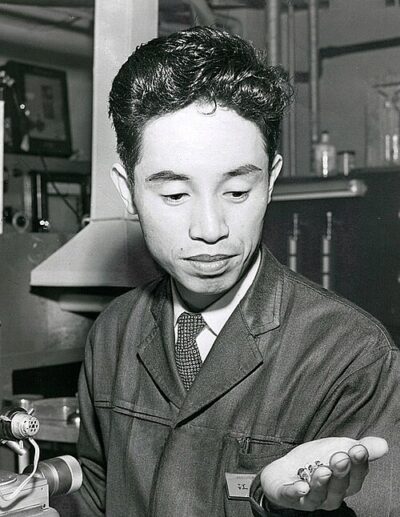
Leo Esaki
Leo Esaki is a Japanese physicist. Born March 12, 1925, in Takaida. Educated at University of Tokyo and Kyoto University. Awards include Asahi Prize, Nishina Memorial Prize and Fellow of the American Physical Society.
Facts
39 facts · 1 confirmed by two sources · 16 cited · 22 from one source
Where this comes from
Papalocal keeps its own record. It started from these sources; what each one said is kept here as it was copied, so a change on their side never changes this page by itself. Tap one to read its version.
What Wikidata says · copied November 16, 2026 · revision 2567792006
- Described as
- Japanese physicist (1925-)
- Other names
- Reona Esaki
- Born
- March 12, 1925 · 6 references
- Born in
- Takaida
- Citizen of
- Japan
- Occupation
- physicist · 1 reference
- Worked for
- Kyoto University; Shibaura Institute of Technology; University of Tsukuba; Yokohama College of Pharmacy; Kwansei Gakuin University · 1 reference; Kawanishi Kikai Seisakusho; Sony Group; IBM Thomas J. Watson Research Center
- Education
- University of Tokyo; Kyoto University; Third Higher School
- Member of
- National Academy of Sciences (1976–) · 2 references; Japan Academy (1975–) · 1 reference; American Academy of Arts and Sciences (1974–) · 1 reference; Russian Academy of Sciences (1994–) · 1 reference; American Philosophical Society · 1 reference; Accademia Nazionale delle Scienze detta dei XL; National Academy of Engineering (1977–) · 1 reference
- Awards
- Asahi Prize (1959) · 1 reference; Nishina Memorial Prize (1959); Fellow of the American Physical Society (1960) · 1 reference; Stuart Ballantine Medal (1961) · 1 reference; IEEE Morris N. Liebmann Memorial Award (1961) · 1 reference; Japan Academy Prize (1965) · 1 reference; IBM Fellow (1967) · 1 reference; Nobel Prize in Physics (1973) · 2 references; Order of Culture (1974); Person of Cultural Merit (1974); James C. McGroddy Prize for New Materials (1985) · 1 reference; honorary doctorate from University of Montpellier-II (1987) · 1 reference; Harold Pender Award (1989) · 1 reference; IEEE Medal of Honor (1991); Order of the Rising Sun, 1st class (1998)
- Field
- physics
- Lived in
- Japan · 1 reference
- Wikipedias with a page
- 75
Wikidata item Q179852 (wikidata.org/wiki/Q179852), public domain (CC0). Copied November 16, 2026.
What Wikipedia says · copied November 16, 2026 · revision 1385714870
Leo Esaki (江崎 玲於奈, Esaki Reona; born March 12, 1925) is a Japanese physicist who shared the 1973 Nobel Prize in Physics with Ivar Giaever and Brian Josephson for his work on tunneling in semiconductors, which led to his invention of the tunnel diode that exploits this phenomenon. His research was done when he was with Sony. He has also contributed in being a pioneer of semiconductor superlattices.
Since the death of Yoichiro Nambu in 2015, Esaki is the oldest living Japanese Nobel laureate.
- Born, in its opening lines
- March 12, 1925
From the Wikipedia article “Leo Esaki” (en.wikipedia.org/wiki/Leo_Esaki), by its contributors, under CC BY-SA 4.0 (creativecommons.org/licenses/by-sa/4.0/). Copied November 16, 2026; not changed.
Confirmed Two sources agree. Cited One source, and it names where it got it. One source One source, without a reference of its own. Sources disagree The sources disagree. We show the best-supported value and keep theirs below.
