
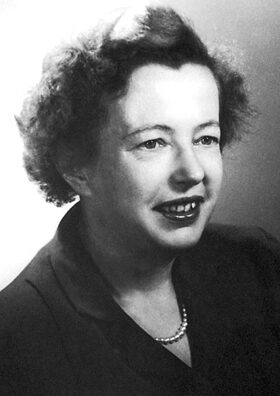
Maria Göppert Mayer
Maria Göppert Mayer was a German-born American theoretical physicist. Born June 28, 1906, in Katowice. Died February 20, 1972, in La Jolla. Known for nuclear shell model. Educated at University of Göttingen. Awards include Nobel Prize in Physics, National Women's Hall of Fame and Fellow of the American Physical Society.
Facts
40 facts · 2 confirmed by two sources · 31 cited · 7 from one source
Where this comes from
Papalocal keeps its own record. It started from these sources; what each one said is kept here as it was copied, so a change on their side never changes this page by itself. Tap one to read its version.
What Wikidata says · copied November 13, 2026 · revision 2566715711
- Described as
- German-born American theoretical physicist (1906-1972)
- Other names
- M. Göppert‐Mayer, Maria Göppert, Maria G. Mayer, Maria Goeppert Mayer, Maria Gertrude Goeppert Mayer, Maria Göppert-Mayer, Maria Mayer
- Born
- June 28, 1906 · 9 references
- Died
- February 20, 1972 · 9 references
- Born in
- Katowice · 2 references
- Died in
- La Jolla · 1 reference
- Buried in
- El Camino Memorial Park · 1 reference
- Cause of death
- circulatory collapse · 1 reference
- Name at birth
- Maria Göppert · 1 reference
- Citizen of
- Germany; United States (1933–) · 1 reference
- Occupation
- physicist · 2 references; nuclear physicist; university teacher · 1 reference; scientist · 1 reference
- Worked for
- Johns Hopkins University (1930–1939) · 1 reference; University of California, San Diego (1960–1972) · 1 reference; Columbia University · 1 reference; Sarah Lawrence College (1941–1942) · 1 reference; Los Alamos National Laboratory (1945–) · 1 reference; Argonne National Laboratory (1946–1959) · 1 reference
- Education
- University of Göttingen (–1930) · 1 reference
- Member of
- Heidelberg Academy of Sciences and Humanities (1950–) · 1 reference; American Academy of Arts and Sciences; American Philosophical Society (1964–) · 2 references; American Physical Society · 1 reference; National Academy of Sciences (1956–) · 1 reference
- Known for
- nuclear shell model · 1 reference
- Awards
- Nobel Prize in Physics (1963) · 2 references; National Women's Hall of Fame (1996) · 1 reference; Fellow of the American Physical Society; Fellow of the American Academy of Arts and Sciences; Golden Plate Award (1965) · 1 reference
- Field
- physics · 1 reference; nuclear physics · 1 reference; radioactivity · 1 reference; quantum mechanics · 1 reference; theoretical physics · 1 reference; physical chemistry · 1 reference
- Spouse
- Joseph Edward Mayer (1930–) · 2 references
- Children
- Maria Mayer
- Father
- Friedrich Göppert · 1 reference
- Wikipedias with a page
- 103
Wikidata item Q57100 (wikidata.org/wiki/Q57100), public domain (CC0). Copied November 13, 2026.
What Wikipedia says · copied November 13, 2026 · revision 1381484772
Maria Goeppert Mayer (German: [maˈʁiːa ˈɡœpɐt ˈmaɪɐ] ; née Göppert; June 28, 1906 – February 20, 1972) was a German–American theoretical physicist who shared the 1963 Nobel Prize in Physics with J. Hans D. Jensen and Eugene Wigner. One half of the prize was awarded jointly to Goeppert Mayer and Jensen "for their discoveries concerning nuclear shell structure." She was the second woman to win the Nobel Prize in Physics, the first being Marie Curie in 1903. In 1986, the Maria Goeppert-Mayer Award for early-career women physicists was established in her honor.
A graduate of the University of Göttingen, Goeppert Mayer wrote her doctoral thesis on the theory of possible two-photon absorption by atoms. At the time, the chances of experimentally verifying her thesis seemed remote, but the development of the laser in the 1960s later permitted this. Today, the unit for the two-photon absorption cross section is called the Goeppert Mayer (GM) unit.
Maria Goeppert married American chemist Joseph Edward Mayer and moved to the United States, where he was an associate professor at Johns Hopkins University. Strict rules against nepotism prevented Johns Hopkins University from taking her on as a faculty member, but she was given a job as an assistant and published a landmark paper on double beta decay in 1935. In 1937, she moved to Columbia University, where she took an unpaid position. During World War II, she worked for the Manhattan Project at Columbia on isotope separation, and with Edward Teller at the Los Alamos Laboratory on the development of thermonuclear weapons.
After the war, Goeppert Mayer became a voluntary Associate Professor of Physics at the University of Chicago (where her husband and Teller worked) and a senior physicist at the university-run Argonne National Laboratory. She developed a mathematical model for the structure of nuclear shells, for which she was awarded the Nobel Prize in Physics in 1963. In 1960, she was appointed Full Professor of Physics at the University of California, San Diego.
- Born, in its opening lines
- June 28, 1906
- Died, in its opening lines
- February 20, 1972
From the Wikipedia article “Maria Goeppert Mayer” (en.wikipedia.org/wiki/Maria_Goeppert_Mayer), by its contributors, under CC BY-SA 4.0 (creativecommons.org/licenses/by-sa/4.0/). Copied November 13, 2026; not changed.
Confirmed Two sources agree. Cited One source, and it names where it got it. One source One source, without a reference of its own. Sources disagree The sources disagree. We show the best-supported value and keep theirs below.
