
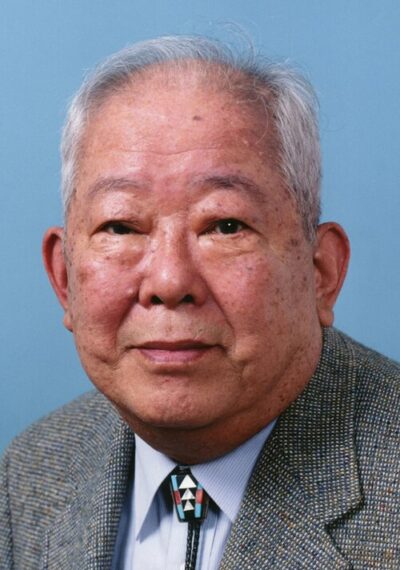
Masatoshi Koshiba
Masatoshi Koshiba was a Japanese physicist and astronomer. Born September 19, 1926, in Toyohashi. Died November 12, 2020, in Tokyo. Educated at University of Tokyo and Meiji University. Awards include Commander's Cross of the Order of Merit of the Federal Republic of Germany, Order of Culture and Nobel Prize in Physics.
Facts
38 facts · 2 confirmed by two sources · 8 cited · 28 from one source
Where this comes from
Papalocal keeps its own record. It started from these sources; what each one said is kept here as it was copied, so a change on their side never changes this page by itself. Tap one to read its version.
What Wikidata says · copied November 16, 2026 · revision 2569184466
- Described as
- Japanese physicist and astronomer (1926-2020)
- Born
- September 19, 1926 · 6 references
- Died
- November 12, 2020 · 2 references
- Born in
- Toyohashi · 1 reference
- Died in
- Tokyo · 1 reference
- Citizen of
- Japan (1947–); Empire of Japan (1926–1947)
- Occupation
- physicist · 2 references; professor; researcher
- Worked for
- University of Hamburg; University of Tokyo; High Energy Accelerator Research Organization; Tokai University; HFBS
- Education
- University of Tokyo; Meiji University · 1 reference; University of Rochester; Kanagawa Prefectural Yokosuka High School
- Member of
- Japan Academy (2002–) · 1 reference; Russian Academy of Sciences; American Physical Society (2002–) · 2 references; National Academy of Sciences (2005–) · 1 reference
- Awards
- Commander's Cross of the Order of Merit of the Federal Republic of Germany (1985); Order of Culture (1997); Nobel Prize in Physics (2002) · 2 references; Benjamin Franklin Medal (2003); Order of the Rising Sun, 1st class (2003); Wolf Prize in Physics (2000) · 1 reference; Humboldt Research Fellowship; Person of Cultural Merit (1988); Asahi Prize (1987); Fellow of the American Physical Society; Panofsky Prize (2002) · 1 reference; Humboldt Prize (1997); Fellow of the Bangladesh Academy of Science; Nishina Memorial Prize (1987)
- Field
- particle physics; astrophysics
- Wikipedias with a page
- 76
Wikidata item Q155773 (wikidata.org/wiki/Q155773), public domain (CC0). Copied November 16, 2026.
What Wikipedia says · copied November 16, 2026 · revision 1372681927
Masatoshi Koshiba (小柴 昌俊, Koshiba Masatoshi; 19 September 1926 – 12 November 2020) was a Japanese physicist and one of the founders of neutrino astronomy. His work with the neutrino detectors Kamiokande and Super-Kamiokande was instrumental in detecting solar neutrinos, providing experimental evidence for the solar neutrino problem.
Koshiba won the Nobel Prize in Physics in 2002, jointly with Raymond Davis Jr., "for pioneering contributions to astrophysics, in particular for the detection of cosmic neutrinos". Koshiba was the first Japanese Nobel laureate to hold two doctoral degrees. In addition, he was the second Japanese recipient of both the Nobel Prize and the Wolf Prize. His mentor, Sin-Itiro Tomonaga, and his student, Takaaki Kajita, were also Nobel Prize winners in Physics.
He was a senior counselor at the International Center for Elementary Particle Physics (ICEPP) and professor at the University of Tokyo.
- Born, in its opening lines
- September 19, 1926
- Died, in its opening lines
- November 12, 2020
From the Wikipedia article “Masatoshi Koshiba” (en.wikipedia.org/wiki/Masatoshi_Koshiba), by its contributors, under CC BY-SA 4.0 (creativecommons.org/licenses/by-sa/4.0/). Copied November 16, 2026; not changed.
Confirmed Two sources agree. Cited One source, and it names where it got it. One source One source, without a reference of its own. Sources disagree The sources disagree. We show the best-supported value and keep theirs below.
