
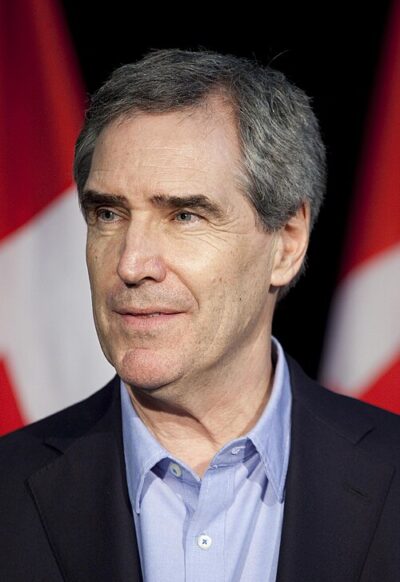
Michael Ignatieff
Michael Ignatieff is a Canadian professor, writer and politician. Born May 12, 1947, in Toronto. Positions held include Leader of the Official Opposition, Leader of the Liberal Party of Canada (2008–2011) and Cleveringa chair (2013–2014). Educated at University of Oxford and Trinity College. Awards include Canada India Foundation ("CIF") Chanchlani Global Indian Award, Hannah Arendt Prize and Lionel Gelber Prize.
Facts
45 facts · 1 confirmed by two sources · 13 cited · 31 from one source
Where this comes from
Papalocal keeps its own record. It started from these sources; what each one said is kept here as it was copied, so a change on their side never changes this page by itself. Tap one to read its version.
What Wikidata says · copied November 15, 2026 · revision 2530162166
- Described as
- Canadian professor, writer and politician
- Other names
- M.G. Ignatieff, Michael Grant Ignatieff
- Born
- May 12, 1947 · 8 references
- Born in
- Toronto · 1 reference
- Citizen of
- Canada
- Occupation
- journalist · 2 references; historian · 1 reference; politician · 1 reference; novelist; philosopher; writer · 2 references; university teacher · 3 references; screenwriter · 1 reference
- Positions held
- Leader of the Official Opposition; Leader of the Liberal Party of Canada (2008–2011); Cleveringa chair (2013–2014) · 1 reference; member of the House of Commons of Canada (2006–2011) · 1 reference
- Political party
- Liberal Party of Canada
- Worked for
- University of Oxford; Harvard University; University of Toronto; University of British Columbia; London School of Economics and Political Science; University of London; Leiden University (2013–2014); Central European University
- Education
- University of Oxford; Trinity College; Harvard University; Upper Canada College; University of Toronto · 1 reference
- Awards
- Canada India Foundation ("CIF") Chanchlani Global Indian Award; Hannah Arendt Prize (2003) · 1 reference; Lionel Gelber Prize (1994); Francisco Cerecedo Prize (2012); Governor General's Award for English-language non-fiction (1987); Gordon Montador Award; Member of the Order of Canada · 1 reference; Heinemann Award (1988); Princess of Asturias Award for Social Sciences (2024) · 1 reference; Dan David Prize (2019) · 1 reference
- Field
- journalist · 1 reference; lecturer · 1 reference
- Father
- George Ignatieff
- Mother
- Alison Grant · 1 reference
- Religion
- Eastern Orthodox Church
- Website
- http://www.michaelignatieff.ca/ · 1 reference
- Wikipedias with a page
- 36
Wikidata item Q311684 (wikidata.org/wiki/Q311684), public domain (CC0). Copied November 15, 2026.
What Wikipedia says · copied November 15, 2026 · revision 1385603014
Michael Grant Ignatieff ( ig-NAT-ee-ef; born May 12, 1947) is a Canadian author, academic and former politician who served as leader of the Liberal Party and leader of the Opposition from 2008 until 2011. Known for his work as a historian, Ignatieff has held senior academic posts at the universities of Cambridge, Oxford, Harvard, and Toronto. Most recently, he was rector and president of Central European University; he held this position from 2016 to 2021.
While living in the United Kingdom from 1978 to 2000, Ignatieff became well known as a television and radio broadcaster and as an editorial columnist for The Observer. His documentary series Blood and Belonging: Journeys into the New Nationalism aired on BBC in 1993, and won a Canadian Gemini Award. His book of the same name, based on the series, won the Gordon Montador Award for Best Canadian Book on Social Issues and the University of Toronto's Lionel Gelber Prize. His memoir, The Russian Album, won Canada's Governor General's Literary Award and the British Royal Society of Literature's Heinemann Prize in 1988. His novel, Scar Tissue, was short-listed for the Booker Prize in 1994. In 2000, he delivered the Massey Lectures, entitled The Rights Revolution, which was released in print later that year.
In the 2006 federal election, Ignatieff was elected to the House of Commons as the member of Parliament (MP) for Etobicoke—Lakeshore. The same year, he ran for the leadership of the Liberal Party, ultimately losing to Stéphane Dion. He served as the party's deputy leader under Dion. After Dion's resignation in the wake of the 2008 election, Ignatieff served as interim leader from December 2008 until he was elected leader at the party's May 2009 convention. In the 2011 federal election, Ignatieff lost his own seat in the Liberal Party's worst showing in its history. Winning only 34 seats, the party placed a distant third behind the Conservatives and NDP, and thus lost its position as the Official Opposition. Ignatieff subsequently resigned as leader of the Liberal Party, and in effect retired from active politics, in May 2011.
Ignatieff taught at the University of Toronto after his 2011 electoral defeat. In 2013, he returned to Harvard Kennedy School part-time, splitting his time between Harvard and Toronto. On July 1, 2014, he returned to Harvard full-time. In 2016, he left Harvard to become president and rector of the Central European University in Budapest; he resigned from this position in July 2021. He continues to publish articles and essays on international affairs as well as Canadian politics. In 2024, he was awarded the Princess of Asturias Award for Social Sciences.
- Born, in its opening lines
- May 12, 1947
From the Wikipedia article “Michael Ignatieff” (en.wikipedia.org/wiki/Michael_Ignatieff), by its contributors, under CC BY-SA 4.0 (creativecommons.org/licenses/by-sa/4.0/). Copied November 15, 2026; not changed.
Confirmed Two sources agree. Cited One source, and it names where it got it. One source One source, without a reference of its own. Sources disagree The sources disagree. We show the best-supported value and keep theirs below.
