
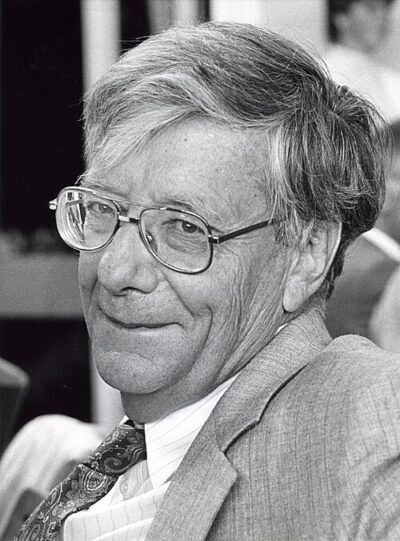
Nicolaas Bloembergen
Nicolaas Bloembergen was a Dutch-born American physicist. Born March 11, 1920, in Dordrecht. Died September 5, 2017, in Tucson. Educated at Leiden University and Harvard University. Awards include Guggenheim Fellowship, Nobel Prize in Physics and Frederic Ives Medal.
Facts
48 facts · 2 confirmed by two sources · 20 cited · 26 from one source
Where this comes from
Papalocal keeps its own record. It started from these sources; what each one said is kept here as it was copied, so a change on their side never changes this page by itself. Tap one to read its version.
What Wikidata says · copied November 13, 2026 · revision 2567933427
- Described as
- Dutch-born American physicist
- Other names
- N. Bloembergen, Nico Bloembergen
- Born
- March 11, 1920 · 8 references
- Died
- September 5, 2017 · 7 references
- Born in
- Dordrecht · 1 reference
- Died in
- Tucson · 1 reference
- Cause of death
- heart failure
- Citizen of
- Kingdom of the Netherlands · 1 reference; United States
- Occupation
- physicist · 1 reference; theoretical physicist; university teacher · 2 references; Nobel Prize winner · 1 reference
- Worked for
- Harvard University; University of Arizona; Leiden University (1972–1973) · 1 reference
- Education
- Leiden University; Harvard University; Utrecht University
- Member of
- German Academy of Sciences Leopoldina (1983–) · 1 reference; French Academy of Sciences; National Academy of Sciences (1960–); Royal Netherlands Academy of Arts and Sciences; American Academy of Arts and Sciences; National Academy of Engineering (1984–); American Physical Society · 1 reference; American Philosophical Society (1982–)
- Awards
- Guggenheim Fellowship · 1 reference; Nobel Prize in Physics (1981) · 2 references; Frederic Ives Medal (1979) · 1 reference; Stuart Ballantine Medal (1961) · 1 reference; Lorentz Medal (1978); Oliver E. Buckley Condensed Matter Prize (1958) · 1 reference; IEEE Medal of Honor (1983) · 1 reference; National Medal of Science (1974); Dirac Medal for the Advancement of Physics (1983) · 1 reference; Humboldt Research Fellowship; IEEE Morris N. Liebmann Memorial Award (1959) · 1 reference; Fellow of the American Physical Society; honorary doctorate at the Laval University (1987) · 1 reference; Humboldt Prize; Fellow of the Optical Society
- Field
- quantum physics; optics · 1 reference; physics · 1 reference; theoretical physics · 1 reference; laser spectroscopy · 1 reference
- Spouse
- Huberta Deliana Brink
- Siblings
- Auke Bloembergen
- Religion
- atheism
- Wikipedias with a page
- 77
Wikidata item Q189987 (wikidata.org/wiki/Q189987), public domain (CC0). Copied November 13, 2026.
What Wikipedia says · copied November 13, 2026 · revision 1383133812
Nicolaas Bloembergen (March 11, 1920 – September 5, 2017) was a Dutch–American physicist recognized for his work in developing driving principles behind nonlinear optics for laser spectroscopy. During his career, he was a professor at Harvard University and later at the University of Arizona and at Leiden University in 1973 (as Lorentz Professor).
Bloembergen shared the 1981 Nobel Prize in Physics along with Arthur Schawlow and Kai Siegbahn because their work "has had a profound effect on our present knowledge of the constitution of matter" through the use of laser spectroscopy. In particular, Bloembergen was singled out because he "founded a new field of science we now call non-linear optics" by mixing "two or more beams of laser light... in order to produce laser light of a different wave length" and thus significantly broaden the laser spectroscopy frequency band.
- Born, in its opening lines
- March 11, 1920
- Died, in its opening lines
- September 5, 2017
From the Wikipedia article “Nicolaas Bloembergen” (en.wikipedia.org/wiki/Nicolaas_Bloembergen), by its contributors, under CC BY-SA 4.0 (creativecommons.org/licenses/by-sa/4.0/). Copied November 13, 2026; not changed.
Confirmed Two sources agree. Cited One source, and it names where it got it. One source One source, without a reference of its own. Sources disagree The sources disagree. We show the best-supported value and keep theirs below.
