
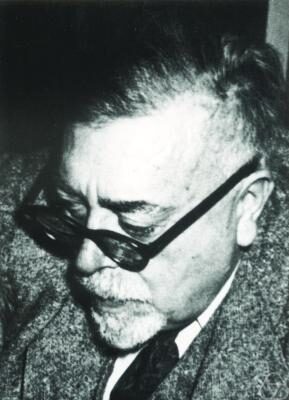
Norbert Wiener
Norbert Wiener was an American mathematician, scientist in cybernetics and artificial intelligence. Born November 26, 1894, in Columbia. Died March 18, 1964, in Stockholm. Known for abstract Wiener space, classical Wiener space and Paley–Wiener theorem. Educated at Harvard University and Cornell University. Awards include National Medal of Science, Guggenheim Fellowship and National Book Award.
Facts
49 facts · 2 confirmed by two sources · 24 cited · 23 from one source
Where this comes from
Papalocal keeps its own record. It started from these sources; what each one said is kept here as it was copied, so a change on their side never changes this page by itself. Tap one to read its version.
What Wikidata says · copied November 13, 2026 · revision 2568744159
- Described as
- American mathematician, scientist in cybernetics and artificial intelligence (1894–1964)
- Other names
- Norbert Vineris, Norbert Viner, N. Vineris
- Born
- November 26, 1894 · 10 references
- Died
- March 18, 1964 · 9 references
- Born in
- Columbia · 1 reference
- Died in
- Stockholm
- Buried in
- Vittum Hill Cemetery · 2 references
- Citizen of
- United States · 1 reference
- Occupation
- mathematician · 2 references; autobiographer; university teacher; psychologist; computer scientist; founder; scientist · 1 reference
- Worked for
- Massachusetts Institute of Technology (1919–1960) · 1 reference; Aberdeen Proving Ground (1916–1919) · 1 reference
- Education
- Harvard University (1909–1913) · 1 reference; Cornell University (1910–1911) · 1 reference; Tufts University (1906–1909) · 1 reference; Peabody School (1901–1903) · 1 reference; Ayer High School (1903–1906) · 1 reference; University of Cambridge (1913–1914) · 1 reference
- Member of
- American Academy of Arts and Sciences (1926–) · 2 references; National Academy of Sciences (1934–1943) · 2 references
- Known for
- abstract Wiener space; classical Wiener space; Paley–Wiener theorem; Wiener algebra; Wiener filter; God & Golem, Inc.; Wiener equation; The Human Use of Human Beings; The Theory of Ignorance
- Awards
- National Medal of Science (1963) · 1 reference; Guggenheim Fellowship (1926) · 1 reference; National Book Award (1965); Josiah Willard Gibbs Lectureship (1949) · 1 reference; Bôcher Memorial Prize (1933) · 2 references; Honorary Doctorate from the National Autonomous University of Mexico (1951)
- Field
- mathematics; cybernetics; informatics · 1 reference; applied mathematics · 1 reference; probability theory · 1 reference; stochastic process · 1 reference
- Spouse
- Margaret Engemann
- Father
- Leo Wiener · 1 reference
- Siblings
- Constance Wiener; Bertha Wiener
- Religion
- Judaism · 1 reference
- Wikipedias with a page
- 74
Wikidata item Q178577 (wikidata.org/wiki/Q178577), public domain (CC0). Copied November 13, 2026.
What Wikipedia says · copied November 13, 2026 · revision 1384578640
Norbert Wiener (November 26, 1894 – March 18, 1964) was an American computer scientist, mathematician, and philosopher. He became a professor of mathematics at the Massachusetts Institute of Technology (MIT). A child prodigy, Wiener later became an early researcher in stochastic and mathematical noise processes, contributing work relevant to electronic engineering, electronic communication, and control systems.
Wiener is considered the originator of cybernetics, the science of communication as it relates to living things and machines, with implications for engineering, systems control, computer science, biology, neuroscience, philosophy, and the organization of society. His work heavily influenced computer pioneer John von Neumann, information theorist Claude Shannon, anthropologists Margaret Mead and Gregory Bateson, and others.
Wiener is credited as being one of the first to theorize that all intelligent behavior was the result of feedback mechanisms that could possibly be simulated by machines, an important early step towards the development of modern artificial intelligence.
- Born, in its opening lines
- November 26, 1894
- Died, in its opening lines
- March 18, 1964
From the Wikipedia article “Norbert Wiener” (en.wikipedia.org/wiki/Norbert_Wiener), by its contributors, under CC BY-SA 4.0 (creativecommons.org/licenses/by-sa/4.0/). Copied November 13, 2026; not changed.
Confirmed Two sources agree. Cited One source, and it names where it got it. One source One source, without a reference of its own. Sources disagree The sources disagree. We show the best-supported value and keep theirs below.
