
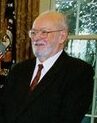
Paul Lauterbur
Paul Lauterbur was an American chemist. Born May 6, 1929, in Sidney. Died March 27, 2007, in Urbana. Known for magnetic resonance imaging. Educated at University of Pittsburgh and Case Western Reserve University. Awards include National Medal of Technology and Innovation, Lasker-DeBakey Clinical Medical Research Award and Canada Gairdner International Award.
Facts
41 facts · 2 confirmed by two sources · 19 cited · 20 from one source
Where this comes from
Papalocal keeps its own record. It started from these sources; what each one said is kept here as it was copied, so a change on their side never changes this page by itself. Tap one to read its version.
What Wikidata says · copied November 13, 2026 · revision 2567406210
- Described as
- American chemist (1929–2007)
- Other names
- Paul Christian Lauterbur, Paul C. Lauterbur, Paul C Lauterbur, P. C. Lauterbur, P C Lauterbur, P. Lauterbur, P Lauterbur, Lauterbur, Lauterbur P, Lauterbur P., Lauterbur PC, Lauterbur P. C.
- Born
- May 6, 1929 · 11 references
- Died
- March 27, 2007 · 12 references
- Born in
- Sidney · 4 references
- Died in
- Urbana · 1 reference
- Buried in
- Graceland Cemetery · 1 reference
- Cause of death
- kidney disease
- Citizen of
- United States · 2 references
- Occupation
- chemist · 3 references; professor · 2 references; physicist · 1 reference; biophysicist; researcher
- Worked for
- University of Illinois Urbana-Champaign; University of Illinois Chicago · 1 reference; Stony Brook University · 1 reference
- Education
- University of Pittsburgh; Case Western Reserve University; Sidney High School · 1 reference
- Member of
- German Academy of Sciences Leopoldina · 1 reference; National Academy of Sciences; American Association for the Advancement of Science · 1 reference; American Physical Society · 1 reference
- Known for
- magnetic resonance imaging · 1 reference
- Awards
- National Medal of Technology and Innovation (1988) · 1 reference; Lasker-DeBakey Clinical Medical Research Award (1984) · 1 reference; Canada Gairdner International Award (1985); IEEE Medal of Honor (1987) · 1 reference; Nobel Prize in Physiology or Medicine (2003) · 4 references; Harvey Prize (1986) · 1 reference; Howard N. Potts Medal (1983) · 1 reference; National Medal of Science (1987); Dr A.H. Heineken Prize for Medicine (1989); National Inventors Hall of Fame (2007) · 2 references; X-ray badge (1987); Kyoto Prize in Advanced Technology (1994) · 2 references; Kettering Prize (1985) · 1 reference; Dickson Prize in Science (1993); Max Delbrück Prize in Biological Physics (1983) · 2 references
- Field
- chemistry · 1 reference; radiology · 1 reference
- Religion
- atheism
- Wikipedias with a page
- 58
Wikidata item Q106547 (wikidata.org/wiki/Q106547), public domain (CC0). Copied November 13, 2026.
What Wikipedia says · copied November 13, 2026 · revision 1384400456
Paul Christian Lauterbur (May 6, 1929 – March 27, 2007) was an American chemist who shared the Nobel Prize in Physiology or Medicine in 2003 with Peter Mansfield for his work which made the development of magnetic resonance imaging (MRI) possible.
Lauterbur was a professor at Stony Brook University from 1963 until 1985, where he conducted his research for the development of the MRI. In 1985 he became a professor along with his wife Joan Dawson at the University of Illinois at Urbana-Champaign for 22 years until his death in Urbana. He and Dawson established the Biomedical Magnetic Resonance Laboratory (BMRL) there. He never stopped working with undergraduates on research, and he served as a professor of chemistry, with appointments in bioengineering, biophysics, the College of Medicine at Urbana-Champaign and computational biology at the Center for Advanced Study.
- Born, in its opening lines
- May 6, 1929
- Died, in its opening lines
- March 27, 2007
From the Wikipedia article “Paul Lauterbur” (en.wikipedia.org/wiki/Paul_Lauterbur), by its contributors, under CC BY-SA 4.0 (creativecommons.org/licenses/by-sa/4.0/). Copied November 13, 2026; not changed.
Confirmed Two sources agree. Cited One source, and it names where it got it. One source One source, without a reference of its own. Sources disagree The sources disagree. We show the best-supported value and keep theirs below.
