
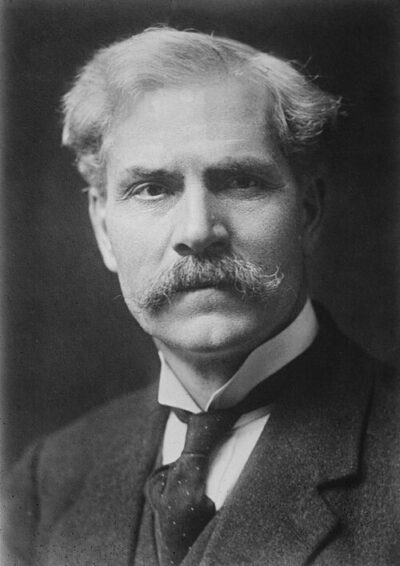
Ramsay MacDonald
Ramsay MacDonald was a British prime minister in 1924 and 1929 to 1935. Born October 12, 1866, in Lossiemouth. Died November 9, 1937, in Atlantic Ocean. Positions held include Prime Minister of the United Kingdom (2 times) (1924–1935), Leader of the Opposition (1922–1929) and Leader of the Labour Party (2 times) (1911–1931). Educated at Birkbeck, University of London. Awards include Fellow of the Royal Society.
Facts
46 facts · 2 confirmed by two sources · 13 cited · 31 from one source
Where this comes from
Papalocal keeps its own record. It started from these sources; what each one said is kept here as it was copied, so a change on their side never changes this page by itself. Tap one to read its version.
What Wikidata says · copied November 16, 2026 · revision 2567357036
- Described as
- British prime minister in 1924 and 1929 to 1935 (1866–1937)
- Other names
- James Ramsay MacDonald, J. R. M., J. Ramsay McDonald, J. Ramsay MacDonald
- Born
- October 12, 1866 · 8 references
- Died
- November 9, 1937 · 8 references
- Born in
- Lossiemouth · 2 references
- Died in
- Atlantic Ocean
- Buried in
- Scotland · 1 reference
- Cause of death
- heart failure
- Name at birth
- James McDonald Ramsay
- Citizen of
- United Kingdom; United Kingdom of Great Britain and Ireland (–1927)
- Occupation
- politician · 1 reference; journalist; diplomat; writer
- Positions held
- Prime Minister of the United Kingdom (2 times) (1924–1935); Leader of the Opposition (1922–1929); Leader of the Labour Party (2 times) (1911–1931); Lord President of the Council (1935–1937); Leader of the House of Commons (2 times) (1924–1935); Secretary of State for Foreign and Commonwealth Affairs (1924); Member of the Privy Council of the United Kingdom (1924–) · 1 reference; member of the 37th Parliament of the United Kingdom (1936–1937) · 1 reference; member of the 36th Parliament of the United Kingdom (1931–1935) · 1 reference; member of the 35th Parliament of the United Kingdom (1929–1931) · 1 reference; member of the 34th Parliament of the United Kingdom (1924–1929) · 1 reference; member of the 33rd Parliament of the United Kingdom (1923–1924) · 1 reference; member of the 32nd Parliament of the United Kingdom (1922–1923) · 1 reference; member of the 30th Parliament of the United Kingdom (1910–1918) · 1 reference; member of the 29th Parliament of the United Kingdom (1910) · 1 reference
- Political party
- Labour Party (–1931); National Labour Organisation (1931–); Liberal Party · 1 reference; Independent Labour Party · 1 reference
- Worked for
- London School of Economics and Political Science
- Education
- Birkbeck, University of London
- Member of
- Royal Society of London
- Awards
- Fellow of the Royal Society (1930)
- Spouse
- Margaret MacDonald · 1 reference
- Children
- Malcolm MacDonald; Ishbel MacDonald; David MacDonald; Sheila Lochhead; Alister MacDonald; Joan Margaret MacKinnon
- Father
- John MacDonald · 1 reference
- Mother
- Anne Ramsay · 1 reference
- Religion
- Free Church of Scotland
- Wikipedias with a page
- 77
Wikidata item Q166646 (wikidata.org/wiki/Q166646), public domain (CC0). Copied November 16, 2026.
What Wikipedia says · copied November 16, 2026 · revision 1385552375
James Ramsay MacDonald (né James McDonald Ramsay; 12 October 1866 – 9 November 1937) was Prime Minister of the United Kingdom twice, first briefly in 1924 and again from 1929 to 1935. The first two of his governments belonged to the Labour Party: a minority Labour government for ten months in 1924, and the second between 1929 and 1931. In 1931, MacDonald was expelled from the Labour Party; after, he formed a National Government dominated by the Conservative Party and supported by only a few Labour members. His premiership then lasted until 1935.
Born into rural poverty in Lossiemouth, in northern Scotland, MacDonald discovered socialism in the 1880s whilst living in England. Along with Keir Hardie and Arthur Henderson, he was one of the three principal founders of the Labour Party in 1900. He was chairman of the Labour MPs between 1911 and 1914. His opposition to the First World War damaged his reputation, however it later recovered sufficiently for him to win the first Labour leadership contest to become Leader of the Labour Party in 1922. Following the 1923 election, MacDonald formed his first minority government with Liberal support in early 1924, making him the first Labour Prime Minister in British history. This government collapsed after just ten months after losing a vote of no confidence, and was defeated in the 1924 election, but proved that Labour was capable of governing.
MacDonald led Labour into the 1929 election, which saw them win the largest number of seats for the first time, but falling short of a majority, forming a second minority government (1929–1931). The Labour government was unable to agree on how to respond to the financial crisis caused by the Great Depression, and so MacDonald formed the National Government with Conservative and some Liberal support in 1931, to carry out spending cuts to defend the gold standard, leading to him and several of his allies being expelled from Labour, and so he created a new National Labour grouping for himself and his supporters. The gold standard had to be abandoned after the Invergordon Mutiny, and so he called a general election in 1931 seeking a "doctor's mandate" to fix the economy.
The National Government won an overwhelming landslide and the Labour Party was reduced to a rump of around 50 seats in the House of Commons, leading to MacDonald being bitterly denounced as a 'traitor' by his former Labour colleagues. MacDonald served as a figurehead Prime Minister in the Conservative dominated National Government, but remained active in foreign policy after 1931, however his health rapidly deteriorated and he stood down as Prime Minister in 1935, remaining as Lord President of the Council until retiring in 1937. He died later that year.
MacDonald's speeches, pamphlets and books made him an important theoretician. Historian John Shepherd states that "MacDonald's natural gifts of an imposing presence, handsome features and a persuasive oratory delivered with an arresting Highlands accent made him the iconic Labour leader". After 1931, MacDonald was repeatedly and bitterly denounced by the Labour movement as a traitor to its cause. Since the 1960s, some historians have defended his reputation, emphasising his earlier role in building up the Labour Party, dealing with the Great Depression, and as a forerunner of the political realignments of the 1990s and 2000s. However, among the broader socialist movement, MacDonald remains widely denounced.
- Born, in its opening lines
- October 12, 1866
- Died, in its opening lines
- November 9, 1937
From the Wikipedia article “Ramsay MacDonald” (en.wikipedia.org/wiki/Ramsay_MacDonald), by its contributors, under CC BY-SA 4.0 (creativecommons.org/licenses/by-sa/4.0/). Copied November 16, 2026; not changed.
Confirmed Two sources agree. Cited One source, and it names where it got it. One source One source, without a reference of its own. Sources disagree The sources disagree. We show the best-supported value and keep theirs below.
