
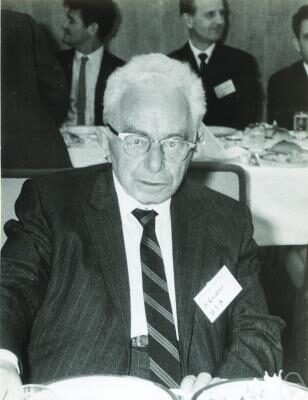
Richard Courant
Richard Courant was a German American mathematician. Born January 8, 1888, in Lubliniec. Died January 27, 1972, in New Rochelle. Known for Courant–Friedrichs–Lewy condition, Courant minimax principle and What Is Mathematics?. Educated at University of Göttingen and University of Wrocław. Awards include Knight Commander's Cross of the Order of Merit of the Federal Republic of Germany and Fellow of the American Physical Society.
Facts
34 facts · 2 confirmed by two sources · 18 cited · 14 from one source
Where this comes from
Papalocal keeps its own record. It started from these sources; what each one said is kept here as it was copied, so a change on their side never changes this page by itself. Tap one to read its version.
What Wikidata says · copied November 15, 2026 · revision 2568908769
- Described as
- German American mathematician (1888-1972)
- Born
- January 8, 1888 · 8 references
- Died
- January 27, 1972 · 9 references
- Born in
- Lubliniec · 2 references
- Died in
- New Rochelle · 2 references
- Citizen of
- Germany · 1 reference; United States · 1 reference
- Occupation
- mathematician · 1 reference; university teacher; physicist · 1 reference
- Political party
- Social Democratic Party of Germany
- Worked for
- New York University (1934–1964) · 1 reference; University of Göttingen (1912–1933) · 1 reference; University of Cambridge (1933–1934) · 1 reference
- Education
- University of Göttingen (1907–1910) · 1 reference; University of Wrocław (1905–1907) · 2 references
- Member of
- Academy of Sciences of the USSR; Accademia Nazionale dei Lincei (1951–) · 1 reference; Russian Academy of Sciences; Royal Netherlands Academy of Arts and Sciences · 1 reference; National Academy of Sciences; Göttingen Academy of Sciences and Humanities in Lower Saxony; American Philosophical Society (1953–)
- Known for
- Courant–Friedrichs–Lewy condition; Courant minimax principle; What Is Mathematics?
- Awards
- Knight Commander's Cross of the Order of Merit of the Federal Republic of Germany; Fellow of the American Physical Society
- Field
- mathematical analysis · 1 reference; mathematics · 1 reference; physics · 1 reference; mathematical physics · 1 reference; calculus of variations · 1 reference; partial differential equation · 1 reference
- Children
- Ernest Courant · 1 reference
- Wikipedias with a page
- 33
Wikidata item Q61046 (wikidata.org/wiki/Q61046), public domain (CC0). Copied November 15, 2026.
What Wikipedia says · copied November 15, 2026 · revision 1382216808
Richard Courant (German: [ˈkuːʁant]; January 8, 1888 – January 27, 1972) was a German-American mathematician. He is best known by the general public for the book What is Mathematics?, co-written with Herbert Robbins. His research focused on the areas of real analysis, mathematical physics, the calculus of variations and partial differential equations. He wrote textbooks widely used by generations of students of physics and mathematics. He is also known for founding the institute now bearing his name at New York University.
- Born, in its opening lines
- January 8, 1888
- Died, in its opening lines
- January 27, 1972
From the Wikipedia article “Richard Courant” (en.wikipedia.org/wiki/Richard_Courant), by its contributors, under CC BY-SA 4.0 (creativecommons.org/licenses/by-sa/4.0/). Copied November 15, 2026; not changed.
Confirmed Two sources agree. Cited One source, and it names where it got it. One source One source, without a reference of its own. Sources disagree The sources disagree. We show the best-supported value and keep theirs below.
