
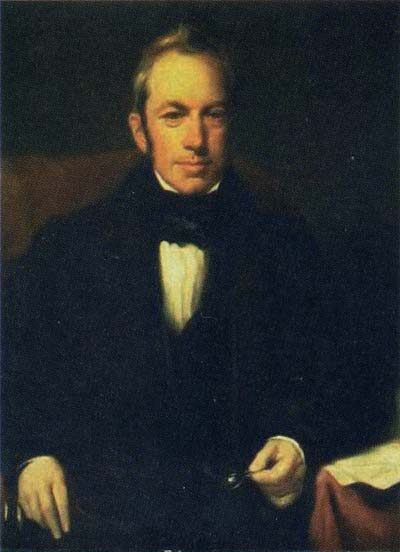
Robert Brown
Robert Brown was a British botanist (1773-1858), discoverer of the cell nucleus and of Brownian Motion. Born December 21, 1773, in Montrose. Died June 10, 1858, in London. Positions held include President of the Linnean Society of London (1849–1853). Educated at Universidad Estatal de Sonora and University of Aberdeen. Awards include Fellow of the Royal Society, Copley Medal and Pour le Mérite for Sciences and Arts order.
Facts
40 facts · 2 confirmed by two sources · 8 cited · 30 from one source
Where this comes from
Papalocal keeps its own record. It started from these sources; what each one said is kept here as it was copied, so a change on their side never changes this page by itself. Tap one to read its version.
What Wikidata says · copied November 16, 2026 · revision 2568748459
- Described as
- British botanist (1773-1858), discoverer of the cell nucleus and of Brownian Motion (1773–1858)
- Other names
- R.Br.
- Born
- December 21, 1773 · 12 references
- Died
- June 10, 1858 · 10 references
- Born in
- Montrose · 3 references
- Died in
- London · 3 references
- Buried in
- Kensal Green Cemetery
- Citizen of
- United Kingdom of Great Britain and Ireland
- Occupation
- botanist · 1 reference; pteridologist; bryologist; surgeon · 1 reference; mycologist; naturalist · 1 reference; botanical collector · 8 references; scientific collector · 1 reference
- Positions held
- President of the Linnean Society of London (1849–1853)
- Worked for
- British Museum
- Education
- Universidad Estatal de Sonora; University of Aberdeen; University of Aberdeen School of Medicine; Montrose Academy; Marischal College
- Member of
- Royal Society of London (1811–); German Academy of Sciences Leopoldina; Royal Swedish Academy of Sciences; Saint Petersburg Academy of Sciences; American Academy of Arts and Sciences; Royal Danish Academy of Sciences and Letters; Royal Prussian Academy of Sciences; Royal Netherlands Academy of Arts and Sciences; Bavarian Academy of Sciences and Humanities; French Academy of Sciences
- Awards
- Fellow of the Royal Society; Copley Medal (1839) · 1 reference; Pour le Mérite for Sciences and Arts order; Honorary Fellow of the Royal Society of Edinburgh; Fellow of the American Academy of Arts and Sciences
- Field
- botany; plant physiology · 1 reference; cryptogam; microscopy
- Wikipedias with a page
- 67
Wikidata item Q155764 (wikidata.org/wiki/Q155764), public domain (CC0). Copied November 16, 2026.
What Wikipedia says · copied November 16, 2026 · revision 1385567566
Robert Brown (21 December 1773 – 10 June 1858) was a Scottish botanist and paleobotanist who made important contributions to botany largely through his pioneering use of the microscope. His contributions include one of the earliest detailed descriptions of the cell nucleus and cytoplasmic streaming; the observation of Brownian motion; early work on plant pollination and fertilisation, including being the first to recognise the fundamental difference between gymnosperms and angiosperms; and some of the earliest studies in palynology. He also made numerous contributions to plant taxonomy, notably erecting a number of plant families that are still accepted today; and numerous Australian plant genera and species, the fruit of his exploration of that continent with Matthew Flinders.
The standard author abbreviation R.Br. is used to indicate this person as the author when citing a botanical name.
- Born, in its opening lines
- December 21, 1773
- Died, in its opening lines
- June 10, 1858
From the Wikipedia article “Robert Brown (botanist, born 1773)” (en.wikipedia.org/wiki/Robert_Brown_(botanist,_born_1773)), by its contributors, under CC BY-SA 4.0 (creativecommons.org/licenses/by-sa/4.0/). Copied November 16, 2026; not changed.
Confirmed Two sources agree. Cited One source, and it names where it got it. One source One source, without a reference of its own. Sources disagree The sources disagree. We show the best-supported value and keep theirs below.
