
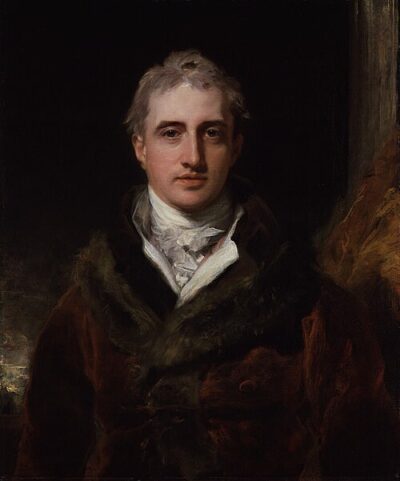
Robert Stewart, Viscount Castlereagh
Robert Stewart, Viscount Castlereagh was a British politician. Born June 18, 1769, in Dublin. Died August 12, 1822, in Loring Hall. Positions held include member of the 4th Parliament of the United Kingdom (1807–1812), Member of Parliament in the Parliament of Ireland and Secretary of State for Foreign and Commonwealth Affairs (1812–1822). Educated at St John's College and The Royal School, Armagh. Awards include Fellow of the Royal Society, Order of the Garter and Knight Grand Cross of the Royal Order of the Welfs.
Facts
39 facts · 2 confirmed by two sources · 13 cited · 24 from one source
Where this comes from
Papalocal keeps its own record. It started from these sources; what each one said is kept here as it was copied, so a change on their side never changes this page by itself. Tap one to read its version.
What Wikidata says · copied November 16, 2026 · revision 2564333731
- Described as
- British politician (1769–1822)
- Other names
- Lord Castlereagh
- Born
- June 18, 1769 · 9 references
- Died
- August 12, 1822 · 8 references
- Born in
- Dublin · 1 reference
- Died in
- Loring Hall
- Buried in
- Westminster Abbey
- Cause of death
- exsanguination
- Citizen of
- United Kingdom of Great Britain and Ireland; Kingdom of Great Britain (–1801)
- Occupation
- politician · 1 reference; diplomat; bretteur
- Positions held
- member of the 4th Parliament of the United Kingdom (1807–1812) · 1 reference; Member of Parliament in the Parliament of Ireland; Secretary of State for Foreign and Commonwealth Affairs (1812–1822); Leader of the House of Commons (1812–1822); Secretary of State for War and the Colonies (1807–1809); President of the Board of Control (1802–1806); Chief Secretary for Ireland (1798–1801); Member of the Privy Council of Ireland; member of the 1st Parliament of the United Kingdom (1801–1802) · 1 reference; member of the 2nd Parliament of the United Kingdom (1802–1806) · 1 reference; member of the 3rd Parliament of the United Kingdom (1806–1807) · 1 reference; member of the 5th Parliament of the United Kingdom (1812–1818) · 1 reference; member of the 6th Parliament of the United Kingdom (1818–1820) · 1 reference; member of the 7th Parliament of the United Kingdom (1820–1821) · 1 reference; member of the 17th Parliament of Great Britain (1794–1796) · 1 reference
- Political party
- Whigs; Tories · 1 reference
- Education
- St John's College · 1 reference; The Royal School, Armagh
- Member of
- Royal Society of London (1802–)
- Awards
- Fellow of the Royal Society; Order of the Garter · 1 reference; Knight Grand Cross of the Royal Order of the Welfs
- Spouse
- Amelia Stewart, Viscountess Castlereagh (1794–) · 2 references
- Father
- Robert Stewart, 1st Marquess of Londonderry · 1 reference
- Mother
- Sarah Seymour · 2 references
- Siblings
- Charles Vane, 3rd Marquess of Londonderry
- Religion
- Presbyterianism
- Wikipedias with a page
- 35
Wikidata item Q333050 (wikidata.org/wiki/Q333050), public domain (CC0). Copied November 16, 2026.
What Wikipedia says · copied November 16, 2026 · revision 1386027902
Robert Stewart, 2nd Marquess of Londonderry (18 June 1769 – 12 August 1822), usually known as Lord Castlereagh, derived from the courtesy title Viscount Castlereagh (UK: KAH-səl-ray) by which he was styled from 1796 to 1821, was a British statesman. As secretary to the Viceroy in Ireland, he worked to suppress the Rebellion of 1798 and to secure passage in 1800 of the Irish Act of Union. As the Foreign Secretary of the United Kingdom from 1812, he was central to the management of the coalition that defeated Napoleon, and was British plenipotentiary at the Congress of Vienna. In the post-war government of Lord Liverpool, Castlereagh was seen to support harsh measures against agitation for reform, and he ended his life an isolated and unpopular figure.
Early in his career in Ireland, and following a visit to revolutionary France, Castlereagh recoiled from the democratic politics of his Presbyterian constituents in Ulster. Crossing the floor of the Irish House of Commons in support of the government, he took a leading role in detaining members of the republican conspiracy, the United Irishmen, his former political associates among them. After the 1798 Rebellion, as Chief Secretary for Ireland he pushed the Act of Union through the Irish Parliament. However, unable to overcome the resistance of King George III to the Catholic Emancipation that they believed should have accompanied the creation of a United Kingdom, both he and Prime Minister William Pitt resigned.
From 1805 Castlereagh served as Secretary of State for War in Pitt's second administration and, from 1806, under the Duke of Portland. In 1809 he was obliged to resign after fighting a duel with the foreign secretary, George Canning. In 1812, Castlereagh returned to government serving Lord Liverpool as Foreign Secretary and as Leader of the House of Commons. Castlereagh organised and financed the alliance that defeated Napoleon, bringing the powers together at the Treaty of Chaumont in 1814.
Following Napoleon's second abdication in 1815, Castlereagh worked with the European courts represented at the Congress of Vienna to frame the territorial, and broadly conservative, continental order that was to hold until mid-century. He resisted the imposition of harsh terms on France, believing that they would upset the European balance of power. After 1815, at home, Castlereagh supported repressive measures that linked him in public opinion to the Peterloo Massacre of 1819. Widely reviled in both Ireland and Great Britain, overworked, and personally distressed, Castlereagh died by suicide in 1822.
- Born, in its opening lines
- June 18, 1769
- Died, in its opening lines
- August 12, 1822
From the Wikipedia article “Robert Stewart, Viscount Castlereagh” (en.wikipedia.org/wiki/Robert_Stewart,_Viscount_Castlereagh), by its contributors, under CC BY-SA 4.0 (creativecommons.org/licenses/by-sa/4.0/). Copied November 16, 2026; not changed.
Confirmed Two sources agree. Cited One source, and it names where it got it. One source One source, without a reference of its own. Sources disagree The sources disagree. We show the best-supported value and keep theirs below.
