
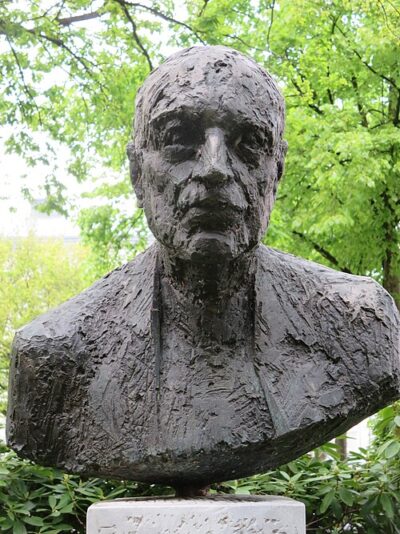
Rudolf Bultmann
Rudolf Bultmann was a German theologian. Born August 20, 1884, in Wiefelstede. Died July 30, 1976, in Marburg. Known for The New Testament and Mythology. Educated at University of Tübingen and University of Marburg. Awards include Commander's Cross of the Order of Merit of the Federal Republic of Germany, Pour le Mérite for Sciences and Arts order and Reuchlin Prize.
Facts
34 facts · 2 confirmed by two sources · 12 cited · 20 from one source
Where this comes from
Papalocal keeps its own record. It started from these sources; what each one said is kept here as it was copied, so a change on their side never changes this page by itself. Tap one to read its version.
What Wikidata says · copied November 16, 2026 · revision 2568959607
- Described as
- German theologian (1884–1976)
- Other names
- Rudolf Karl Bultmann
- Born
- August 20, 1884 · 8 references
- Died
- July 30, 1976 · 7 references
- Born in
- Wiefelstede · 2 references
- Died in
- Marburg · 2 references
- Buried in
- Main Cemetery of Marburg
- Citizen of
- Germany · 1 reference
- Occupation
- theologian · 2 references; university teacher · 1 reference; philosopher · 1 reference; professor · 1 reference; scientist · 1 reference; writer · 1 reference
- Political party
- Social Democratic Party of Germany · 1 reference
- Worked for
- University of Marburg; University of Giessen; University of Wrocław
- Education
- University of Tübingen; University of Marburg; Humboldt-Universität zu Berlin · 1 reference
- Member of
- Heidelberg Academy of Sciences and Humanities (1958–) · 1 reference; Accademia Nazionale dei Lincei (1968–) · 1 reference; Akademische Verbindung Igel Tübingen · 1 reference; Camera obscura Oldenburgensis · 1 reference; Göttingen Academy of Sciences and Humanities in Lower Saxony
- Known for
- The New Testament and Mythology
- Awards
- Commander's Cross of the Order of Merit of the Federal Republic of Germany; Pour le Mérite for Sciences and Arts order (1969); Reuchlin Prize (1957); Great Cross with Star and Sash of the Order of Merit of the Federal Republic of Germany; Goethe-Plakette des Landes Hessen (1954)
- Children
- Antje Bultmann Lemke · 1 reference
- Father
- Arthur Kennedy Bultmann · 1 reference
- Siblings
- Peter Bultmann · 1 reference
- Religion
- liberal Christianity
- Wikipedias with a page
- 51
Wikidata item Q76327 (wikidata.org/wiki/Q76327), public domain (CC0). Copied November 16, 2026.
What Wikipedia says · copied November 16, 2026 · revision 1383901156
Rudolf Karl Bultmann (; German: [ˈbʊltman]; 20 August 1884 – 30 July 1976) was a German Lutheran theologian and professor of the New Testament at the University of Marburg. He was one of the major figures of early 20th-century biblical studies. A prominent critic of liberal theology, Bultmann instead argued for an existentialist interpretation of the New Testament. His hermeneutical approach to the New Testament led him to be a proponent of dialectical theology.
Bultmann is known for his belief that the historical analysis of the New Testament is both futile and unnecessary, given that the earliest Christian literature showed little interest in specific locations. Bultmann argued that all that matters is the "thatness," not the "whatness" of Jesus, i.e. only that Jesus existed, preached, and died by crucifixion matters, not what happened throughout his life.
Bultmann relied on demythologization, an approach interpreting the mythological elements in the New Testament existentially. Bultmann contended that only faith in the kerygma, or proclamation, of the New Testament was necessary for Christian faith, not any particular facts regarding the historical Jesus.
- Born, in its opening lines
- August 20, 1884
- Died, in its opening lines
- July 30, 1976
From the Wikipedia article “Rudolf Bultmann” (en.wikipedia.org/wiki/Rudolf_Bultmann), by its contributors, under CC BY-SA 4.0 (creativecommons.org/licenses/by-sa/4.0/). Copied November 16, 2026; not changed.
Confirmed Two sources agree. Cited One source, and it names where it got it. One source One source, without a reference of its own. Sources disagree The sources disagree. We show the best-supported value and keep theirs below.
