
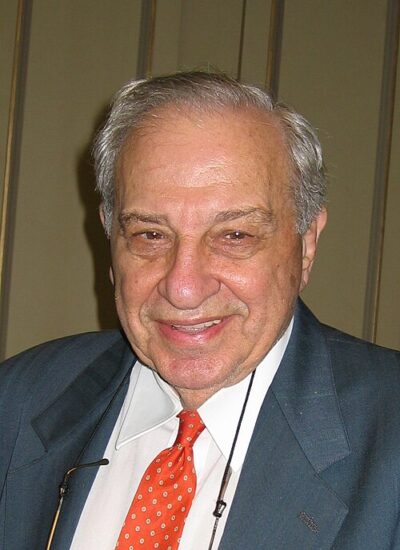
Rudolph A. Marcus
Rudolph A. Marcus was a Canadian-American chemist. Born July 21, 1923, in Montreal. Died July 16, 2026, in Pasadena. Known for Unimolecular Dissociations and Free Radical Recombination Reactions. Educated at McGill University and Baron Byng High School. Awards include Nobel Prize in Chemistry, Willard Gibbs Award and ACS Award in Theoretical Chemistry.
Facts
39 facts · 2 confirmed by two sources · 17 cited · 20 from one source
Where this comes from
Papalocal keeps its own record. It started from these sources; what each one said is kept here as it was copied, so a change on their side never changes this page by itself. Tap one to read its version.
What Wikidata says · copied November 13, 2026 · revision 2565697234
- Described as
- Canadian-American chemist (1923-2026)
- Other names
- Rudolph "Rudy" Arthur Marcus, R. A. Marcus, Rudolph A Marcus, RA Marcus, R.A. Marcus, Rudolph Arthur Marcus, Rudolph Marcus
- Born
- July 21, 1923 · 4 references
- Died
- July 16, 2026 · 3 references
- Born in
- Montreal · 3 references
- Died in
- Pasadena · 1 reference
- Citizen of
- Canada; United States (1958–) · 3 references
- Occupation
- chemist · 2 references; university teacher
- Worked for
- University of Illinois Urbana-Champaign; California Institute of Technology (1978–) · 1 reference; New York University Tandon School of Engineering · 1 reference; University of North Carolina at Chapel Hill (1949–1951) · 1 reference
- Education
- McGill University · 1 reference; Baron Byng High School
- Member of
- Royal Society of London; National Academy of Sciences; Chinese Academy of Sciences; Royal Society of Canada; International Academy of Quantum Molecular Science; American Academy of Arts and Sciences; American Philosophical Society; American Physical Society · 1 reference
- Known for
- Unimolecular Dissociations and Free Radical Recombination Reactions
- Awards
- Nobel Prize in Chemistry (1992) · 2 references; Willard Gibbs Award (1988) · 1 reference; ACS Award in Theoretical Chemistry (1997) · 1 reference; National Medal of Science (1989); Wolf Prize in Chemistry (1984) · 1 reference; Humboldt Research Fellowship; Lavoisier Medal (1994); Centenary Prize (1988); Fellow of the American Physical Society; Irving Langmuir Award in Chemical Physics (1978) · 1 reference; Humboldt Prize; Foreign Member of the Royal Society (1987) · 1 reference; Linus Pauling Award (1991) · 1 reference; Peter Debye Award in Physical Chemistry (1988) · 1 reference; Oesper Award (1997) · 1 reference
- Field
- chemistry
- Wikipedias with a page
- 57
Wikidata item Q239067 (wikidata.org/wiki/Q239067), public domain (CC0). Copied November 13, 2026.
What Wikipedia says · copied November 13, 2026 · revision 1384413656
Rudolph Arthur Marcus (July 21, 1923 – July 16, 2026) was a Canadian-born American chemist who received the 1992 Nobel Prize in Chemistry "for his contributions to the theory of electron transfer reactions in chemical systems". Marcus theory, named after him, provides a thermodynamic and kinetic framework for describing one electron outer-sphere electron transfer. He was a professor at Caltech, Nanyang Technological University, Singapore and a member of the International Academy of Quantum Molecular Science.
- Born, in its opening lines
- July 21, 1923
- Died, in its opening lines
- July 16, 2026
From the Wikipedia article “Rudolph A. Marcus” (en.wikipedia.org/wiki/Rudolph_A._Marcus), by its contributors, under CC BY-SA 4.0 (creativecommons.org/licenses/by-sa/4.0/). Copied November 13, 2026; not changed.
Confirmed Two sources agree. Cited One source, and it names where it got it. One source One source, without a reference of its own. Sources disagree The sources disagree. We show the best-supported value and keep theirs below.
