
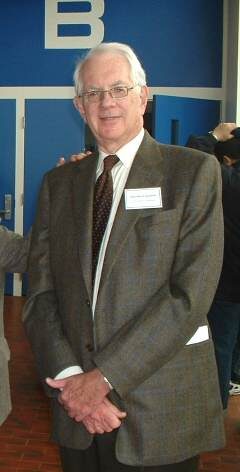
Sheldon Glashow
Sheldon Glashow is an American theoretical physicist. Born December 5, 1932, in New York City. Known for string theory. Educated at Harvard University and Cornell University. Awards include Nobel Prize in Physics, High Energy and Particle Physics Prize and J. Robert Oppenheimer Memorial Prize.
Facts
34 facts · 1 confirmed by two sources · 17 cited · 16 from one source
Where this comes from
Papalocal keeps its own record. It started from these sources; what each one said is kept here as it was copied, so a change on their side never changes this page by itself. Tap one to read its version.
What Wikidata says · copied November 13, 2026 · revision 2566822514
- Described as
- American theoretical physicist
- Other names
- Glashow, Sheldon L. Glashow, Sheldon Lee Glashow
- Born
- December 5, 1932 · 7 references
- Born in
- New York City · 1 reference
- Citizen of
- United States · 1 reference
- Occupation
- physicist · 1 reference; scientist · 2 references; theoretical physicist; university teacher · 1 reference
- Worked for
- Harvard University; Boston University; University of California, Berkeley · 1 reference
- Education
- Harvard University · 1 reference; Cornell University; Bronx High School of Science · 1 reference; Boston University · 1 reference
- Member of
- National Academy of Sciences (1977–); American Academy of Arts and Sciences; Russian Academy of Sciences (1994–); American Philosophical Society · 1 reference; American Association for the Advancement of Science · 1 reference; American Physical Society · 1 reference; Accademia Nazionale dei Lincei (2007–) · 1 reference
- Known for
- string theory · 1 reference
- Awards
- Nobel Prize in Physics (1979) · 2 references; High Energy and Particle Physics Prize (2011) · 1 reference; J. Robert Oppenheimer Memorial Prize (1977); honorary doctor of the Bar-Ilan University; Richtmyer Memorial Lecture Award (1994) · 1 reference; honorary doctor of Yeshiva University; honorary doctorate of the University of the Mediterranean - Aix Marseille II (1982) · 1 reference
- Field
- theoretical physics · 1 reference; electroweak interaction · 1 reference; particle physics · 1 reference; field theory · 1 reference
- Religion
- atheism
- Wikipedias with a page
- 71
Wikidata item Q107420 (wikidata.org/wiki/Q107420), public domain (CC0). Copied November 13, 2026.
What Wikipedia says · copied November 13, 2026 · revision 1381191418
Sheldon Lee Glashow (US: , UK: ; born December 5, 1932) is an American theoretical physicist. He shared the 1979 Nobel Prize in Physics with Abdus Salam and Steven Weinberg "for their contributions to the theory of the unified weak and electromagnetic interaction between elementary particles, including, inter alia, the prediction of the weak neutral current". He is the Metcalf Professor of Mathematics and Physics at Boston University, and a Eugene Higgins Professor of Physics, emeritus, at Harvard University. Glashow is a member of the board of sponsors for the Bulletin of the Atomic Scientists.
- Born, in its opening lines
- December 5, 1932
From the Wikipedia article “Sheldon Glashow” (en.wikipedia.org/wiki/Sheldon_Glashow), by its contributors, under CC BY-SA 4.0 (creativecommons.org/licenses/by-sa/4.0/). Copied November 13, 2026; not changed.
Confirmed Two sources agree. Cited One source, and it names where it got it. One source One source, without a reference of its own. Sources disagree The sources disagree. We show the best-supported value and keep theirs below.
