
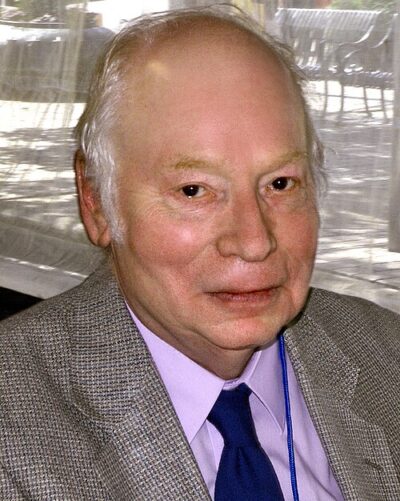
Steven Weinberg
Steven Weinberg was an American theoretical physicist. Born May 3, 1933, in New York City. Died July 23, 2021, in Austin. Educated at Princeton University and Columbia University. Awards include Nobel Prize in Physics, Humanist of the Year and Elliott Cresson Medal.
Facts
47 facts · 2 confirmed by two sources · 23 cited · 22 from one source
Where this comes from
Papalocal keeps its own record. It started from these sources; what each one said is kept here as it was copied, so a change on their side never changes this page by itself. Tap one to read its version.
What Wikidata says · copied November 13, 2026 · revision 2568518686
- Described as
- American theoretical physicist (1933-2021)
- Born
- May 3, 1933 · 8 references
- Died
- July 23, 2021 · 3 references
- Born in
- New York City · 2 references
- Died in
- Austin · 1 reference
- Buried in
- Texas State Cemetery · 1 reference
- Citizen of
- United States
- Occupation
- physicist · 1 reference; writer; university teacher · 1 reference; theoretical physicist; cosmologist
- Worked for
- University of Texas at Austin; Harvard University; University of California, Berkeley; University of Copenhagen Niels Bohr Institute; Massachusetts Institute of Technology · 1 reference
- Education
- Princeton University (–1957) · 1 reference; Columbia University; Cornell University; Bronx High School of Science (–1950)
- Member of
- Royal Society of London (1981–) · 1 reference; National Academy of Sciences (1972–) · 1 reference; American Academy of Arts and Sciences (1968–) · 1 reference; American Philosophical Society (1982–) · 1 reference; Royal Irish Academy (2007–) · 1 reference; International Astronomical Union
- Awards
- Nobel Prize in Physics (1979) · 2 references; Humanist of the Year (2002) · 1 reference; Elliott Cresson Medal (1979) · 1 reference; Oskar Klein Medal (1989) · 1 reference; National Medal of Science (1991); Josiah Willard Gibbs Lectureship (1996) · 1 reference; James Joyce Awards (2009) · 2 references; J. Robert Oppenheimer Memorial Prize (1973); Richtmyer Memorial Lecture Award (1974) · 1 reference; Dannie Heineman Prize for Mathematical Physics (1977) · 1 reference; honorary doctor of the University of Padua; honorary doctorate of the University of Salamanca (1992) · 1 reference; Fellow of the Committee for Skeptical Inquiry; Foreign Member of the Royal Society (1981) · 1 reference; Emperor Has No Clothes Award (1999) · 1 reference
- Field
- theoretical physics; cosmology; physics · 1 reference
- Spouse
- Louise Weinberg (1954–)
- Religion
- atheism
- Lived in
- Austin · 1 reference
- Wikipedias with a page
- 96
Wikidata item Q179282 (wikidata.org/wiki/Q179282), public domain (CC0). Copied November 13, 2026.
What Wikipedia says · copied November 13, 2026 · revision 1382810470
Steven Weinberg (; May 3, 1933 – July 23, 2021) was an American theoretical physicist. He was one of the main developers of the standard model of particle physics.
Weinberg held the Josey Regental Chair in Science at the University of Texas at Austin. His research on elementary particles and physical cosmology was honored with numerous prizes and awards. He shared the 1979 Nobel Prize in Physics with Abdus Salam and Sheldon Glashow for their contributions to the theory of the unified weak and electromagnetic interaction between elementary particles.
Weinberg also had an extensive career as a writer. His first textbook was Gravitation and Cosmology (1972). His three-volume series The Quantum Theory of Fields is considered a classic. He also wrote popular science, beginning with The First Three Minutes. He occasionally wrote articles on various subjects for The New York Review of Books and other periodicals.
- Born, in its opening lines
- May 3, 1933
- Died, in its opening lines
- July 23, 2021
From the Wikipedia article “Steven Weinberg” (en.wikipedia.org/wiki/Steven_Weinberg), by its contributors, under CC BY-SA 4.0 (creativecommons.org/licenses/by-sa/4.0/). Copied November 13, 2026; not changed.
Confirmed Two sources agree. Cited One source, and it names where it got it. One source One source, without a reference of its own. Sources disagree The sources disagree. We show the best-supported value and keep theirs below.
