
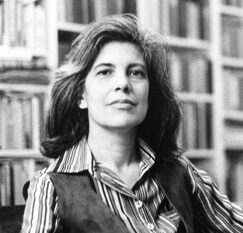
Susan Sontag
Susan Sontag was an American writer and filmmaker, professor, and activist. Born January 16, 1933, in New York City. Died December 28, 2004, in New York City. Known for On Photography, Against Interpretation and Illness as Metaphor. Educated at University of Paris and Harvard University. Awards include George Polk Award, Guggenheim Fellowship (2 times) and National Book Critics Circle Award in Criticism.
Facts
50 facts · 2 confirmed by two sources · 18 cited · 29 from one source · 1 where the sources disagree
What’s different
- Cause of death: we show leukemia (Sources disagree). Wikidata also lists myelodysplastic syndrome
Where this comes from
Papalocal keeps its own record. It started from these sources; what each one said is kept here as it was copied, so a change on their side never changes this page by itself. Tap one to read its version.
What Wikidata says · copied November 13, 2026 · revision 2568758244
- Described as
- American writer and filmmaker, professor, and activist (1933–2004)
- Other names
- Susan Lee Sontag, Susan Rosenblatt, Susan Lee Rosenblatt
- Born
- January 16, 1933 · 12 references
- Died
- December 28, 2004 · 13 references
- Born in
- New York City · 1 reference
- Died in
- New York City · 1 reference
- Buried in
- Montparnasse Cemetery
- Cause of death
- leukemia; myelodysplastic syndrome
- Citizen of
- United States
- Occupation
- writer · 4 references; film director · 1 reference; screenwriter; professor · 1 reference; essayist · 1 reference; novelist · 1 reference; philosopher; literary critic
- Worked for
- Sarah Lawrence College
- Education
- University of Paris; Harvard University · 1 reference; University of Oxford · 1 reference; University of Chicago (1951) · 1 reference; University of California, Berkeley · 1 reference; St Anne's College · 1 reference
- Member of
- American Academy of Arts and Letters; American Academy of Arts and Sciences; Phi Beta Kappa Society; PEN America
- Genre
- essay
- Known for
- On Photography; Against Interpretation; Illness as Metaphor; AIDS and Its Metaphors (1990) · 1 reference; Under the Sign of Saturn
- Awards
- George Polk Award (1965); Guggenheim Fellowship (2 times) (1966, 1975) · 1 reference; National Book Critics Circle Award in Criticism (1977) · 1 reference; National Book Award (2000) · 1 reference; National Book Award for Fiction (2000); Jerusalem Prize (2001); Princess of Asturias Literary Prize (2003); Peace Prize of the German Publishers' and Booksellers' Association (2003) · 1 reference; Harvard Centennial Medal; Commandeur des Arts et des Lettres · 1 reference; MacArthur Fellows Program; Premio Malaparte
- Field
- English-language literature; history; philosophy
- Spouse
- Philip Rieff (1950–1959) · 1 reference
- Children
- David Rieff · 1 reference
- Website
- http://www.susansontag.com
- Wikipedias with a page
- 96
Wikidata item Q152824 (wikidata.org/wiki/Q152824), public domain (CC0). Copied November 13, 2026.
What Wikipedia says · copied November 13, 2026 · revision 1376801555
Susan Lee Sontag (; January 16, 1933 – December 28, 2004) was an American writer and critic. She primarily wrote essays, but also published novels; she published her first major work, the essay "Notes on 'Camp' ", in 1964. Her best-known works include the critical works Against Interpretation (1966), On Photography (1977), Illness as Metaphor (1978) and Regarding the Pain of Others (2003), the short story "The Way We Live Now" (1986) and the novels The Volcano Lover (1992) and In America (1999).
Sontag was active in writing and speaking about, or traveling to, areas of conflict, including during the Vietnam War and the Siege of Sarajevo. She wrote extensively about literature, cinema, photography and media, illness, war, human rights, and left-wing politics. Her essays and speeches drew backlash and controversy, and she has been called "one of the most influential critics of her generation".
- Born, in its opening lines
- January 16, 1933
- Died, in its opening lines
- December 28, 2004
From the Wikipedia article “Susan Sontag” (en.wikipedia.org/wiki/Susan_Sontag), by its contributors, under CC BY-SA 4.0 (creativecommons.org/licenses/by-sa/4.0/). Copied November 13, 2026; not changed.
Confirmed Two sources agree. Cited One source, and it names where it got it. One source One source, without a reference of its own. Sources disagree The sources disagree. We show the best-supported value and keep theirs below.
