
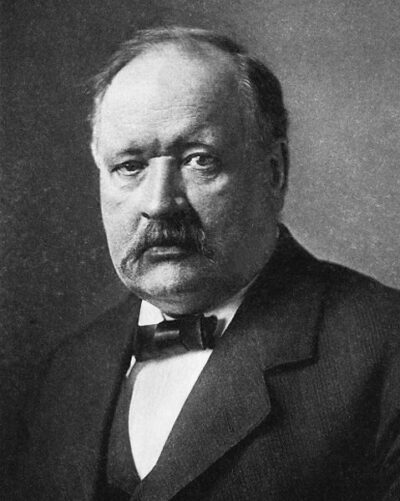
Svante August Arrhenius
Svante August Arrhenius was a Swedish astronomer, chemist and physicist. Born February 19, 1859, in Wik Castle. Died October 2, 1927, in Stockholm. Educated at Uppsala University and Stockholm University. Awards include Faraday Lectureship Prize, Nobel Prize in Chemistry and Willard Gibbs Award.
Facts
53 facts · 2 confirmed by two sources · 12 cited · 39 from one source
Where this comes from
Papalocal keeps its own record. It started from these sources; what each one said is kept here as it was copied, so a change on their side never changes this page by itself. Tap one to read its version.
What Wikidata says · copied November 16, 2026 · revision 2565537807
- Described as
- Swedish astronomer, chemist and physicist (1859–1927)
- Other names
- Arrhenius, Svante Arrhenius
- Born
- February 19, 1859 · 14 references
- Died
- October 2, 1927 · 15 references
- Born in
- Wik Castle · 1 reference
- Died in
- Stockholm · 3 references
- Buried in
- Uppsala Old Cemetery (1927) · 2 references
- Cause of death
- functional gastrointestinal disorder
- Name at birth
- Svante August Arrhenius
- Citizen of
- Sweden
- Occupation
- astronomer; chemist · 3 references; physicist · 1 reference; university teacher
- Worked for
- Riga Technical University; Stockholm University; Uppsala University · 1 reference
- Education
- Uppsala University; Stockholm University · 1 reference
- Member of
- Royal Society of London (1910–); Royal Swedish Academy of Sciences; Göttingen Academy of Sciences and Humanities in Lower Saxony; Saint Petersburg Academy of Sciences; American Academy of Arts and Sciences; Norwegian Academy of Science and Letters; Royal Netherlands Academy of Arts and Sciences; Royal Physiographic Society in Lund; Royal Swedish Academy of Engineering Sciences; Royal Society of Arts and Sciences in Gothenburg
- Awards
- Faraday Lectureship Prize (1914); Nobel Prize in Chemistry (1903) · 2 references; Willard Gibbs Award (1911) · 1 reference; honorary doctor of the University of Edinburgh; Davy Medal (1902) · 1 reference; Silliman Memorial Lectures (1910); Franklin Medal (1920); honorary doctorate from the University of Cambridge; Honorary doctor of the University of Groningen; Honorary doctor of the Heidelberg University (1903); honorary doctor of the Leipzig University; Honorary doctor of the University of Oxford; honorary doctor of the University of Birmingham; Fellow of the American Academy of Arts and Sciences; Foreign Member of the Royal Society (1910) · 1 reference
- Field
- physics; chemistry; climate change; greenhouse effect
- Spouse
- Maria Arrhenius (1905–); Sofia Rudbeck (1894–)
- Children
- Olof Arrhenius · 1 reference; Anna-Lisa Arrhenius
- Father
- Svanta Gustav Arrhenius · 1 reference
- Mother
- Carolina Christina Thunberg · 1 reference
- Religion
- atheism
- Wikipedias with a page
- 104
Wikidata item Q80956 (wikidata.org/wiki/Q80956), public domain (CC0). Copied November 16, 2026.
What Wikipedia says · copied November 16, 2026 · revision 1378807281
Svante August Arrhenius (19 February 1859 – 2 October 1927) was a Swedish scientist. Originally a physicist, but often referred to as a chemist, Arrhenius was one of the founders of the science of physical chemistry. In 1903, he received the Nobel Prize in Chemistry, becoming the first Swedish Nobel laureate. In 1905, he became the director of the Nobel Institute, where he remained until his death.
Arrhenius was the first to use the principles of physical chemistry to estimate the extent to which increases in the atmospheric carbon dioxide are responsible for the Earth's increasing surface temperature. His work played an important role in the emergence of modern climate science. In the 1960s, Charles David Keeling reliably measured the level of carbon dioxide present in the air showing it was increasing and that, according to the greenhouse hypothesis, it was sufficient to cause significant global warming.
The Arrhenius equation, Arrhenius acid, Arrhenius base, lunar crater Arrhenius, Martian crater Arrhenius, the mountain of Arrheniusfjellet, and the Arrhenius Labs at Stockholm University were so named to commemorate his contributions to science.
- Born, in its opening lines
- February 19, 1859
- Died, in its opening lines
- October 2, 1927
From the Wikipedia article “Svante Arrhenius” (en.wikipedia.org/wiki/Svante_Arrhenius), by its contributors, under CC BY-SA 4.0 (creativecommons.org/licenses/by-sa/4.0/). Copied November 16, 2026; not changed.
Confirmed Two sources agree. Cited One source, and it names where it got it. One source One source, without a reference of its own. Sources disagree The sources disagree. We show the best-supported value and keep theirs below.
