
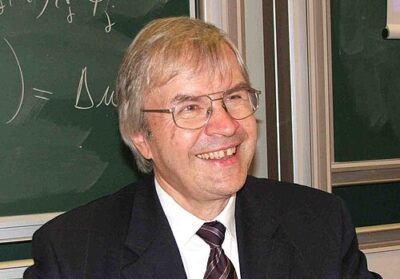
Theodor W. Hänsch
Theodor W. Hänsch is a German physicist and nobel laureate. Born October 30, 1941, in Heidelberg. Positions held include professor. Educated at Heidelberg University and Stanford University. Awards include Bayerische Verfassungsmedaille in Gold, Knight Commander's Cross of the Order of Merit of the Federal Republic of Germany and Pour le Mérite for Sciences and Arts order.
Facts
44 facts · 1 confirmed by two sources · 14 cited · 29 from one source
Where this comes from
Papalocal keeps its own record. It started from these sources; what each one said is kept here as it was copied, so a change on their side never changes this page by itself. Tap one to read its version.
What Wikidata says · copied November 13, 2026 · revision 2565608212
- Described as
- German physicist and nobel laureate (born 1941)
- Other names
- Theodor Hänsch, Theodor Hansch, Theodor Wolfgang Hänsch, Theodor Wolfgang Hansch, Theodore Wolfgang Hansch, Theodor W. Hansch, Theodor Haensch, Theodore Wolfgang Hänsch, T. W. Hänsch, Th. W. Hänsch, Hänsch, Theodor W., Theodorus Wolfgangus Hänsch
- Born
- October 30, 1941 · 4 references
- Born in
- Heidelberg
- Citizen of
- Germany · 1 reference; United States · 1 reference
- Occupation
- physicist; university teacher
- Positions held
- professor
- Worked for
- LMU Munich; Stanford University; Heidelberg University · 1 reference; Max Planck Institute of Quantum Optics; University of Florence
- Education
- Heidelberg University; Stanford University; LMU Munich; Helmholtz-Gymnasium Heidelberg
- Member of
- German Academy of Sciences Leopoldina · 1 reference; Accademia Nazionale dei Lincei (2002–) · 1 reference; Pontifical Academy of Sciences; National Academy of Sciences (2001–) · 1 reference; Bavarian Academy of Sciences and Humanities; Berlin-Brandenburg Academy of Sciences and Humanities; French Academy of Sciences; American Academy of Arts and Sciences; American Physical Society · 1 reference; Academia Europaea (2009–) · 1 reference
- Awards
- Bayerische Verfassungsmedaille in Gold (2010) · 1 reference; Knight Commander's Cross of the Order of Merit of the Federal Republic of Germany (2006) · 1 reference; Pour le Mérite for Sciences and Arts order (2008) · 1 reference; Nobel Prize in Physics (2005) · 2 references; Rudolf-Diesel-Medaille (2006) · 2 references; Frederic Ives Medal (2005) · 1 reference; Stern–Gerlach Medal (2000); Otto Hahn Prize (2005); Albert A. Michelson Medal (1986); King Faisal Prize in Science (1989); Alfried-Krupp Science Prize (2002); Wilhelm Exner Medal (2012) · 1 reference; Bavarian Maximilian Order for Science and Art (2003); Gottfried Wilhelm Leibniz Prize (1989); Matteucci Medal (2001)
- Field
- physics
- Website
- http://www.mpq.mpg.de/~haensch/; http://www.mpq.mpg.de/~haensch/htm_neu/HaenschCV.html · 1 reference
- Wikipedias with a page
- 68
Wikidata item Q71013 (wikidata.org/wiki/Q71013), public domain (CC0). Copied November 13, 2026.
What Wikipedia says · copied November 13, 2026 · revision 1383150346
Theodor Wolfgang Hänsch (German pronunciation: [ˈteːodoːɐ̯ ˈhɛnʃ] ; born 30 October 1941) is a German physicist. He received one-fourth of the 2005 Nobel Prize in Physics for "contributions to the development of laser-based precision spectroscopy, including the optical frequency comb technique", sharing the prize with John L. Hall and Roy J. Glauber. (Glauber received a half share of the prize; Hall and Hänsch split the other half share.)
Hänsch is Director of the Max-Planck-Institut für Quantenoptik (quantum optics) and Professor of experimental physics and laser spectroscopy at LMU Munich in Munich, Bavaria, Germany.
- Born, in its opening lines
- October 30, 1941
From the Wikipedia article “Theodor W. Hänsch” (en.wikipedia.org/wiki/Theodor_W._Hänsch), by its contributors, under CC BY-SA 4.0 (creativecommons.org/licenses/by-sa/4.0/). Copied November 13, 2026; not changed.
Confirmed Two sources agree. Cited One source, and it names where it got it. One source One source, without a reference of its own. Sources disagree The sources disagree. We show the best-supported value and keep theirs below.
