
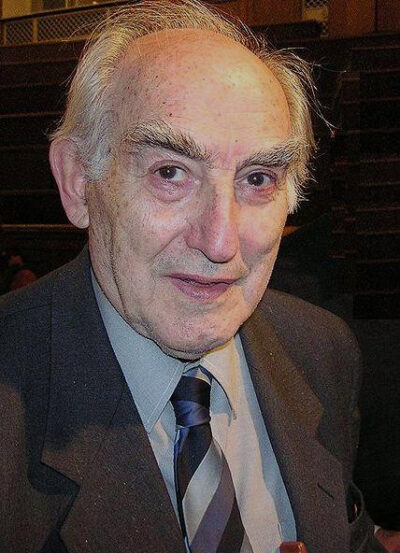
Vitaly Ginzburg
Vitaly Ginzburg was a Russian physicist. Born October 4, 1916, in Moscow. Died November 8, 2009, in Moscow. Educated at MSU Faculty of Physics and Lomonosov Moscow State University. Awards include Order of Lenin, UNESCO Niels Bohr Medal and Order of the Badge of Honour.
Facts
51 facts · 2 confirmed by two sources · 19 cited · 30 from one source
Where this comes from
Papalocal keeps its own record. It started from these sources; what each one said is kept here as it was copied, so a change on their side never changes this page by itself. Tap one to read its version.
What Wikidata says · copied November 16, 2026 · revision 2568912806
- Described as
- Russian physicist (1916–2009)
- Other names
- Vitaly L. Ginzburg, Vitaly Lazarevich Ginzburg
- Born
- October 4, 1916 · 2 references
- Died
- November 8, 2009 · 9 references
- Born in
- Moscow · 6 references
- Died in
- Moscow · 4 references
- Buried in
- Novodevichy Cemetery · 1 reference
- Cause of death
- heart failure
- Citizen of
- Soviet Union; Russia · 3 references
- Occupation
- physicist · 4 references; astrophysicist; inventor; university teacher; scientist · 3 references; theoretical physicist
- Political party
- Communist Party of the Soviet Union
- Worked for
- Lebedev Physical Institute
- Education
- MSU Faculty of Physics; Lomonosov Moscow State University · 1 reference
- Member of
- Royal Society of London (1987–) · 1 reference; National Academy of Sciences (1981–) · 2 references; Russian Academy of Sciences (1953–) · 1 reference; Academy of Sciences of Moldova; American Academy of Arts and Sciences; Indian National Science Academy; Academia Europaea (1990–) · 1 reference; European Academy of Sciences (2004–) · 1 reference; Academy of Sciences of the USSR · 1 reference; International Astronomical Union
- Awards
- Order of Lenin (1954) · 1 reference; UNESCO Niels Bohr Medal (1998); Order of the Badge of Honour; Nobel Prize in Physics (2003) · 2 references; Order "For Merit to the Fatherland", 1st class (2006) · 1 reference; Order "For Merit to the Fatherland", 3rd class (1996) · 1 reference; Gold Medal of the Royal Astronomical Society (1991); Lomonosov Gold Medal (1995) · 1 reference; Wolf Prize in Physics (1995) · 1 reference; Order of the Red Banner of Labour; Medal "For Valiant Labour in the Great Patriotic War 1941–1945"; Lenin Prize (1966) · 1 reference; Jubilee Medal "In Commemoration of the 100th Anniversary of the Birth of Vladimir Ilyich Lenin" (1970); Medal "In Commemoration of the 800th Anniversary of Moscow" (1948); Fellow of the American Physical Society (2003) · 1 reference
- Field
- theoretical physics; physics · 1 reference; astrophysics · 1 reference
- Spouse
- Olga Zamsha Ginzburg; Nina Yermakova Ginzburg
- Religion
- atheism · 1 reference
- Lived in
- Soviet Union · 1 reference; Klykovka, Kazan · 1 reference
- Wikipedias with a page
- 87
Wikidata item Q104668 (wikidata.org/wiki/Q104668), public domain (CC0). Copied November 16, 2026.
What Wikipedia says · copied November 16, 2026 · revision 1380544155
Vitaly Lazarevich Ginzburg ForMemRS (Russian: Вита́лий Ла́заревич Ги́нзбург; 4 October [O.S. 21 September] 1916 – 8 November 2009) was a Russian physicist who was honored with the Nobel Prize in Physics in 2003, together with Alexei Abrikosov and Anthony Leggett for their "pioneering contributions to the theory of superconductors and superfluids."
He spent his career in the former Soviet Union and was one of the leading figure in former Soviet program of nuclear weapons, working towards designs of the thermonuclear devices. He became a member of the Russian Academy of Sciences and succeeded Igor Tamm as head of the Department of Theoretical Physics of the Lebedev Physical Institute of the Russian Academy of Sciences (FIAN). After the fall of the Soviet-Union Ginzburg presented himself as an atheist and became an outspoken critic of the Russian Orthodox clergy's influence in Russian society. Yet simultaneously, he publicly identified as an agnostic Jew, served on the board of directors of the Russian Jewish Congress, vocally fought what he considered anti-semitism in Russian society and was a very active supporter and fundraiser for Israel and Zionist causes.
- Born, in its opening lines
- October 4, 1916
- Died, in its opening lines
- November 8, 2009
From the Wikipedia article “Vitaly Ginzburg” (en.wikipedia.org/wiki/Vitaly_Ginzburg), by its contributors, under CC BY-SA 4.0 (creativecommons.org/licenses/by-sa/4.0/). Copied November 16, 2026; not changed.
Confirmed Two sources agree. Cited One source, and it names where it got it. One source One source, without a reference of its own. Sources disagree The sources disagree. We show the best-supported value and keep theirs below.
