
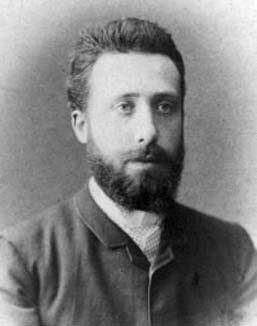
Vito Volterra
Vito Volterra was an Italian mathematician and mathematical physicist. Born May 3, 1860, in Ancona. Died October 11, 1940, in Rome. Positions held include senator of the Kingdom of Italy (1905–), President of the Accademia Nazionale dei Lincei (1923–1926) and chairperson (1924–1927). Known for Lotka–Volterra equations, Smith–Volterra–Cantor set and Volterra integral equation. Educated at Scuola Normale Superiore and University of Pisa. Awards include Order of Leopold, Royal Order of the Polar Star and Mathematical Prize of the Italian Academy of Sciences.
Facts
50 facts · 2 confirmed by two sources · 22 cited · 26 from one source
Where this comes from
Papalocal keeps its own record. It started from these sources; what each one said is kept here as it was copied, so a change on their side never changes this page by itself. Tap one to read its version.
What Wikidata says · copied November 16, 2026 · revision 2568765470
- Described as
- Italian mathematician and mathematical physicist (1860-1940)
- Born
- May 3, 1860 · 8 references
- Died
- October 11, 1940 · 9 references
- Born in
- Ancona · 4 references
- Died in
- Rome · 4 references
- Buried in
- Ariccia cemetery · 1 reference
- Name at birth
- Samuel Giuseppe Vito Volterra · 1 reference
- Citizen of
- Kingdom of Italy (1861–)
- Occupation
- mathematician · 1 reference; physicist · 1 reference; university teacher; politician
- Positions held
- senator of the Kingdom of Italy (1905–) · 1 reference; President of the Accademia Nazionale dei Lincei (1923–1926) · 2 references; chairperson (1924–1927) · 1 reference
- Worked for
- University of Turin (1893–1900); University of Pisa (1882–1893); Sapienza University of Rome (1900–1931)
- Education
- Scuola Normale Superiore (1879–1882) · 2 references; University of Pisa (1878–1879) · 2 references; Lc Dante (–1870) · 2 references; Liceo classico statale Galileo (1870–1873) · 2 references
- Member of
- Royal Society of London (1910–) · 2 references; Academy of Sciences of the USSR; Saint Petersburg Academy of Sciences; Royal Swedish Academy of Sciences; Pontifical Academy of Sciences (1936–) · 1 reference; Hungarian Academy of Sciences; Russian Academy of Sciences; German Academy of Sciences Leopoldina; Accademia Nazionale delle Scienze detta dei XL; Royal Society of Edinburgh (1913–) · 1 reference
- Known for
- Lotka–Volterra equations; Smith–Volterra–Cantor set; Volterra integral equation; Volterra series; Volterra operator; Volterra space; Volterra's function; Volterra lattice
- Awards
- Order of Leopold; Royal Order of the Polar Star; Mathematical Prize of the Italian Academy of Sciences (1887) · 1 reference; doctor honoris causa from the University of Paris (1919) · 1 reference; honorary doctorate from the University of Strasbourg (1920) · 2 references; honorary doctor of the University of St Andrews (1938) · 1 reference; Fellow of the Royal Society (1910) · 1 reference; Knight of the Order of the Crown of Italy (1891) · 1 reference
- Field
- mathematical analysis; functional analysis
- Children
- Edoardo Volterra · 1 reference
- Wikipedias with a page
- 48
Wikidata item Q216812 (wikidata.org/wiki/Q216812), public domain (CC0). Copied November 16, 2026.
What Wikipedia says · copied November 16, 2026 · revision 1384081879
Vito Volterra (, Italian: [ˈviːto volˈtɛrra]; 3 May 1860 – 11 October 1940) was an Italian mathematician and physicist, known for his contributions to mathematical biology and integral equations, being one of the founders of functional analysis.
- Born, in its opening lines
- May 3, 1860
- Died, in its opening lines
- October 11, 1940
From the Wikipedia article “Vito Volterra” (en.wikipedia.org/wiki/Vito_Volterra), by its contributors, under CC BY-SA 4.0 (creativecommons.org/licenses/by-sa/4.0/). Copied November 16, 2026; not changed.
Confirmed Two sources agree. Cited One source, and it names where it got it. One source One source, without a reference of its own. Sources disagree The sources disagree. We show the best-supported value and keep theirs below.
