
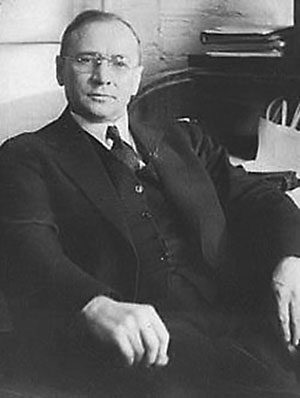
Vladimir K. Zworykin
Vladimir K. Zworykin was a Russian-American engineer. Born July 17, 1888, in Murom. Died July 29, 1982, in Princeton. Educated at St. Petersburg Practical Institute of Technology. Awards include Edison Medal, IEEE Medal of Honor and Howard N. Potts Medal.
Facts
41 facts · 0 confirmed by two sources · 21 cited · 19 from one source · 1 where the sources disagree
What’s different
- Born: we show July 17, 1888 (Sources disagree). Wikidata also lists July 30, 1889
Where this comes from
Papalocal keeps its own record. It started from these sources; what each one said is kept here as it was copied, so a change on their side never changes this page by itself. Tap one to read its version.
What Wikidata says · copied November 13, 2026 · revision 2558274626
- Described as
- Russian-American engineer (1888–1982)
- Other names
- Vladimir Kosmich Zworykin, Vladimir Koz'mich Zworykin, Vladimir Zworykin, Vladimir Kosmich Zvorykin, Vladimir Kosma Zworykin, Wladimir Kosmitsch Zworykin
- Born
- July 17, 1888; July 30, 1889
- Died
- July 29, 1982 · 5 references
- Born in
- Murom · 2 references
- Died in
- Princeton · 2 references
- Buried in
- Princeton Cemetery · 1 reference
- Citizen of
- Russian Empire; Russian Republic; Siberian Republic; Russian State
- Occupation
- engineer; physicist; inventor; electrical engineer · 1 reference
- Education
- St. Petersburg Practical Institute of Technology (–1912)
- Member of
- American Physical Society (1931–) · 1 reference; American Academy of Arts and Sciences; National Academy of Sciences (1943–) · 1 reference; National Academy of Engineering (1965–) · 1 reference; American Philosophical Society (1948–)
- Awards
- Edison Medal (1952) · 1 reference; IEEE Medal of Honor (1951) · 1 reference; Howard N. Potts Medal (1947) · 1 reference; Faraday Medal (1965); National Medal of Science (1966); Rumford Prize (1941) · 1 reference; National Inventors Hall of Fame (1977) · 1 reference; IEEE Morris N. Liebmann Memorial Award (1934) · 1 reference; IEEE Lamme Medal (1948) · 1 reference; Progress Medal (SMPTE) (1950) · 2 references; Maxwell Lecture (1959); National Academy of Engineering Founders Award (1968); Fellow of the American Physical Society; Eduard Rhein Ring of Honor (1980); Trustees Award (1984) · 2 references
- Field
- electrical engineering; physics · 1 reference; technology of television · 1 reference; television transmitter · 1 reference; television · 1 reference; electron microscopy · 2 references
- Religion
- Eastern Orthodox Church
- Wikipedias with a page
- 41
Wikidata item Q296545 (wikidata.org/wiki/Q296545), public domain (CC0). Copied November 13, 2026.
What Wikipedia says · copied November 13, 2026 · revision 1384151896
Vladimir Kosma Zworykin (1888/1889 – July 29, 1982) was a Russian-American inventor, engineer, and pioneer of television technology. Zworykin invented a television transmitting and receiving system employing cathode-ray tubes. He played a role in the practical development of television from the early thirties, including charge storage-type tubes, infrared image tubes and the electron microscope.
From the Wikipedia article “Vladimir K. Zworykin” (en.wikipedia.org/wiki/Vladimir_K._Zworykin), by its contributors, under CC BY-SA 4.0 (creativecommons.org/licenses/by-sa/4.0/). Copied November 13, 2026; not changed.
Confirmed Two sources agree. Cited One source, and it names where it got it. One source One source, without a reference of its own. Sources disagree The sources disagree. We show the best-supported value and keep theirs below.
