
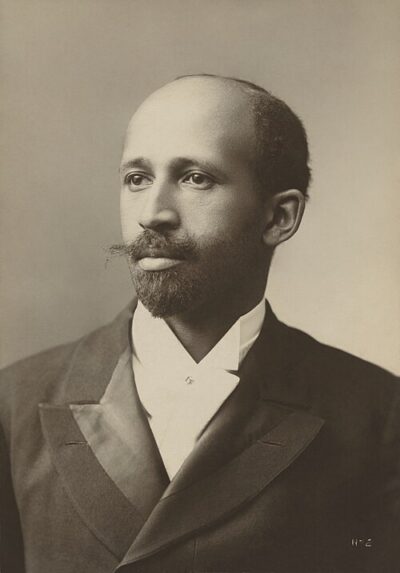
W. E. B. Du Bois
W. E. B. Du Bois was an American sociologist and activist. Born February 23, 1868, in Great Barrington. Died August 27, 1963, in Accra. Positions held include civil rights advocate. Known for The Souls of Black Folk, John Brown and Black Reconstruction. Educated at Fisk University and Harvard University. Awards include Lenin Peace Prize, Spingarn Medal and National Association of Black Journalists Hall of Fame.
Facts
49 facts · 2 confirmed by two sources · 16 cited · 31 from one source
Where this comes from
Papalocal keeps its own record. It started from these sources; what each one said is kept here as it was copied, so a change on their side never changes this page by itself. Tap one to read its version.
What Wikidata says · copied November 13, 2026 · revision 2568487591
- Described as
- American sociologist and activist (1868–1963)
- Other names
- W.E.B. du Bois, WEB Du Bois, W.E.B. Du Bois, W. E. B. du Bois, William Edward Burghardt Du Bois
- Born
- February 23, 1868 · 7 references
- Died
- August 27, 1963 · 12 references
- Born in
- Great Barrington · 2 references
- Died in
- Accra · 4 references
- Buried in
- Osu Castle (–1985); W.E.B. Dubois Memorial Centre for Pan African Culture (1985–) · 1 reference
- Citizen of
- United States (1868–); Ghana (1961–) · 1 reference
- Occupation
- historian · 3 references; novelist · 1 reference; philosopher · 1 reference; writer · 2 references; sociologist · 3 references; social worker; human rights defender; photographer
- Positions held
- civil rights advocate
- Political party
- Socialist Party of America
- Worked for
- The New School; Wilberforce University · 2 references; University of Georgia; University of Pennsylvania (1896–1897) · 1 reference; Clark Atlanta University · 1 reference
- Education
- Fisk University (–1888) · 1 reference; Harvard University (–1896) · 1 reference; Humboldt-Universität zu Berlin (1892–1894) · 1 reference; Heidelberg University · 1 reference; Searles High School
- Member of
- German Academy of Sciences at Berlin; Hungarian Academy of Sciences; Alpha Phi Alpha; NAACP; American Academy of Arts and Letters
- Known for
- The Souls of Black Folk; John Brown; Black Reconstruction · 1 reference; Dusk of Dawn · 1 reference; The Philadelphia Negro · 1 reference
- Awards
- Lenin Peace Prize (1959); Spingarn Medal (1920) · 1 reference; National Association of Black Journalists Hall of Fame (2004)
- Field
- civil and political rights · 1 reference
- Spouse
- Nina Gomer Du Bois (1896–1950); Shirley Graham Du Bois (1951–) · 2 references
- Children
- Nina Yolande Du Bois
- Lived in
- Atlanta · 1 reference; Ghana (1961–) · 1 reference; Berlin · 1 reference; Accra (1961–) · 1 reference
- Wikipedias with a page
- 76
Wikidata item Q158060 (wikidata.org/wiki/Q158060), public domain (CC0). Copied November 13, 2026.
What Wikipedia says · copied November 13, 2026 · revision 1383255895
William Edward Burghardt Du Bois ( doo-BOYSS; February 23, 1868 – August 27, 1963) was an American sociologist, writer, historian, and Pan-Africanist civil rights activist. Born in Great Barrington, Massachusetts, Du Bois grew up in a relatively tolerant and integrated community. He completed graduate work at Harvard University, where he was the first African American to earn a doctorate. He was a professor at Atlanta University and over the course of his life wrote many books and articles. He spent the last years of his life in Ghana and died in Accra on August 27, 1963.
Du Bois rose to national prominence as a leader of the Niagara Movement, a group of black civil rights activists seeking equal rights. Du Bois and his supporters opposed the Atlanta Compromise. Instead, Du Bois insisted on full civil rights and increased political representation, which he believed would be brought about by the African-American intellectual elite. He referred to this group as the talented tenth, a concept under the umbrella of racial uplift, and believed that African Americans needed the chance for advanced education to develop their leadership. Du Bois was one of the founders of the National Association for the Advancement of Colored People (NAACP) in 1909. Du Bois used his position in the NAACP to respond to racist incidents.
He was a proponent of Pan-Africanism and helped organize several meetings of the Pan-African Congress to fight for the independence of African colonies from European powers. Du Bois made several trips to Europe, Africa and Asia. After the First World War, he attended the Pan-African Congresses, embraced socialism and became a professor at Atlanta University. Once the Second World War had ended, he engaged in peace activism and was targeted by the Federal Bureau of Investigation. Du Bois believed that capitalism was a primary cause of racism, and he was sympathetic to socialist causes.
Du Bois was a prolific author. He primarily targeted racism in his writing, which protested strongly against lynching, Jim Crow laws, and racial discrimination in important social institutions. His cause included people of color everywhere, particularly Africans and Asians in colonies. His collection of essays, The Souls of Black Folk, is a seminal work in African-American literature; and his 1935 magnum opus, Black Reconstruction in America, challenged the prevailing orthodoxy that blacks were responsible for the failures of the Reconstruction era. Borrowing a phrase from Frederick Douglass, he popularized the use of the term color line to represent the injustice of the separate but equal doctrine prevalent in American social and political life. His 1940 autobiography Dusk of Dawn is regarded in part as one of the first scientific treatises in the field of American sociology. In his role as editor of the NAACP's journal The Crisis, he published many influential pieces.
- Born, in its opening lines
- February 23, 1868
- Died, in its opening lines
- August 27, 1963
From the Wikipedia article “W. E. B. Du Bois” (en.wikipedia.org/wiki/W._E._B._Du_Bois), by its contributors, under CC BY-SA 4.0 (creativecommons.org/licenses/by-sa/4.0/). Copied November 13, 2026; not changed.
Confirmed Two sources agree. Cited One source, and it names where it got it. One source One source, without a reference of its own. Sources disagree The sources disagree. We show the best-supported value and keep theirs below.
