
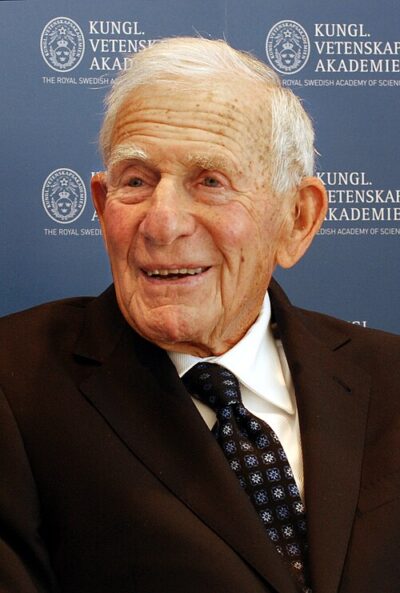
Walter Munk
Walter Munk was an American oceanographer. Born October 19, 1917, in Vienna. Died February 8, 2019, in La Jolla. Educated at California Institute of Technology and Columbia University. Awards include Guggenheim Fellowship, Arthur L. Day Medal and William Bowie Medal.
Facts
43 facts · 2 confirmed by two sources · 19 cited · 22 from one source
Where this comes from
Papalocal keeps its own record. It started from these sources; what each one said is kept here as it was copied, so a change on their side never changes this page by itself. Tap one to read its version.
What Wikidata says · copied November 16, 2026 · revision 2568847632
- Described as
- American oceanographer (1917–2019)
- Other names
- Walter Heinrich Munk, Walter H. Munk, Walter H Munk, W. H. Munk, W H Munk, W. Munk, W Munk, Munk, Munk W, Munk W., Munk W. H., Munk WH
- Born
- October 19, 1917 · 4 references
- Died
- February 8, 2019 · 2 references
- Born in
- Vienna · 1 reference
- Died in
- La Jolla · 1 reference
- Name at birth
- Walter Heinrich Munk
- Citizen of
- United States; Austria
- Occupation
- oceanographer · 1 reference; university teacher; physicist; geophysicist · 2 references
- Worked for
- University of California, San Diego
- Education
- California Institute of Technology; Columbia University; University of California, Los Angeles (–1947) · 1 reference; Scripps Institution of Oceanography
- Member of
- Royal Society of London; German Academy of Sciences Leopoldina (1970–) · 1 reference; National Academy of Sciences (1956–) · 1 reference; American Academy of Arts and Sciences (1957–) · 1 reference; Russian Academy of Sciences (1994–) · 1 reference; JASON (1960–) · 1 reference; European Academy of Sciences (2007–) · 1 reference
- Awards
- Guggenheim Fellowship (1948) · 1 reference; Arthur L. Day Medal (1965) · 1 reference; William Bowie Medal (1989) · 2 references; Captain Robert Dexter Conrad Award (1978) · 1 reference; Gold Medal of the Royal Astronomical Society (1968); Alexander Agassiz Medal (1976) · 1 reference; National Medal of Science (1983); Josiah Willard Gibbs Lectureship (1970); Vetlesen Prize (1993) · 1 reference; Kyoto Prize in Basic Sciences (1999) · 1 reference; Royal Society Bakerian Medal (1986) · 1 reference; Crafoord Prize in Geosciences (2010) · 1 reference; Foreign Member of the Royal Society (1976) · 1 reference; Maurice Ewing Medal (1976) · 1 reference; Royal Society Bakerian Medal
- Field
- oceanography; ocean current · 1 reference; geophysics · 1 reference
- Lived in
- Vienna; California
- Wikipedias with a page
- 20
Wikidata item Q113081 (wikidata.org/wiki/Q113081), public domain (CC0). Copied November 16, 2026.
What Wikipedia says · copied November 16, 2026 · revision 1385846620
Walter Heinrich Munk (October 19, 1917 – February 8, 2019) was an American physical oceanographer. He was one of the first scientists to bring statistical methods to the analysis of oceanographic data. Munk worked on a wide range of topics, including surface waves, geophysical implications of variations in the Earth's rotation, tides, internal waves, deep-ocean drilling into the sea floor, acoustical measurements of ocean properties, sea level rise, and climate change. His work won awards including the National Medal of Science, the Kyoto Prize, and induction to the French Legion of Honour.
Munk's career began before the outbreak of World War II and ended nearly 80 years later with his death in 2019. The war interrupted his doctoral studies at the Scripps Institution of Oceanography (Scripps), and led to his participation in U.S. military research efforts. Munk and his doctoral advisor Harald Sverdrup developed methods for forecasting wave conditions which were used in support of beach landings in all theaters of the war. He was involved with oceanographic programs during the atomic bomb tests in Bikini Atoll.
Beginning in 1975, Munk and Carl Wunsch developed ocean acoustic tomography to exploit the ease with which sound travels in the ocean and use acoustical signals for measurement of broad-scale temperature and current. In a 1991 experiment, Munk and his collaborators investigated the ability of underwater sound to propagate from the Southern Indian Ocean across all ocean basins, with the aim of measuring global ocean temperature. The experiment was criticized by environmental groups, who expected that the loud acoustic signals would adversely affect marine life. Munk continued to develop and advocate for acoustical measurements of the ocean throughout his career.
For most of his career, he was a professor of geophysics at Scripps. Additionally, Munk and his wife Judy were active in developing the Scripps campus and integrating it with the new University of California, San Diego. Munk's career included being a member of the JASON think tank, and holding the Secretary of the Navy/Chief of Naval Operations Oceanography Chair.
- Born, in its opening lines
- October 19, 1917
- Died, in its opening lines
- February 8, 2019
From the Wikipedia article “Walter Munk” (en.wikipedia.org/wiki/Walter_Munk), by its contributors, under CC BY-SA 4.0 (creativecommons.org/licenses/by-sa/4.0/). Copied November 16, 2026; not changed.
Confirmed Two sources agree. Cited One source, and it names where it got it. One source One source, without a reference of its own. Sources disagree The sources disagree. We show the best-supported value and keep theirs below.
