
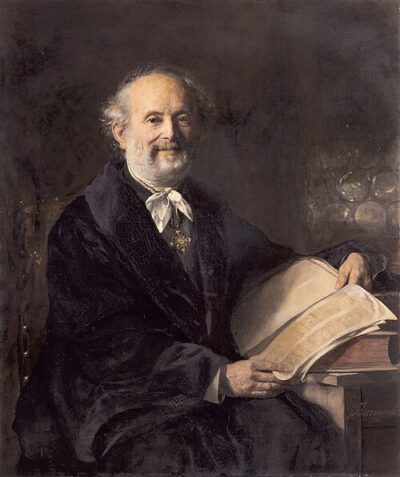
Wilhelm Eduard Weber
Wilhelm Eduard Weber was a German physicist. Born October 24, 1804, in Lutherstadt Wittenberg. Died June 23, 1891, in Göttingen. Known for Wellenlehre auf Experimente gegründet, Atlas des Erdmagnetismus: nach den Elementen der Theorie entworfen and Gauß-Weber-Telegraph. Educated at Martin Luther University Halle-Wittenberg and Francke Foundations. Awards include Copley Medal, Pour le Mérite for Sciences and Arts order and Cothenius Medal.
Facts
53 facts · 2 confirmed by two sources · 22 cited · 29 from one source
Where this comes from
Papalocal keeps its own record. It started from these sources; what each one said is kept here as it was copied, so a change on their side never changes this page by itself. Tap one to read its version.
What Wikidata says · copied November 16, 2026 · revision 2569142931
- Described as
- German physicist (1804–1891)
- Other names
- Wilhelm Weber
- Born
- October 24, 1804 · 5 references
- Died
- June 23, 1891 · 10 references
- Born in
- Lutherstadt Wittenberg · 5 references
- Died in
- Göttingen · 5 references
- Buried in
- Göttingen City Cemetery · 1 reference
- Name at birth
- Wilhelm Eduard Weber · 1 reference
- Citizen of
- Kingdom of Prussia
- Occupation
- physicist · 1 reference; university teacher; philosopher · 1 reference; professor · 1 reference
- Worked for
- Leipzig University (1843–1849) · 1 reference; University of Göttingen (1831–1837) · 1 reference; Martin Luther University Halle-Wittenberg (1827–1831) · 1 reference; Göttingen Observatory (1849–) · 2 references
- Education
- Martin Luther University Halle-Wittenberg (1822–1826) · 1 reference; Francke Foundations (1821–1822) · 1 reference
- Member of
- Royal Society of London (1850–) · 1 reference; Saxon Academy of Sciences and Humanities (1846–); Royal Swedish Academy of Sciences; American Academy of Arts and Sciences (1889–) · 1 reference; Russian Academy of Sciences; Royal Prussian Academy of Sciences (1863–) · 1 reference; German Academy of Sciences Leopoldina; Bavarian Academy of Sciences and Humanities; Royal Netherlands Academy of Arts and Sciences · 1 reference; Academy of Sciences of Turin (1828–) · 1 reference
- Known for
- Wellenlehre auf Experimente gegründet; Atlas des Erdmagnetismus: nach den Elementen der Theorie entworfen; Gauß-Weber-Telegraph; Weber electrodynamics
- Awards
- Copley Medal (1859) · 1 reference; Pour le Mérite for Sciences and Arts order (1864) · 1 reference; Cothenius Medal (1879) · 1 reference; Matteucci Medal (1879) · 1 reference; Bavarian Maximilian Order for Science and Art (1859); Foreign Member of the Royal Society (1850) · 1 reference; honorary doctor of the University of Königsberg; honorary member of the Physics Association (Frankfurt am Main, Germany) (1846)
- Field
- physics
- Father
- Michael Weber · 1 reference
- Mother
- Christina Friederica Wilhelmina Lippold · 1 reference
- Siblings
- Ernst Heinrich Weber · 1 reference; Eduard Weber · 1 reference; Ernst Michael Weber · 1 reference; Ernestina Friedrica Wilhelmina Weber · 1 reference; Ernst Gustav Weber · 1 reference; Friedrich Christian Weber · 1 reference; Christian Ferdinand Weber · 1 reference; Christian Heinrich Weber · 1 reference; Minna Weber · 1 reference; Lina Weber · 1 reference
- Lived in
- Kingdom of Prussia
- Wikipedias with a page
- 71
Wikidata item Q76707 (wikidata.org/wiki/Q76707), public domain (CC0). Copied November 16, 2026.
What Wikipedia says · copied November 16, 2026 · revision 1381837896
Wilhelm Eduard Weber ( WEB-er or VEY-ber; German: [ˈveːbɐ] ; 24 October 1804 – 23 June 1891) was a German physicist and, together with Carl Friedrich Gauss, inventor of the first electromagnetic telegraph.
- Born, in its opening lines
- October 24, 1804
- Died, in its opening lines
- June 23, 1891
From the Wikipedia article “Wilhelm Eduard Weber” (en.wikipedia.org/wiki/Wilhelm_Eduard_Weber), by its contributors, under CC BY-SA 4.0 (creativecommons.org/licenses/by-sa/4.0/). Copied November 16, 2026; not changed.
Confirmed Two sources agree. Cited One source, and it names where it got it. One source One source, without a reference of its own. Sources disagree The sources disagree. We show the best-supported value and keep theirs below.
