
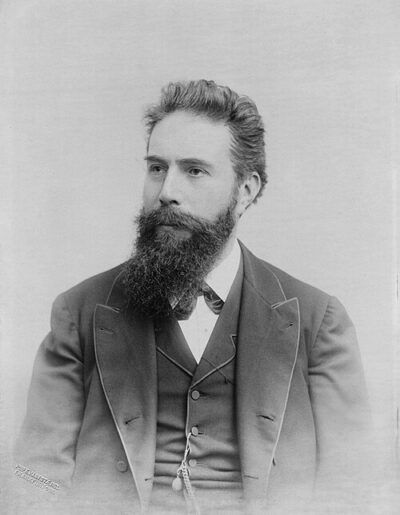
Wilhelm Röntgen
Wilhelm Röntgen was a German physicist. Born March 27, 1845, in Lennep. Died February 10, 1923, in Munich. Positions held include professor. Known for X-ray. Educated at ETH Zurich and University of Zurich. Awards include Nobel Prize in Physics, Pour le Mérite for Sciences and Arts order and Elliott Cresson Medal.
Facts
59 facts · 2 confirmed by two sources · 13 cited · 44 from one source
Where this comes from
Papalocal keeps its own record. It started from these sources; what each one said is kept here as it was copied, so a change on their side never changes this page by itself. Tap one to read its version.
What Wikidata says · copied November 16, 2026 · revision 2568757647
- Described as
- German physicist (1845–1923)
- Other names
- Wilhelm Konrad von Röntgen, Wilhelm C. Röntgen, Wilhelm Conrad Rontgen, Wilhelm Rontgen, Wilhelm Roentgen, Wilhelm Conrad Roentgen, W. C. Röntgen
- Born
- March 27, 1845 · 13 references
- Died
- February 10, 1923 · 14 references
- Born in
- Lennep · 2 references
- Died in
- Munich · 5 references
- Buried in
- Alter Friedhof Gießen, Friedhofskapelle
- Cause of death
- colorectal cancer
- Citizen of
- Weimar Republic (1918–); German Empire (1888–1918); Kingdom of Prussia (–1848)
- Occupation
- physicist · 1 reference; professor · 1 reference; engineer · 1 reference
- Positions held
- professor
- Worked for
- LMU Munich (1900–1920); University of Würzburg (1888–); University of Giessen (1879–); University of Strasbourg; University of Hohenheim (1875–); University of Zurich · 1 reference
- Education
- ETH Zurich (1865–1868) · 1 reference; University of Zurich; Utrecht University; University of Strasbourg (1872–); LMU Munich · 1 reference
- Member of
- Royal Prussian Academy of Sciences; Bavarian Academy of Sciences and Humanities; Royal Swedish Academy of Sciences; Royal Netherlands Academy of Arts and Sciences (1907–); Accademia Nazionale delle Scienze detta dei XL; Académie Nationale de Médecine; Physikalisch-medizinische Gesellschaft zu Würzburg (1870–); Academy of Sciences of Turin (1903–) · 1 reference; Göttingen Academy of Sciences and Humanities in Lower Saxony; Accademia Nazionale dei Lincei (1898–) · 1 reference
- Known for
- X-ray · 1 reference
- Awards
- Nobel Prize in Physics (1901) · 2 references; Pour le Mérite for Sciences and Arts order; Elliott Cresson Medal (1898) · 2 references; Helmholtz Medal (1918); Rumford Medal (1896) · 1 reference; Matteucci Medal (1896); Bavarian Maximilian Order for Science and Art (1901); honorary citizenship (1909); Barnard Medal for Meritorious Service to Science (1900) · 1 reference; 2nd Class Order of the Crown with the Star; Iron Cross on white ribbon; Luitpold Medal of Bavaria; Order of Saint Michael; commander of the Order of the Crown of Italy; Merit Order of the Bavarian Crown
- Field
- physics
- Spouse
- Bertha Röntgen (1872–) · 1 reference
- Father
- Friedrich Konrad Röntgen · 1 reference
- Mother
- Constance Charlotte Röntgen · 1 reference
- Lived in
- Apeldoorn (1848–); Zurich; Würzburg; Munich; Utrecht
- Wikipedias with a page
- 158
Wikidata item Q35149 (wikidata.org/wiki/Q35149), public domain (CC0). Copied November 16, 2026.
What Wikipedia says · copied November 16, 2026 · revision 1381603985
Wilhelm Conrad Röntgen (27 March 1845 – 10 February 1923) was a German experimental physicist who produced and detected electromagnetic radiation in a wavelength range known as X-rays (known as Röntgen rays in many languages). In 1901, Röntgen became the first recipient of the Nobel Prize in Physics "in recognition of the extraordinary services he has rendered by the discovery of the remarkable rays subsequently named after him." The element roentgenium is named in his honor.
- Born, in its opening lines
- March 27, 1845
- Died, in its opening lines
- February 10, 1923
From the Wikipedia article “Wilhelm Röntgen” (en.wikipedia.org/wiki/Wilhelm_Röntgen), by its contributors, under CC BY-SA 4.0 (creativecommons.org/licenses/by-sa/4.0/). Copied November 16, 2026; not changed.
Confirmed Two sources agree. Cited One source, and it names where it got it. One source One source, without a reference of its own. Sources disagree The sources disagree. We show the best-supported value and keep theirs below.
