
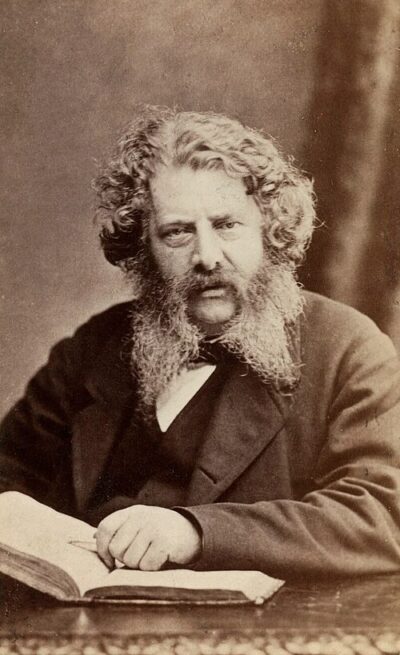
William John Macquorn Rankine
William John Macquorn Rankine was a civil engineer. Born July 5, 1820, in Edinburgh. Died December 24, 1872, in Glasgow. Positions held include Regius Professor of Civil Engineering and Mechanics (1855–1872) and chairperson (1857–1859). Known for Rankine body, Rankine half body and Rankine cycle. Educated at University of Edinburgh and Ayr Academy. Awards include Fellow of the Royal Society, Keith Medal and Fellow of the Royal Society of Edinburgh.
Facts
36 facts · 2 confirmed by two sources · 15 cited · 19 from one source
Where this comes from
Papalocal keeps its own record. It started from these sources; what each one said is kept here as it was copied, so a change on their side never changes this page by itself. Tap one to read its version.
What Wikidata says · copied November 16, 2026 · revision 2546659971
- Described as
- civil engineer (1820–1872)
- Other names
- W. J. Macquorn Rankine
- Born
- July 5, 1820 · 7 references
- Died
- December 24, 1872 · 7 references
- Born in
- Edinburgh · 1 reference
- Died in
- Glasgow · 1 reference
- Buried in
- Sighthill Cemetery · 1 reference
- Citizen of
- United Kingdom of Great Britain and Ireland
- Occupation
- engineer · 1 reference; physicist · 1 reference; civil engineer; university teacher · 1 reference; inventor · 1 reference
- Positions held
- Regius Professor of Civil Engineering and Mechanics (1855–1872) · 1 reference; chairperson (1857–1859) · 1 reference
- Worked for
- University of Glasgow (1855–1872) · 1 reference; John Benjamin Macneill (1838–1841) · 1 reference
- Education
- University of Edinburgh (1836–1838) · 1 reference; Ayr Academy (1828–1829) · 1 reference; Scottish Naval and Military Academy (1834–); Glasgow Academy (1830) · 1 reference
- Member of
- Royal Society of London (1853–); Royal Swedish Academy of Sciences; American Academy of Arts and Sciences; Royal Society of Edinburgh
- Known for
- Rankine body; Rankine half body; Rankine cycle; Rankine's method; Rankine scale; Rankine theory; Rankine vortex; Rankine–Hugoniot conditions
- Awards
- Fellow of the Royal Society (1853) · 1 reference; Keith Medal (1851) · 1 reference; Fellow of the Royal Society of Edinburgh (1850) · 1 reference; honorary doctorate of Trinity College, Dublin (1857) · 1 reference
- Field
- engineering
- Wikipedias with a page
- 67
Wikidata item Q232149 (wikidata.org/wiki/Q232149), public domain (CC0). Copied November 16, 2026.
What Wikipedia says · copied November 16, 2026 · revision 1385640846
William John Macquorn Rankine (; 5 July 1820 – 24 December 1872) was a Scottish mathematician and physicist. He was a founding contributor, with Rudolf Clausius and William Thomson (Lord Kelvin), to the science of thermodynamics, particularly focusing on its First Law. He developed the Rankine scale, a Fahrenheit-based equivalent to the Celsius-based Kelvin scale of temperature.
Rankine developed a complete theory of the steam engine and indeed of all heat engines. His manuals of engineering science and practice were used for many decades after their publication in the 1850s and 1860s. He published several hundred papers and notes on science and engineering topics, from 1840 onwards, and his interests were extremely varied, including, in his youth, botany, music theory and number theory, and, in his mature years, most major branches of science, mathematics and engineering.
He was also a singer, pianist and cellist as well as a rifleman.
- Born, in its opening lines
- July 5, 1820
- Died, in its opening lines
- December 24, 1872
From the Wikipedia article “W. J. M. Rankine” (en.wikipedia.org/wiki/W._J._M._Rankine), by its contributors, under CC BY-SA 4.0 (creativecommons.org/licenses/by-sa/4.0/). Copied November 16, 2026; not changed.
Confirmed Two sources agree. Cited One source, and it names where it got it. One source One source, without a reference of its own. Sources disagree The sources disagree. We show the best-supported value and keep theirs below.
