
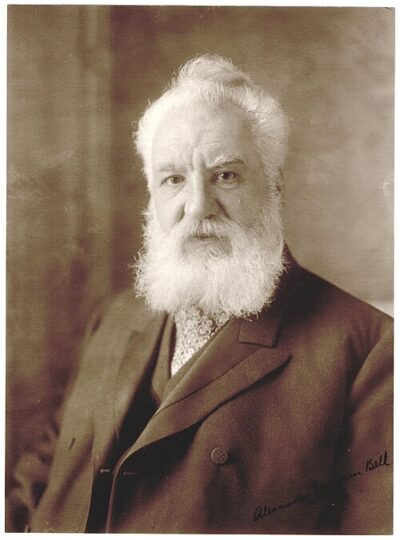
Alexander Graham Bell
Alexander Graham Bell was a Canadian-American scientist inventor of telephone. Born March 3, 1847, in Edinburgh. Died August 2, 1922, in Beinn Bhreagh. Positions held include professor and board member (1898–1922). Known for invention of telephone. Educated at University of Edinburgh and University College London. Awards include Edison Medal, Elliott Cresson Medal and Hughes Medal.
Facts
49 facts · 2 confirmed by two sources · 27 cited · 20 from one source
Where this comes from
Papalocal keeps its own record. It started from these sources; what each one said is kept here as it was copied, so a change on their side never changes this page by itself. Tap one to read its version.
What Wikidata says · copied November 13, 2026 · revision 2568566937
- Described as
- Canadian-American scientist inventor of telephone (1847–1922)
- Other names
- Alexander G. Bell, H. A. Largelamb, Alexander Bell, Graham Bell
- Born
- March 3, 1847 · 14 references
- Died
- August 2, 1922 · 9 references
- Born in
- Edinburgh · 2 references
- Died in
- Beinn Bhreagh · 1 reference
- Buried in
- Beinn Bhreagh
- Cause of death
- diabetes · 1 reference
- Citizen of
- United States (1882–) · 1 reference; United Kingdom of Great Britain and Ireland (–1882) · 1 reference
- Occupation
- physicist; electrical engineer; businessperson · 1 reference; inventor · 1 reference; professor; physiologist · 1 reference; teacher of the deaf · 1 reference; scientist · 1 reference
- Positions held
- professor; board member (1898–1922)
- Worked for
- Smithsonian Institution
- Education
- University of Edinburgh · 1 reference; University College London; Royal High School, Bath · 1 reference; Royal High School
- Member of
- National Academy of Sciences (1883–) · 1 reference; American Academy of Arts and Sciences (1877–) · 1 reference; German Academy of Sciences Leopoldina (1887–) · 1 reference; Phi Beta Kappa Society; American Philosophical Society (1882–); Literary Society of Washington
- Known for
- invention of telephone
- Awards
- Edison Medal (1914) · 1 reference; Elliott Cresson Medal (1912) · 1 reference; Hughes Medal (1913) · 1 reference; National Aviation Hall of Fame (1965) · 1 reference; National Inventors Hall of Fame (1974) · 1 reference; Albert Medal (1902) · 1 reference; Canada's Walk of Fame (2001) · 1 reference; Fellow of the American Association for the Advancement of Science (1879) · 1 reference; John Fritz Medal (1907) · 1 reference; Person of National Historic Significance (1977) · 1 reference
- Field
- speech-language pathology; telephony · 1 reference
- Spouse
- Mabel Gardiner Hubbard (1877–1922) · 2 references
- Children
- Elsie May Grosvenor · 1 reference; Marian Fairchild
- Father
- Alexander Melville Bell · 1 reference
- Mother
- Eliza Bell
- Lived in
- Brodhead-Bell-Morton Mansion (1883–1889) · 2 references
- Height
- 1.83 m (6 ft 0 in) · 1 reference
- Wikipedias with a page
- 161
Wikidata item Q34286 (wikidata.org/wiki/Q34286), public domain (CC0). Copied November 13, 2026.
What Wikipedia says · copied November 13, 2026 · revision 1382118412
Alexander Graham Bell ( ; born Alexander Bell; March 3, 1847 – August 2, 1922) was a Scottish-born Canadian-American inventor, scientist, and engineer who is credited with patenting the first practical telephone. He also co-founded the American Telephone and Telegraph Company (AT&T) in 1885.
Bell's father, grandfather, and brother had all been associated with work on elocution and speech, and both his mother and wife were deaf, profoundly influencing Bell's life's work. His research on hearing and speech further led him to experiment with hearing devices, which eventually culminated in his being awarded the first U.S. patent for the telephone, on March 7, 1876. Bell considered his invention an intrusion on his real work as a scientist and refused to have a telephone in his study.
Many other inventions marked Bell's later life, including ground-breaking work in optical telecommunications, hydrofoils, and aeronautics. Bell also had a strong influence on the National Geographic Society and its magazine while serving as its second president from 1898 to 1903. For National Geographic, Bell wrote under the pseudonym H. A. Largelamb, an anagram of his name.
Beyond his work in engineering, Bell had a deep interest in the emerging science of heredity. His work in this area has been called "the soundest, and most useful study of human heredity proposed in nineteenth-century America ... Bell's most notable contribution to basic science, as distinct from invention."
- Born, in its opening lines
- March 3, 1847
- Died, in its opening lines
- August 2, 1922
From the Wikipedia article “Alexander Graham Bell” (en.wikipedia.org/wiki/Alexander_Graham_Bell), by its contributors, under CC BY-SA 4.0 (creativecommons.org/licenses/by-sa/4.0/). Copied November 13, 2026; not changed.
Confirmed Two sources agree. Cited One source, and it names where it got it. One source One source, without a reference of its own. Sources disagree The sources disagree. We show the best-supported value and keep theirs below.
