
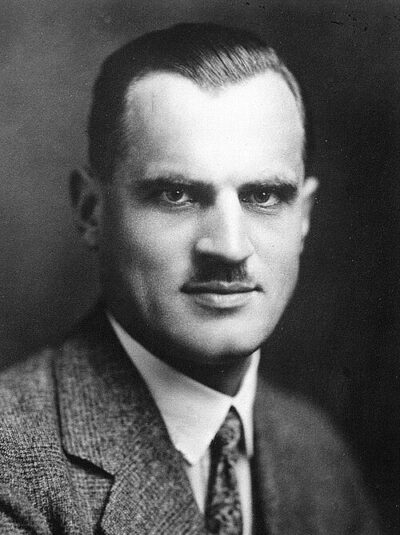
Arthur Holly Compton
Arthur Holly Compton was an American physicist. Born September 10, 1892, in Wooster. Died March 15, 1962, in Berkeley. Positions held include board member (1938–1962). Known for Compton effect. Educated at Princeton University and College of Wooster. Awards include Pour le Mérite for Sciences and Arts order, Guggenheim Fellowship and Nobel Prize in Physics.
Facts
49 facts · 2 confirmed by two sources · 14 cited · 33 from one source
Where this comes from
Papalocal keeps its own record. It started from these sources; what each one said is kept here as it was copied, so a change on their side never changes this page by itself. Tap one to read its version.
What Wikidata says · copied November 13, 2026 · revision 2568748687
- Described as
- American physicist (1892–1962)
- Other names
- Arthur Compton, Arthur H. Compton
- Born
- September 10, 1892 · 13 references
- Died
- March 15, 1962 · 13 references
- Born in
- Wooster · 2 references
- Died in
- Berkeley · 2 references
- Buried in
- Wooster Cemetery · 1 reference
- Cause of death
- cerebral hemorrhage
- Name at birth
- Arthur Holly Compton
- Citizen of
- United States
- Occupation
- physicist · 1 reference; university teacher; theoretical physicist; nuclear physicist
- Positions held
- board member (1938–1962)
- Worked for
- University of Chicago; Washington University in St. Louis; Massachusetts Institute of Technology · 1 reference
- Education
- Princeton University; College of Wooster; University of Chicago · 1 reference; University of Minnesota · 1 reference; Bluffton University; Cavendish Laboratory
- Member of
- Royal Prussian Academy of Sciences; German Academy of Sciences Leopoldina; American Academy of Arts and Sciences; Accademia Nazionale dei Lincei (1927–) · 1 reference; American Philosophical Society · 1 reference; American Association for the Advancement of Science · 1 reference; American Physical Society · 1 reference; Royal Netherlands Academy of Arts and Sciences · 1 reference; National Academy of Sciences
- Known for
- Compton effect
- Awards
- Pour le Mérite for Sciences and Arts order; Guggenheim Fellowship (1926) · 1 reference; Nobel Prize in Physics (1927) · 2 references; Hughes Medal (1940); Matteucci Medal (1930); Rumford Prize (1926) · 1 reference; X-ray badge (1957); Franklin Medal (1940); Richtmyer Memorial Lecture Award (1941) · 1 reference; Guthrie Lecture (1935) · 1 reference; Fellow of the American Association for the Advancement of Science; Honorary Fellow of the Royal Society Te Apārangi (1934–) · 1 reference
- Field
- atomic physics
- Spouse
- Betty Charity McCloskey
- Children
- John Compton
- Siblings
- Karl Taylor Compton · 1 reference
- Lived in
- Arthur H. Compton House (–1945)
- Wikipedias with a page
- 89
Wikidata item Q127944 (wikidata.org/wiki/Q127944), public domain (CC0). Copied November 13, 2026.
What Wikipedia says · copied November 13, 2026 · revision 1379526377
Arthur Holly Compton (September 10, 1892 – March 15, 1962) was an American physicist who shared the 1927 Nobel Prize in Physics with C. T. R. Wilson for his discovery of the Compton effect, which demonstrated the particle nature of electromagnetic radiation. It was a significant discovery at the time; the wave nature of light had been well-demonstrated, but the idea that light had both wave and particle properties was not easily accepted.
In 1919, Compton was awarded one of the first two National Research Council Fellowships that allowed students to study abroad. He chose to go to the University of Cambridge's Cavendish Laboratory in England, where he studied the scattering and absorption of gamma rays. Further research along these lines led to the discovery of the Compton effect.
Compton used X-rays to investigate ferromagnetism, concluding that it was a result of the alignment of electron spins, and studied cosmic rays, discovering that they were made principally of positively charged particles.
During World War II, Compton was a key figure in the Manhattan Project that developed the first nuclear weapons. His reports were important in launching the project. In 1942, he became a member of the S-1 Executive Committee, and then head of the "X" projects overseeing the Metallurgical Laboratory, with responsibility for producing nuclear reactors to convert uranium into plutonium, finding ways to separate the plutonium from the uranium and to design an atomic bomb. Compton oversaw Enrico Fermi's creation of Chicago Pile-1, the first nuclear reactor, which went critical on December 2, 1942. The Metallurgical Laboratory was also responsible for the design and operation of the X-10 Graphite Reactor at Oak Ridge, Tennessee. Plutonium began being produced in the Hanford Site reactors in 1945.
After the War, Compton became Chancellor of Washington University in St. Louis. During his tenure, the university formally desegregated its undergraduate divisions, named its first female full professor, and enrolled a record number of students after wartime veterans returned to the United States.
- Born, in its opening lines
- September 10, 1892
- Died, in its opening lines
- March 15, 1962
From the Wikipedia article “Arthur Compton” (en.wikipedia.org/wiki/Arthur_Compton), by its contributors, under CC BY-SA 4.0 (creativecommons.org/licenses/by-sa/4.0/). Copied November 13, 2026; not changed.
Confirmed Two sources agree. Cited One source, and it names where it got it. One source One source, without a reference of its own. Sources disagree The sources disagree. We show the best-supported value and keep theirs below.
