
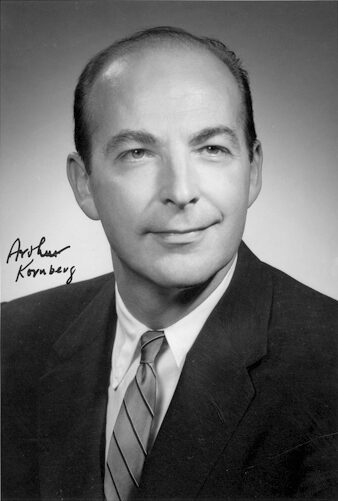
Arthur Kornberg
Arthur Kornberg was an American biochemist. Born March 3, 1918, in Brooklyn. Died October 26, 2007, in Stanford. Educated at City College of New York and Grossman School of Medicine. Awards include Guggenheim Fellowship, Pfizer Award in Enzyme Chemistry and Nobel Prize in Physiology or Medicine.
Facts
40 facts · 2 confirmed by two sources · 12 cited · 26 from one source
Where this comes from
Papalocal keeps its own record. It started from these sources; what each one said is kept here as it was copied, so a change on their side never changes this page by itself. Tap one to read its version.
What Wikidata says · copied November 13, 2026 · revision 2565600741
- Described as
- American biochemist
- Born
- March 3, 1918 · 12 references
- Died
- October 26, 2007 · 9 references
- Born in
- Brooklyn · 1 reference
- Died in
- Stanford · 1 reference
- Citizen of
- United States
- Occupation
- physician; biochemist · 1 reference; university teacher; non-fiction writer; chemist · 1 reference
- Worked for
- United States National Institutes of Health; Washington University in St. Louis; Stanford University
- Education
- City College of New York; Grossman School of Medicine; University of Rochester; Abraham Lincoln High School · 1 reference; URochester Medicine
- Member of
- Royal Society of London (1970–); German Academy of Sciences Leopoldina · 1 reference; National Academy of Sciences (1957–); American Academy of Arts and Sciences; European Molecular Biology Organization; American Philosophical Society (1960–) · 1 reference; American Association for the Advancement of Science · 1 reference; Japan Academy (2004–) · 1 reference
- Awards
- Guggenheim Fellowship · 1 reference; Pfizer Award in Enzyme Chemistry (1951); Nobel Prize in Physiology or Medicine (1959) · 2 references; AMA Scientific Achievement Award (1968); Foreign Member of the Royal Society (1970) · 1 reference; National Medal of Science (1979); doctor honoris causa from the Pierre and Marie Curie University (1981) · 1 reference; Sir Hans Krebs Medal (1983); Canada Gairdner International Award (1995); honorary doctor of the University of Miami (1997) · 1 reference
- Field
- biochemistry
- Spouse
- Sylvy Kornberg · 1 reference
- Children
- Roger D. Kornberg; Thomas B. Kornberg · 1 reference
- Wikipedias with a page
- 61
Wikidata item Q295678 (wikidata.org/wiki/Q295678), public domain (CC0). Copied November 13, 2026.
What Wikipedia says · copied November 13, 2026 · revision 1381480965
Arthur Kornberg (March 3, 1918 – October 26, 2007) was an American biochemist who won the Nobel Prize in Physiology or Medicine in 1959 for the discovery of "the mechanisms in the biological synthesis of ribonucleic acid and deoxyribonucleic acid" together with Spanish biochemist and physician Severo Ochoa of New York University. He was also awarded the Paul-Lewis Award in Enzyme Chemistry from the American Chemical Society in 1951, an L.H.D. degree from Yeshiva University in 1962, and the National Medal of Science in 1979. In 1991, Kornberg received the Golden Plate Award of the American Academy of Achievement and the Gairdner Foundation Award in 1995.
Kornberg's primary research interests were in biochemistry, especially enzyme chemistry, deoxyribonucleic acid synthesis (DNA replication) and studying the nucleic acids which control heredity in animals, plants, bacteria and viruses.
- Born, in its opening lines
- March 3, 1918
- Died, in its opening lines
- October 26, 2007
From the Wikipedia article “Arthur Kornberg” (en.wikipedia.org/wiki/Arthur_Kornberg), by its contributors, under CC BY-SA 4.0 (creativecommons.org/licenses/by-sa/4.0/). Copied November 13, 2026; not changed.
Confirmed Two sources agree. Cited One source, and it names where it got it. One source One source, without a reference of its own. Sources disagree The sources disagree. We show the best-supported value and keep theirs below.
