
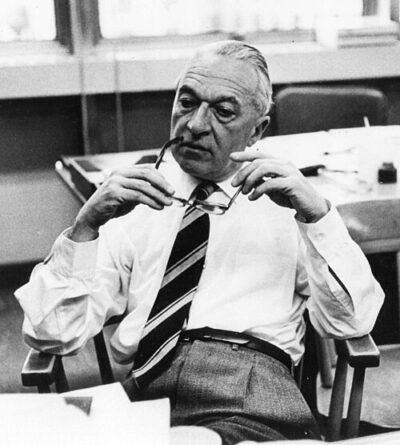
Bruno Rossi
Bruno Rossi was an Italian experimental physicist. Born April 13, 1905, in Venice. Died November 21, 1993, in Cambridge. Educated at University of Bologna. Awards include Wolf Prize in Physics, Elliott Cresson Medal and National Medal of Science.
Facts
36 facts · 2 confirmed by two sources · 10 cited · 24 from one source
Where this comes from
Papalocal keeps its own record. It started from these sources; what each one said is kept here as it was copied, so a change on their side never changes this page by itself. Tap one to read its version.
What Wikidata says · copied November 15, 2026 · revision 2567383517
- Described as
- Italian experimental physicist (1905–1993)
- Other names
- Bruno Benedetto Rossi
- Born
- April 13, 1905 · 7 references
- Died
- November 21, 1993 · 5 references
- Born in
- Venice · 1 reference
- Died in
- Cambridge · 1 reference
- Buried in
- Cimitero delle Porte Sante
- Citizen of
- Italy (1946–); Kingdom of Italy (–1946); United States
- Occupation
- astronomer; astrophysicist; physicist · 1 reference; university teacher; nuclear physicist
- Worked for
- University of Palermo; Cornell University; University of Chicago; Massachusetts Institute of Technology · 1 reference; University of Padua · 1 reference; University of Florence · 1 reference
- Education
- University of Bologna
- Member of
- National Academy of Sciences (1950–); American Academy of Arts and Sciences; German Academy of Sciences Leopoldina; American Philosophical Society (1959–) · 1 reference; American Astronomical Society · 1 reference; Academy of Sciences of Turin; Accademia Nazionale dei Lincei (1959–) · 1 reference
- Awards
- Wolf Prize in Physics (1987) · 1 reference; Elliott Cresson Medal (1974) · 1 reference; National Medal of Science (1983) · 1 reference; Matteucci Medal (1991); Rumford Prize (1976) · 1 reference; honorary doctor of Durham University; honorary doctor of the University of Palermo · 1 reference; Commander of the Order of Merit of the Italian Republic (1994)
- Field
- physics · 1 reference
- Wikipedias with a page
- 26
Wikidata item Q993725 (wikidata.org/wiki/Q993725), public domain (CC0). Copied November 15, 2026.
What Wikipedia says · copied November 15, 2026 · revision 1378395986
Bruno Benedetto Rossi ( ROSS-ee, Italian: [ˈbruːno beneˈdetto ˈrossi]; 13 April 1905 – 21 November 1993) was an Italian-American experimental physicist. He made major contributions to particle physics and the study of cosmic rays. A 1927 graduate of the University of Bologna, he became interested in cosmic rays. To study them, he invented an improved electronic coincidence circuit and travelled to Eritrea to conduct experiments that showed that cosmic ray intensity from the West was significantly larger than that from the East.
Forced to emigrate in October 1938 due to the Italian racial laws, Rossi moved to Denmark, where he worked with Niels Bohr. He then moved to Britain, where he worked with Patrick Blackett at the University of Manchester. Finally, he went to the United States, where he worked with Enrico Fermi at the University of Chicago, and later at Cornell University. Rossi stayed in the United States and became an American citizen.
During World War II, Rossi worked on radar at the MIT Radiation Laboratory, and he played a pivotal role in the Manhattan Project, heading the group at the Los Alamos Laboratory that carried out the RaLa Experiments. After the war, he was recruited by Jerrold Zacharias at MIT, where Rossi continued his pre-war research into cosmic rays.
In the 1960s, he pioneered X-ray astronomy and space plasma physics. His instrumentation on Explorer 10 detected the magnetopause, and he initiated the rocket experiments that discovered Scorpius X-1, the first extra-solar source of X-rays.
- Born, in its opening lines
- April 13, 1905
- Died, in its opening lines
- November 21, 1993
From the Wikipedia article “Bruno Rossi” (en.wikipedia.org/wiki/Bruno_Rossi), by its contributors, under CC BY-SA 4.0 (creativecommons.org/licenses/by-sa/4.0/). Copied November 15, 2026; not changed.
Confirmed Two sources agree. Cited One source, and it names where it got it. One source One source, without a reference of its own. Sources disagree The sources disagree. We show the best-supported value and keep theirs below.
