
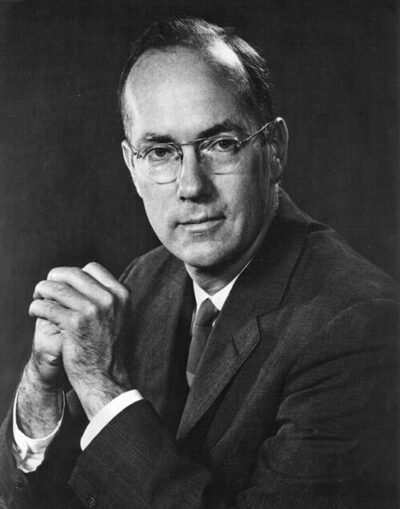
Charles Hard Townes
Charles Hard Townes was the 20th-century American physicist. Born July 28, 1915, in Greenville. Died January 27, 2015, in Oakland. Known for maser. Educated at California Institute of Technology and Duke University. Awards include Guggenheim Fellowship, Niels Bohr International Gold Medal and Nobel Prize in Physics.
Facts
45 facts · 2 confirmed by two sources · 20 cited · 23 from one source
Where this comes from
Papalocal keeps its own record. It started from these sources; what each one said is kept here as it was copied, so a change on their side never changes this page by itself. Tap one to read its version.
What Wikidata says · copied November 13, 2026 · revision 2563201033
- Described as
- 20th-century American physicist
- Other names
- Charles H. Townes
- Born
- July 28, 1915 · 9 references
- Died
- January 27, 2015 · 9 references
- Born in
- Greenville · 1 reference
- Died in
- Oakland
- Citizen of
- United States
- Occupation
- physicist · 2 references; nuclear physicist; university teacher; inventor · 1 reference
- Worked for
- University of California, Berkeley; University of Michigan; Massachusetts Institute of Technology · 1 reference
- Education
- California Institute of Technology; Duke University; Furman University; Greenville High School · 1 reference
- Member of
- Royal Society of London; National Academy of Sciences (1956–) · 1 reference; American Academy of Arts and Sciences; Pontifical Academy of Sciences (1983–) · 1 reference; Russian Academy of Sciences; National Academy of Engineering (1998–) · 1 reference; Indian National Science Academy; American Philosophical Society (1960–) · 1 reference; American Astronomical Society · 1 reference; American Physical Society · 1 reference
- Known for
- maser · 1 reference
- Awards
- Guggenheim Fellowship (1955) · 1 reference; Niels Bohr International Gold Medal (1979) · 1 reference; Nobel Prize in Physics (1964) · 2 references; Frederic Ives Medal (1996) · 1 reference; Stuart Ballantine Medal (1962) · 1 reference; Templeton Prize (2005) · 1 reference; SPIE Gold Medal (2010) · 1 reference; IEEE David Sarnoff Award (1961) · 1 reference; Lomonosov Gold Medal (2000); Petrie Prize Lecture (1985); IEEE Medal of Honor (1967) · 1 reference; Wilhelm Exner Medal (1970) · 1 reference; Henry Norris Russell Lectureship (1998); National Medal of Science (1982); Karl Schwarzschild Medal (2002) · 1 reference
- Field
- physics
- Spouse
- Frances Brow
- Father
- Henry Keith Townes, Sr. · 1 reference
- Wikipedias with a page
- 84
Wikidata item Q184566 (wikidata.org/wiki/Q184566), public domain (CC0). Copied November 13, 2026.
What Wikipedia says · copied November 13, 2026 · revision 1380678562
Charles Hard Townes (July 28, 1915 – January 27, 2015) was an American physicist. Townes worked on the theory and application of the maser, for which he obtained the fundamental patent, and other work in quantum electronics associated with both maser and laser devices. He shared the 1964 Nobel Prize in Physics with Nikolay Basov and Alexander Prokhorov. Townes was an adviser to the U.S. Government, meeting every President from Harry S. Truman (1945) to Bill Clinton (1999).
Townes directed the U.S. government's Science and Technology Advisory Committee for the Apollo lunar landing program. After becoming a professor of the University of California, Berkeley, in 1967, he began an astrophysical program that produced several important discoveries, for example, the black hole at the center of the Milky Way galaxy.
Townes was religious, and believed that science and religion are converging to provide a greater understanding of the nature and purpose of the universe.
- Born, in its opening lines
- July 28, 1915
- Died, in its opening lines
- January 27, 2015
From the Wikipedia article “Charles H. Townes” (en.wikipedia.org/wiki/Charles_H._Townes), by its contributors, under CC BY-SA 4.0 (creativecommons.org/licenses/by-sa/4.0/). Copied November 13, 2026; not changed.
Confirmed Two sources agree. Cited One source, and it names where it got it. One source One source, without a reference of its own. Sources disagree The sources disagree. We show the best-supported value and keep theirs below.
