
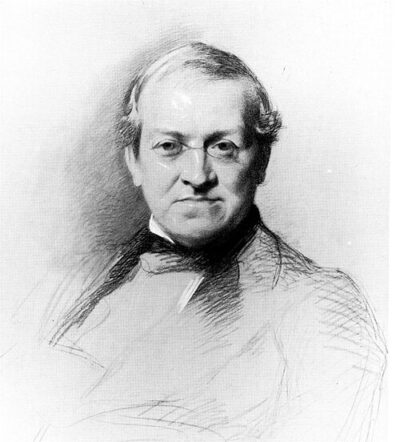
Charles Wheatstone
Charles Wheatstone was a British scientist and inventor. Born February 6, 1802, in Gloucester. Died October 19, 1875, in Paris. Awards include Fellow of the Royal Society, Copley Medal and Pour le Mérite for Sciences and Arts order.
Facts
33 facts · 2 confirmed by two sources · 8 cited · 23 from one source
Where this comes from
Papalocal keeps its own record. It started from these sources; what each one said is kept here as it was copied, so a change on their side never changes this page by itself. Tap one to read its version.
What Wikidata says · copied November 16, 2026 · revision 2568657864
- Described as
- British scientist and inventor (1802–1875)
- Other names
- Sir Charles Wheatstone
- Born
- February 6, 1802 · 10 references
- Died
- October 19, 1875 · 11 references
- Born in
- Gloucester · 2 references
- Died in
- Paris · 3 references
- Buried in
- Kensal Green Cemetery · 1 reference
- Citizen of
- United Kingdom of Great Britain and Ireland
- Occupation
- cryptographer; mathematician; physicist · 2 references; inventor · 1 reference; musical instrument maker; photographer
- Worked for
- King's College London
- Member of
- Royal Society of London (1836–); Royal Swedish Academy of Sciences (1859–); American Academy of Arts and Sciences; Royal Prussian Academy of Sciences; Accademia Nazionale delle Scienze detta dei XL; Bavarian Academy of Sciences and Humanities; French Academy of Sciences (1873–); Institution of Civil Engineers (1875–); Academy of Sciences of Turin (1845–) · 1 reference; Göttingen Academy of Sciences and Humanities in Lower Saxony
- Awards
- Fellow of the Royal Society (1836); Copley Medal (1868) · 1 reference; Pour le Mérite for Sciences and Arts order (1868); Royal Medal (2 times) (1840, 1843); Albert Medal (1867) · 1 reference; Royal Society Bakerian Medal (1852) · 2 references; Knight Bachelor; honorary member of the Physics Association (Frankfurt am Main, Germany) (1854)
- Field
- physics · 1 reference
- Lived in
- United Kingdom of Great Britain and Ireland · 1 reference
- Wikipedias with a page
- 47
Wikidata item Q156942 (wikidata.org/wiki/Q156942), public domain (CC0). Copied November 16, 2026.
What Wikipedia says · copied November 16, 2026 · revision 1383299444
Sir Charles Wheatstone (; 6 February 1802 – 19 October 1875) was an English physicist and inventor best known for his contributions to the development of the Wheatstone bridge, originally invented by Samuel Hunter Christie, which is used to measure an unknown electrical resistance, and as a major figure in the development of telegraphy. His other contributions include the English concertina, the stereoscope (a device for displaying three-dimensional images) and the Playfair cipher (an encryption technique).
- Born, in its opening lines
- February 6, 1802
- Died, in its opening lines
- October 19, 1875
From the Wikipedia article “Charles Wheatstone” (en.wikipedia.org/wiki/Charles_Wheatstone), by its contributors, under CC BY-SA 4.0 (creativecommons.org/licenses/by-sa/4.0/). Copied November 16, 2026; not changed.
Confirmed Two sources agree. Cited One source, and it names where it got it. One source One source, without a reference of its own. Sources disagree The sources disagree. We show the best-supported value and keep theirs below.
