
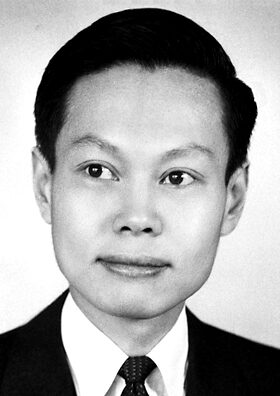
Chen-ning Yang
Chen-ning Yang was a Chinese physicist. Born October 1, 1922, in Hefei. Died October 18, 2025, in Beijing. Educated at National Southwestern Associated University and Tsinghua University. Awards include Benjamin Franklin Medal, Fellow of the American Physical Society and Fellow of the American Association for the Advancement of Science.
Facts
51 facts · 2 confirmed by two sources · 13 cited · 36 from one source
Where this comes from
Papalocal keeps its own record. It started from these sources; what each one said is kept here as it was copied, so a change on their side never changes this page by itself. Tap one to read its version.
What Wikidata says · copied November 13, 2026 · revision 2565350395
- Described as
- Chinese physicist (1922–2025)
- Other names
- Yang Chen-ning, Yang Chen Ning, Yang Zhenning, C. N. Yang, Chen Ning Yang, Chen-Ning Franklin Yang, C.N. Yang
- Born
- October 1, 1922 · 2 references
- Died
- October 18, 2025 · 2 references
- Born in
- Hefei · 1 reference
- Died in
- Beijing · 2 references
- Citizen of
- People's Republic of China (2015–); United States (1964–2015) · 1 reference; Republic of China (1922–1949); Taiwan (1949–2015)
- Occupation
- physicist · 2 references; university teacher · 1 reference; theoretical physicist
- Worked for
- Tsinghua University · 1 reference; Stony Brook University · 1 reference; Institute for Advanced Study · 1 reference; The Chinese University of Hong Kong; University of Chicago; Leiden University · 1 reference
- Education
- National Southwestern Associated University; Tsinghua University; University of Chicago (1946–1948) · 1 reference; Peking University; Nankai University · 1 reference
- Member of
- Pontifical Academy of Sciences (1997–2025); National Academy of Sciences (1965–2025) · 1 reference; Academia Sinica; Polish Academy of Sciences; American Association for the Advancement of Science; American Academy of Arts and Sciences; Russian Academy of Sciences (1994–2025); American Physical Society · 1 reference; Chinese Academy of Sciences (2017–2025); Brazilian Academy of Sciences
- Awards
- Benjamin Franklin Medal; Fellow of the American Physical Society; Fellow of the American Association for the Advancement of Science; honorary doctor of the Chinese University of Hong Kong; Nobel Prize in Physics (1957) · 2 references; Guggenheim Fellowship (1962) · 1 reference; Josiah Willard Gibbs Lectureship (1962); Rumford Prize (1980) · 1 reference; honorary doctor of the Fudan University (1984); National Medal of Science (1986); Oskar Klein Medal (1988) · 1 reference; Foreign Member of the Royal Society (1992) · 1 reference; doctor honoris causa from the Pierre and Marie Curie University (1992) · 1 reference; Bower Award and Prize for Achievement in Science (1994) · 1 reference; Albert Einstein Medal (1995)
- Field
- particle physics
- Spouse
- Du Zhili (1950–2003); Weng Fan (2004–2025)
- Father
- Yang Wu-chih
- Wikipedias with a page
- 88
Wikidata item Q181369 (wikidata.org/wiki/Q181369), public domain (CC0). Copied November 13, 2026.
What Wikipedia says · copied November 13, 2026 · revision 1383540633
Yang Chen-Ning (simplified Chinese: 杨振宁; traditional Chinese: 楊振寧; pinyin: Yáng Zhènníng; October 1, 1922 – October 18, 2025) also known as C.N. Yang and Franklin Yang, was a Chinese-American theoretical physicist who made significant contributions to statistical mechanics, integrable systems, gauge theory, particle physics and condensed matter physics.
Yang is known for his collaboration with Robert Mills in 1954 in developing non-abelian gauge theory, widely known as the Yang–Mills theory, which describes the nuclear forces in the Standard Model of particle physics.
Yang and Tsung-Dao Lee received the 1957 Nobel Prize in Physics for their work on parity non-conservation of the weak interaction, which was confirmed by the Wu experiment in 1956. The two proposed that the conservation of parity, a physical law observed to hold in all other physical processes, is violated in weak nuclear reactions – those nuclear processes that result in the emission of beta particles.
- Born, in its opening lines
- October 1, 1922
- Died, in its opening lines
- October 18, 2025
From the Wikipedia article “Yang Chen-Ning” (en.wikipedia.org/wiki/Yang_Chen-Ning), by its contributors, under CC BY-SA 4.0 (creativecommons.org/licenses/by-sa/4.0/). Copied November 13, 2026; not changed.
Confirmed Two sources agree. Cited One source, and it names where it got it. One source One source, without a reference of its own. Sources disagree The sources disagree. We show the best-supported value and keep theirs below.
