
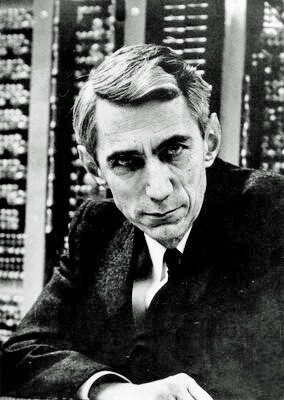
Claude Shannon
Claude Shannon was an American mathematician and information theorist. Born April 30, 1916, in Petoskey. Died February 24, 2001, in Medford. Known for A Mathematical Theory of Communication, A Symbolic Analysis of Relay and Switching Circuits and Nyquist–Shannon sampling theorem. Educated at University of Michigan and Massachusetts Institute of Technology. Awards include Stuart Ballantine Medal, John Fritz Medal and Harold Pender Award.
Facts
60 facts · 2 confirmed by two sources · 30 cited · 28 from one source
Where this comes from
Papalocal keeps its own record. It started from these sources; what each one said is kept here as it was copied, so a change on their side never changes this page by itself. Tap one to read its version.
What Wikidata says · copied November 13, 2026 · revision 2566991081
- Described as
- American mathematician and information theorist (1916–2001)
- Other names
- C E Shannon, Claude E. Shannon, C.E. Shannon, C. E. Shannon, Shannon, Claude Elwood Shannon
- Born
- April 30, 1916 · 8 references
- Died
- February 24, 2001 · 7 references
- Born in
- Petoskey · 1 reference
- Died in
- Medford · 1 reference
- Buried in
- Mount Auburn Cemetery · 3 references
- Cause of death
- Alzheimer's disease · 1 reference
- Citizen of
- United States
- Occupation
- mathematician · 1 reference; cryptographer · 2 references; computer scientist · 1 reference; inventor; university teacher; engineer · 1 reference; geneticist · 1 reference
- Worked for
- Massachusetts Institute of Technology (1957–2001) · 2 references; Bell Labs (1941–1958) · 2 references; Institute for Advanced Study (1940–1941)
- Education
- University of Michigan (1932–1936); Massachusetts Institute of Technology (1936–1940); Gaylord High School (–1932)
- Member of
- American Academy of Arts and Sciences (1957–) · 1 reference; Royal Netherlands Academy of Arts and Sciences (1975–) · 1 reference; German Academy of Sciences Leopoldina (1970–) · 1 reference; American Philosophical Society (1983–) · 1 reference; National Academy of Sciences (1956–) · 1 reference; Royal Society of London (1991–) · 2 references
- Sport
- cycle sport
- Known for
- A Mathematical Theory of Communication; A Symbolic Analysis of Relay and Switching Circuits; Nyquist–Shannon sampling theorem; Shannon's source coding theorem; Noisy-channel coding theorem; Shannon–Hartley theorem; Shannon's expansion; Shannon's generalized De Morgan law; Shannon capacity; information entropy
- Awards
- Stuart Ballantine Medal (1955) · 1 reference; John Fritz Medal (1983) · 1 reference; Harold Pender Award (1978) · 2 references; Harvey Prize (1972) · 1 reference; IEEE Medal of Honor (1966) · 1 reference; National Medal of Science (1966) · 1 reference; Josiah Willard Gibbs Lectureship (1963) · 1 reference; National Inventors Hall of Fame (2004) · 1 reference; Claude E. Shannon Award (1972) · 1 reference; IEEE Morris N. Liebmann Memorial Award (1949) · 1 reference; Kyoto Prize in Basic Sciences (1985) · 1 reference; Foreign Member of the Royal Society (1991) · 1 reference; Marconi Prize (2000) · 1 reference; Edwin Howard Armstrong Achievement Award (1973) · 1 reference; Noble Prize (1939) · 1 reference
- Field
- probability theory; electrical engineering; information theory; cybernetics; cryptography
- Spouse
- Betty Shannon (1949–) · 1 reference; Norma Barzman (1939–1941) · 1 reference
- Lived in
- Gaylord · 1 reference
- Wikipedias with a page
- 70
Wikidata item Q92760 (wikidata.org/wiki/Q92760), public domain (CC0). Copied November 13, 2026.
What Wikipedia says · copied November 13, 2026 · revision 1385326915
Claude Elwood Shannon (April 30, 1916 – February 24, 2001) was an American polymath who was a mathematician, electrical engineer, computer scientist, cryptographer, and inventor known as the "father of information theory" and is generally credited with laying the foundations of the Information Age.
Shannon was among the first to describe the use of Boolean algebra—essential to all digital electronic circuits—and helped found the field of artificial intelligence. The roboticist Rodney Brooks declared Shannon the 20th century engineer who contributed the most to 21st century technologies, and the mathematician Solomon W. Golomb described his intellectual achievement as "one of the greatest of the twentieth century".
At the University of Michigan, Shannon graduated with Bachelor of Science degrees in electrical engineering and mathematics, both in 1936. The following year, in his MIT electrical engineering master's thesis "A Symbolic Analysis of Relay and Switching Circuits", he demonstrated that electrical applications of Boolean algebra could construct any logical numerical relationship, thereby establishing the theory behind digital computing and digital circuits. Called by some the most important master's thesis of all time, it is the "birth certificate of the digital revolution", and started him in a lifetime of work that led him to win a Kyoto Prize in 1985. He graduated from MIT in 1940 with a PhD in mathematics; his thesis, which focused on genetics, contained important results though it remained unpublished and relatively unknown until recently.
Shannon contributed to the field of cryptanalysis for national defense of the United States during World War II, including his fundamental work on codebreaking and secure telecommunications, writing a paper which is considered one of the foundational pieces of modern cryptography, with his work described as "a turning point, and marked the closure of classical cryptography and the beginning of modern cryptography". His work was foundational for symmetric-key cryptography, including the work of Horst Feistel, the Data Encryption Standard (DES), and the Advanced Encryption Standard (AES). As a result, Shannon has been called the "founding father of modern cryptography".
His 1948 paper "A Mathematical Theory of Communication" laid the foundations for the field of information theory, referred to as a "blueprint for the digital era" by electrical engineer Robert G. Gallager and "the Magna Carta of the Information Age" by Scientific American. Golomb compared Shannon's influence on the digital age to that which "the inventor of the alphabet has had on literature". Shannon is also regarded as the most important post-1948 contributor to the theory. Advancements across multiple scientific disciplines utilized Shannon's theory—including the invention of the compact disc, the development of the Internet, the commercialization of mobile telephony, and the understanding of black holes. He formally introduced the term "bit", and was a co-inventor of both pulse-code modulation and the first wearable computer. He also invented the concept of a signal-flow graph and evaluation of the graph determinant.
Shannon joined the Central Intelligence Agency's Special Cryptologic Advisory Group in 1951. From 1956 to 1978, he was a professor at MIT. He also made numerous contributions to the field of artificial intelligence, including co-organizing the 1956 Dartmouth workshop, considered to be the discipline's founding event, and papers on the programming of chess computers. His Theseus machine was the first electrical device to learn by trial and error, being one of the first examples of artificial intelligence.
- Born, in its opening lines
- April 30, 1916
- Died, in its opening lines
- February 24, 2001
From the Wikipedia article “Claude Shannon” (en.wikipedia.org/wiki/Claude_Shannon), by its contributors, under CC BY-SA 4.0 (creativecommons.org/licenses/by-sa/4.0/). Copied November 13, 2026; not changed.
Confirmed Two sources agree. Cited One source, and it names where it got it. One source One source, without a reference of its own. Sources disagree The sources disagree. We show the best-supported value and keep theirs below.
