
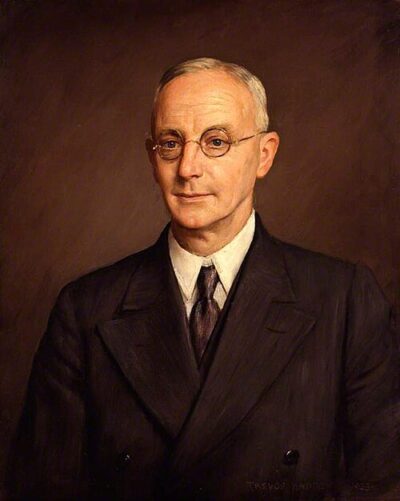
E. T. Whittaker
E. T. Whittaker was a British mathematician. Born October 24, 1873, in Southport. Died March 24, 1956, in Edinburgh. Positions held include Andrews Professor of Astronomy (1906–1912), President of the Royal Society of Edinburgh (1939–1944) and chairperson (3 times) (1914–1929). Known for Whittaker–Shannon interpolation formula, Whittaker function and Whittaker model. Educated at Trinity College and The Manchester Grammar School. Awards include Fellow of the Royal Society, Copley Medal and De Morgan Medal.
Facts
52 facts · 2 confirmed by two sources · 27 cited · 23 from one source
Where this comes from
Papalocal keeps its own record. It started from these sources; what each one said is kept here as it was copied, so a change on their side never changes this page by itself. Tap one to read its version.
What Wikidata says · copied November 18, 2026 · revision 2559667361
- Described as
- British mathematician (1873-1956)
- Other names
- Sir Edmund Taylor Whittaker, Sir Edmund Whittaker, Edmund T. Whittaker, Edmund Whittaker, Edmund Taylor Whittaker
- Born
- October 24, 1873 · 5 references
- Died
- March 24, 1956 · 6 references
- Born in
- Southport
- Died in
- Edinburgh · 1 reference
- Buried in
- Mount Vernon Cemetery
- Name at birth
- Edmund Taylor Whittaker
- Citizen of
- United Kingdom
- Occupation
- mathematician · 2 references; astronomer · 1 reference; historian of science; university teacher; philosopher · 1 reference; physicist · 1 reference
- Positions held
- Andrews Professor of Astronomy (1906–1912) · 1 reference; President of the Royal Society of Edinburgh (1939–1944) · 1 reference; chairperson (3 times) (1914–1929) · 1 reference
- Worked for
- Trinity College (1896–1906) · 1 reference; Trinity College, Dublin (1906–1911); University of Edinburgh (1911–1946) · 1 reference; Royal Astronomer of Ireland (1906–1911) · 1 reference
- Education
- Trinity College (1892–1895) · 1 reference; The Manchester Grammar School (1884–1892) · 1 reference
- Member of
- Royal Society of London (1905–); Pontifical Academy of Sciences · 1 reference; Accademia Nazionale dei Lincei (1922–) · 1 reference; Royal Society of Edinburgh (1912–); American Philosophical Society (1944–)
- Known for
- Whittaker–Shannon interpolation formula; Whittaker function; Whittaker model; Whittaker and Watson; A History of the Theories of Aether and Electricity; Analytical Dynamics of Particles and Rigid Bodies
- Awards
- Fellow of the Royal Society (1905–) · 2 references; Copley Medal (1954) · 2 references; De Morgan Medal (1935) · 1 reference; Guthrie Lecture (1943) · 1 reference; Sylvester Medal (1931) · 1 reference; Smith's Prize (1897) · 1 reference; Pro Ecclesia et Pontifice (1935) · 1 reference; Gunning Victoria Jubilee Prize (1924) · 1 reference; Fellow of the Royal Society of Edinburgh (1912) · 1 reference; Tyson Medal (1896) · 1 reference
- Field
- mathematics; physics · 1 reference; philosophy · 1 reference; applied mathematics · 1 reference; mathematical physics · 1 reference; astronomy · 1 reference
- Children
- John Macnaghten Whittaker; Stephen Robert Ferguson Whittaker · 1 reference
- Religion
- Catholicism (1930–)
- Wikipedias with a page
- 20
Wikidata item Q909884 (wikidata.org/wiki/Q909884), public domain (CC0). Copied November 18, 2026.
What Wikipedia says · copied November 18, 2026 · revision 1373011495
Sir Edmund Taylor Whittaker (24 October 1873 – 24 March 1956) was a British mathematician, physicist, and historian of science. Whittaker was a leading mathematical scholar of the early 20th century who contributed widely to applied mathematics and was renowned for his research in mathematical physics and numerical analysis, including the theory of special functions, along with his contributions to astronomy, celestial mechanics, the history of physics, and digital signal processing.
Among the most influential publications in Whittaker's bibliography, he authored several popular reference works in mathematics, physics, and the history of science, including A Course of Modern Analysis (better known as Whittaker and Watson), Analytical Dynamics of Particles and Rigid Bodies, and A History of the Theories of Aether and Electricity. Whittaker is also remembered for his role in the relativity priority dispute, as he credited Henri Poincaré and Hendrik Lorentz with developing special relativity in the second volume of his History, a dispute which has lasted several decades, though scientific consensus has remained with Einstein.
Whittaker served as the Royal Astronomer of Ireland early in his career, a position he held from 1906 through 1912, before moving on to the chair of mathematics at the University of Edinburgh for the next three decades and, towards the end of his career, received the Copley Medal and was knighted. The School of Mathematics of the University of Edinburgh holds The Whittaker Colloquium, a yearly lecture, in his honour and the Edinburgh Mathematical Society promotes an outstanding young Scottish mathematician once every four years with the Sir Edmund Whittaker Memorial Prize, also given in his honour.
- Born, in its opening lines
- October 24, 1873
- Died, in its opening lines
- March 24, 1956
From the Wikipedia article “E. T. Whittaker” (en.wikipedia.org/wiki/E._T._Whittaker), by its contributors, under CC BY-SA 4.0 (creativecommons.org/licenses/by-sa/4.0/). Copied November 18, 2026; not changed.
Confirmed Two sources agree. Cited One source, and it names where it got it. One source One source, without a reference of its own. Sources disagree The sources disagree. We show the best-supported value and keep theirs below.
