
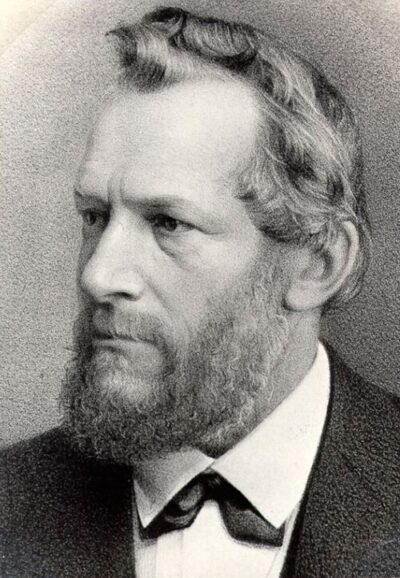
Emil du Bois-Reymond
Emil du Bois-Reymond was a German physician and physiologist. Born November 7, 1818, in Berlin. Died December 26, 1896, in Berlin. Educated at University of Bonn and Humboldt-Universität zu Berlin. Awards include Pour le Mérite for Sciences and Arts order, Helmholtz Medal and Bavarian Maximilian Order for Science and Art.
Facts
40 facts · 2 confirmed by two sources · 17 cited · 21 from one source
Where this comes from
Papalocal keeps its own record. It started from these sources; what each one said is kept here as it was copied, so a change on their side never changes this page by itself. Tap one to read its version.
What Wikidata says · copied November 16, 2026 · revision 2569007578
- Described as
- German physician and physiologist (1818–1896)
- Other names
- Reymond Dubois, Emil Heinrich du Bois-Reymond, E. Du Bois-Reymond
- Born
- November 7, 1818 · 12 references
- Died
- December 26, 1896 · 11 references
- Born in
- Berlin · 4 references
- Died in
- Berlin · 4 references
- Buried in
- Französischer Friedhof
- Citizen of
- Kingdom of Prussia · 1 reference
- Occupation
- physician · 1 reference; physiologist · 1 reference; university teacher · 1 reference; physicist · 1 reference; zoologist · 1 reference; neurologist · 1 reference
- Worked for
- Frederick William University Berlin (1855–); Academy of Arts, Berlin (1849–)
- Education
- University of Bonn · 1 reference; Humboldt-Universität zu Berlin · 1 reference; Französisches Gymnasium Berlin (–1837) · 1 reference
- Member of
- Royal Society of London; Royal Prussian Academy of Sciences (1851–) · 1 reference; Royal Swedish Academy of Sciences; Hungarian Academy of Sciences; American Academy of Arts and Sciences (1886–); Pontificia Accademia dei Nuovi Lincei (1853–) · 1 reference; Russian Academy of Sciences (1892–) · 1 reference; Bavarian Academy of Sciences and Humanities; Royal Netherlands Academy of Arts and Sciences · 1 reference; National Academy of Sciences (1892–)
- Awards
- Pour le Mérite for Sciences and Arts order (1877); Helmholtz Medal (1892); Bavarian Maximilian Order for Science and Art (1873); honorary doctor of the University of Vienna · 1 reference; Foreign Member of the Royal Society (1877) · 1 reference
- Field
- electrophysiology; physiology
- Children
- Estelle Du Bois-Reymond · 1 reference; Alard Du Bois -Reymond · 1 reference
- Father
- Felix-Henri du Bois-Reymond · 1 reference
- Mother
- Minette Henry
- Siblings
- Paul du Bois-Reymond · 1 reference
- Religion
- reformed · 1 reference
- Wikipedias with a page
- 37
Wikidata item Q76571 (wikidata.org/wiki/Q76571), public domain (CC0). Copied November 16, 2026.
What Wikipedia says · copied November 16, 2026 · revision 1383829683
Emil Heinrich du Bois-Reymond (7 November 1818 – 26 December 1896) was a German physiologist, the co-discoverer of nerve action potential, and the developer of experimental electrophysiology. His lectures on science and culture earned him great esteem during the latter half of the 19th century.
- Born, in its opening lines
- November 7, 1818
- Died, in its opening lines
- December 26, 1896
From the Wikipedia article “Emil du Bois-Reymond” (en.wikipedia.org/wiki/Emil_du_Bois-Reymond), by its contributors, under CC BY-SA 4.0 (creativecommons.org/licenses/by-sa/4.0/). Copied November 16, 2026; not changed.
Confirmed Two sources agree. Cited One source, and it names where it got it. One source One source, without a reference of its own. Sources disagree The sources disagree. We show the best-supported value and keep theirs below.
